
Actinium Pharmaceuticals Presents New Radiochemistry Data at SNMMI 2026 Demonstrating That CAR Optimization Improves Tumor Targeting and Pharmacokinetics of Actinium-225 Radioconjugates
Rhea-AI Summary
Actinium Pharmaceuticals (NYSE American: ATNM) presented new radiochemistry data at SNMMI 2026 on May 31, 2026, showing that optimizing chelator-to-antibody ratio (CAR) for Actinium-225 radioconjugates affects radiolabeling, antigen binding, internalization, and biodistribution.
Lower-CAR constructs maintained tumor uptake while reducing liver and spleen exposure, potentially widening the therapeutic index across Actinium’s radioconjugate pipeline.
Positive
- None.
Negative
- None.
Details
News Market Reaction – ATNM
In the Jun 1 session, ATNM declined 6.35%, reflecting a notable negative market reaction.
Data tracked by StockTitan Argus on the day of publication.
Key Figures
- CAR range tested
- 0.7–9
- Antibody-DOTA conjugate chelator-to-antibody ratios
- Minimum effective CAR
- CAR ≥1.7
- Enabled robust 225Ac labeling vs. CAR 0.7 insufficient
- Antigen binding low CAR
- 91–98%
- Binding retention at CAR 0.7–3.2
- Antigen binding high CAR
- 79–85%
- Binding retention at CAR 7–9
- Tumor uptake duration
- 192 h
- Sustained tumor retention for both conjugates in vivo
- Radiochemical purity
- >97%
- Stability of both conjugates over 7 days
- Stability period
- 7 days
- Timeframe over which radiochemical purity remained above 97%
- Low-CAR example
- CAR 2.5
- Conjugate with reduced liver and spleen uptake in vivo
Historical Context
-
Three SNMMI 2026 abstracts on ATNM-400 and radioconjugate optimization.
-
Compelling pan-tumor ATNM-400 data across multiple solid tumor models.
-
Actimab-A mutation-agnostic activity and enhanced killing in AML combinations.
-
Announcement of AACR 2026 abstracts for ATNM-400 and Actimab-A programs.
-
Notice of two AACR 2026 abstracts focused on ATNM-400 and Actimab-A.
24h Move is the share-price change in the day after each event; other market factors may also have contributed.
Key Terms
chelator-to-antibody ratio medical
radioconjugates medical
pharmacokinetics medical
biodistribution medical
radiochemical purity medical
AI-generated analysis. How Rhea-AI works. Not financial advice.




- Optimization of chelator-to-antibody ratio (CAR) is a key design parameter for next-generation radioconjugates, presenting tunable levers Actinium is utilizing to engineer more effective drug candidates
- Optimized CAR improved tumor targeting, internalization, and pharmacokinetics of 225Ac-labeled antibodies
- Lower-CAR conjugates preserved tumor targeting while reducing off-target liver and spleen uptake, supporting a wider therapeutic window that may enable higher, safer dosing
- Findings reinforce Actinium's proprietary radiochemistry expertise and directly support the Company's broader radioconjugate pipeline a capability that applies to every program from the platform
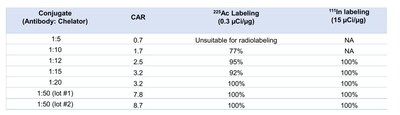
The poster presented a systematic evaluation of chelator-to-antibody ratio (CAR) optimization for Actinium-225 (225Ac)-labeled antibody radioconjugates, a critical but often underappreciated design parameter that directly influences radiolabeling efficiency, antigen binding, internalization, and biodistribution. The findings reinforce a proprietary radiochemistry capability that underpins the Company's broader pipeline. Practically, CAR governs how many radioactive payloads each tumor-seeking antibody carries. Too few a payload causes a radioconjugate drug to under deliver, too many and the antibody loses its aim and leaks dose into healthy tissue. Therefore, identifying the optimal ratio is what separates a technically active therapy from one that can be dosed effectively and safely.
Sandesh Seth, Actinium's Chairman and CEO, said, "Our CAR optimization data underscore the depth of our radiochemistry expertise and our focus on maximizing therapeutic index, which we believe is a key differentiator of our platform. Getting the chelator-to-antibody ratio right is fundamental to preserving the biological integrity of an antibody while enabling robust 225Ac labeling and favorable pharmacokinetics. These findings have direct implications for the design of next-generation radioconjugates, and reinforce a radiochemistry advantage that supports successful clinical translation across our pipeline."
Highlights from the SNMMI 2026 Poster Presentation
Poster Titled: Optimizing Chelator-to-Antibody Ratio Improves Tumor Targeting and Pharmacokinetics of 225Ac-Labeled Antibodies
Optimizing the chelator-to-antibody ratio (CAR) is a critical but often underappreciated design parameter in antibody-based radiopharmaceuticals. Actinium's scientists conducted a systematic evaluation of CAR for 225Ac-labeled antibody radioconjugates, with findings directly applicable to the development of Actinium's radiopharma pipeline:
- Antibody-DOTA conjugates spanning CAR 0.7–9 were prepared. CAR ≥1.7 enabled robust 225Ac labeling, while CAR 0.7 was insufficient. This establishes the minimum loading needed to carry an effective radioactive dose
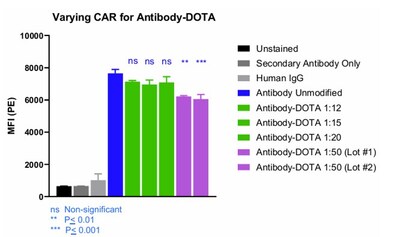
- Antigen binding stayed high at low CAR (91–
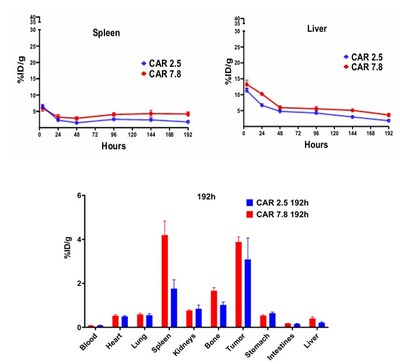
98% at CAR 0.7–3.2) but fell at high CAR (79–85% at CAR 7–9), and low-CAR conjugates internalized more, keeping more of the antibody functional. Median Fluorescence Intensity (MFI) is a proxy for binding or antigen affinity retention. Findings suggest overloading the antibody degrades its ability to find and enter cancer cells - In vivo, both conjugates showed comparable tumor uptake and sustained retention through 192 h, but the low-CAR (2.5) conjugate significantly reduced liver and spleen uptake, providing a basis for a wider therapeutic index
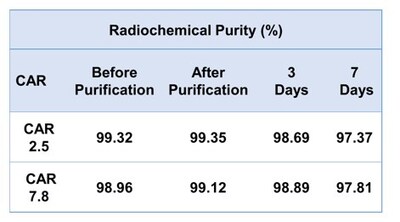
- Both conjugates remained stable over 7 days (radiochemical purity above
97% ), showing that CAR can be optimized for performance without compromising manufacturability or clinical supply. Safety and targeting gains can come with no manufacturing trade-off - A wider therapeutic index could allow more dose to reach the tumor at a given level of safety, a proprietary radiochemistry framework Actinium is applying to de-risk its broader pipeline resulting in lower technical risk across the portfolio
About Actinium Pharmaceuticals, Inc.
Actinium is a pioneer in targeted radiotherapies designed to improve outcomes for patients with cancer. The company employs a biology-driven approach to develop differentiated radiopharmaceuticals for solid tumors and hematologic malignancies. Its mission is to transform cancer treatment through innovative radioconjugates that maximize therapeutic efficacy while minimizing toxicity to healthy tissue by combining expertise in tumor biology, translational medicine, and radiochemistry. Since inception, Actinium has focused on developing innovative radiotherapies. Its pipeline reflects this strategy across three areas: (1) solid tumor therapeutics including ATNM-400 and Actimab-A with pan-tumor potential; (2) Actimab-A as a therapeutic backbone for acute myeloid leukemia (AML) and myelodysplastic syndrome (MDS) in collaboration with the National Cancer Institute (NCI); and (3) targeted conditioning agents including Iomab-B for bone marrow transplant and Iomab-ACT for cell and gene therapy conditioning. ATNM-400 targets a novel antigen distinct from PSMA and has demonstrated preclinical activity across metastatic castration-resistant prostate cancer (mCRPC), non-small cell lung cancer (NSCLC), and breast cancer. Actimab-A has shown improved survival in relapsed/refractory AML with CLAG-M and is advancing toward a Phase 2/3 trial, with additional development ongoing through a CRADA with the NCI. Actinium is also advancing preclinical solid tumor programs and holds ~250 patents and patent applications, including intellectual property related to cyclotron-based production of Ac-225. For more information, please visit www.actiniumpharma.com.
Forward-Looking Statements
This press release may contain projections or other "forward-looking statements" within the meaning of the "safe-harbor" provisions of the private securities litigation reform act of 1995 regarding future events or the future financial performance of the Company which the Company undertakes no obligation to update. These statements, including statements as related to regaining compliance with the rules of the NYSE American and submission of a compliance plan, are based on management's current expectations and are subject to risks and uncertainties that may cause actual results to differ materially from the anticipated or estimated future results, including the risks and uncertainties associated with preliminary study results varying from final results, estimates of potential markets for drugs under development, clinical trials, actions by the FDA and other governmental agencies, regulatory clearances, responses to regulatory matters, the market demand for and acceptance of Actinium's products and services, performance of clinical research organizations and other risks detailed from time to time in Actinium's filings with the Securities and Exchange Commission (the "SEC"), including without limitation its most recent annual report on form 10-K, subsequent quarterly reports on Forms 10-Q and Forms 8-K, each as amended and supplemented from time to time.
Investors: investorrelations@actiniumpharma.com

 View original content to download multimedia:https://www.prnewswire.com/news-releases/actinium-pharmaceuticals-presents-new-radiochemistry-data-at-snmmi-2026-demonstrating-that-car-optimization-improves-tumor-targeting-and-pharmacokinetics-of-actinium-225-radioconjugates-302786571.html
SOURCE Actinium Pharmaceuticals, Inc.
FAQ
AI-generated questions and answers. How Rhea-AI works. Not financial advice.