
Actinium Presents New ATNM-400 Data in KRAS and EGFR Mutant Models at SNMMI 2026 Supporting a Mutation-Agnostic Opportunity In Non-Small Cell Lung Cancer
Actinium (NYSE American: ATNM) reported new preclinical data for ATNM-400 in non-small cell lung cancer at SNMMI 2026.
Rhea-AI Summary
Actinium (NYSE American: ATNM) reported new preclinical data for ATNM-400 in non-small cell lung cancer at SNMMI 2026. ATNM-400 outperformed KRAS inhibitors sotorasib and adagrasib in models and showed strong synergy with EGFR inhibitor osimertinib, achieving complete tumor regression in combination.
ATNM-400’s target is expressed in about 98% of NSCLC tumors and can increase 3.5–3.8x after KRAS inhibitor treatment. According to Actinium, this supports a potential mutation-agnostic backbone role across large EGFR- and KRAS-mutant NSCLC segments.
Positive
- KRAS inhibitors increased ATNM-400 target expression up to 3.5–3.8-fold, enhancing combination activity
- In EGFR-mutant models, ATNM-400 plus osimertinib achieved 107% tumor growth inhibition with 100% cures in mice
- ATNM-400 monotherapy delivered 75% tumor growth inhibition versus 40% for osimertinib in an EGFR-mutant model
- Single-dose ATNM-400 caused 124% and 135% tumor inhibition in a KRAS G13D model with full body-weight recovery
- Target antigen present in approximately 98% of NSCLC tumors and highly expressed in about 70%
- KRAS inhibitor NSCLC segment projected over $5 billion and EGFR-mutant segment over $15 billion in peak sales
Negative
- None.
Details
News Market Reaction – ATNM
On Jun 3, the day this news came out, ATNM closed 4.92% below the previous close.
Data tracked by StockTitan Argus for the Jun 3 session.
Key Figures
- NSCLC driver share
- 40–50% of NSCLC cases
- Proportion of NSCLC with EGFR or KRAS mutations
- NSCLC incidence share
- 85% of >2 million cases
- NSCLC share of global annual lung cancer diagnoses
- Target prevalence
- 98% of NSCLC tumors
- ATNM-400 target antigen presence across NSCLC tumors
- High target expression
- 70% of NSCLC tumors
- Proportion of NSCLC with high target expression
- Target upregulation
- Up to 3.8-fold increase
- Adagrasib-induced increase in ATNM-400 target expression
- Tumor inhibition combo
- 107% tumor growth inhibition
- ATNM-400 plus osimertinib in EGFR-mutant model
- Single-dose potency
- 135% tumor inhibition
- Higher ATNM-400 dose in KRAS G13D Calu-3 model
- TAGRISSO sales
- $7.3 billion
- Osimertinib 2025 sales in EGFR-mutant NSCLC segment
Historical Context
-
Hired experienced oncology CMO to steer pipeline, including ATNM-400, toward key readouts.
-
Presented CAR-optimization data suggesting improved tumor targeting and therapeutic index for Ac-225 agents.
-
Announced new patents alongside disclosure of NYSE American equity non-compliance and related timelines.
-
Outlined ATNM-400 poster plans and separately detailed NYSE American listing standards deficiency notice.
-
Announced three SNMMI 2026 abstracts featuring ATNM-400 in NSCLC and prostate cancer and CAR optimization.
24h Move is the share-price change in the day after each event; other market factors may also have contributed.
Key Terms
non-small cell lung cancer medical
kras medical
braf medical
radioconjugate medical
actinium-225 medical
pet imaging medical
AI-generated analysis. How Rhea-AI works. Not financial advice.




- New KRAS-mutant data show ATNM-400 outperformed standard-of-care inhibitors sotorasib and adagrasib as a monotherapy. Treatment with these agents increased expression of the ATNM-400 target greater than 3.5x and enhanced their effect in combination
- Additional data in the EGFR-mutant setting demonstrated powerful synergy with osimertinib due to enhanced target expression in treated animals resulting in complete tumor regression in the combination arm
- The data with EGFR and KRAS mutations which account for approximately 40-50 percent of all NSCLC cases provide compelling evidence of the potential of ATNM-400 as a monotherapy or in combination with inhibitory agents against these mutations
- ATNM-400 is a radioconjgate comprising an antibody coupled to Actinium-225 which causes cell death via double stranded DNA breaks independent of cellular mechanisms and offers broad potential as a mutation agnostic agent in NSCLC where its target is expressed in over 90 percent of tumors with greater expression as resistance emerges
The new KRAS-mutant data, together with a growing body of EGFR-mutant data, demonstrate ATNM-400's activity across the two major mutation driver classes in NSCLC and support a distinct strategic opportunity. ATNM-400 can be developed as a potential mutation-agnostic backbone for the broader NSCLC market, alone or in combination with standard-of-care therapies, rather than as another mutation-specific drug for a narrow subset.
NSCLC accounts for roughly
ATNM-400's target antigen, from previously published immunohistochemistry studies, is present in approximately
These combination benefits also broaden ATNM-400's commercial opportunity. The franchises it could enhance are substantial; the KRAS inhibitor class in NSCLC is projected to exceed
Sandesh Seth, Actinium's Chairman and CEO, said, "Today's data further strengthen our conviction that ATNM-400 represents a fundamentally different approach to treating NSCLC solid tumors. While most targeted therapies are designed for a single mutation-defined patient population, ATNM-400 combines the mutation-independent cell-killing power of Actinium-225 with a target that is broadly expressed across tumors and becomes even more abundant as resistance emerges. The consistency of activity we have now demonstrated across both EGFR- and KRAS-driven NSCLC supports our vision for ATNM-400 as a potential mutation-agnostic backbone therapy that can be used alone or in combination across large patient populations. We believe this opportunity could extend beyond lung cancer and may position ATNM-400 as a foundational therapy across multiple solid tumor indications."
Highlights from the SNMMI 2026 Poster Presentation
Poster Titled: ATNM-400: A First-in-Class Actinium-225 Antibody Radioconjugate Demonstrating Durable, Mutation-Agnostic Anti-Tumor Activity in Non-Small Cell Lung Cancer Models
New data demonstrated ATNM-400's potential as a mutation-agnostic antibody radioconjugate therapy for NSCLC:
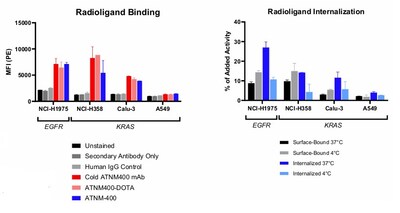
- Across a panel of four lung cancer cell lines spanning EGFR- and KRAS-driver mutations, ATNM-400 bound and was internalized specifically by the three target-positive lines (NCI-H1975, NCI-H358 and Calu-3) but not by the target-negative line (A549), confirming that its activity is driven by target expression rather than by any particular mutation.
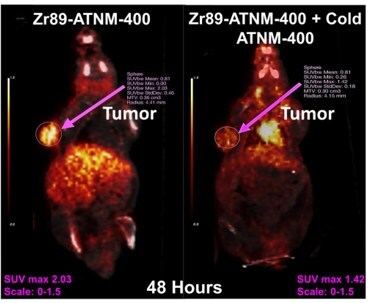
- In a KRAS G12C model (NCI-H358), PET imaging of radiolabeled ATNM-400 showed the drug concentrating in the tumor with low uptake in healthy tissue, visually confirming that it reaches its target in a living animal and delivers its alpha payload where intended while largely sparing normal organs.
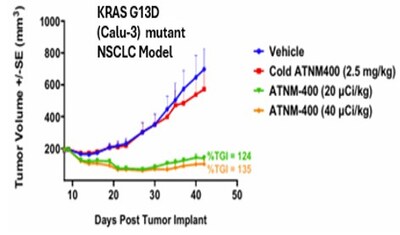
- In a KRAS G13D model (Calu-3), a single dose of ATNM-400 drove tumor regression (
124% and135% inhibition at two dose levels), indicating marked antitumor potencywith full body-weight recovery. Deep responses from one dose with a clean tolerability profile point to a wide therapeutic window and dosing flexibility, favorable attributes for clinical translation.
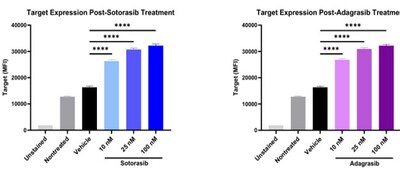
- Treatment with both approved KRAS inhibitors (sotorasib and adagrasib) raised ATNM-400's target expression dose-dependently—up to roughly 3.5- to 3.8-fold—reaching statistical significance at every dose (p < 0.0001). The effect occurred with both agents, indicating a class-wide consequence of KRAS G12C inhibition that builds a rationale for combining ATNM-400 with these therapies.
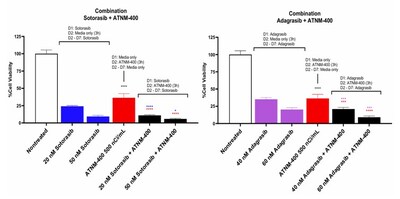
- ATNM-400 plus sotorasib or adagrasib decreased cancer-cell viability beyond either inhibitor alone. The data demonstrate that ATNM-400 has development potential not only as a monotherapy but also in combination with these leading KRAS therapies and possibly the entire KRAS-mutant class.
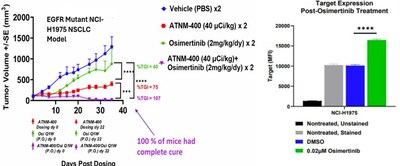
- In an EGFR-mutant model (NCI-H1975), ATNM-400 monotherapy achieved
75% tumor growth inhibition versus40% for osimertinib; combined with osimertinib it reached107% inhibition with complete cures in100% of mice. Osimertinib raised target expression, providing a clear rationale for the combination.
About Actinium Pharmaceuticals, Inc.
Actinium is a pioneer in targeted radiotherapies designed to improve outcomes for patients with cancer. The company employs a biology-driven approach to develop differentiated radiopharmaceuticals for solid tumors and hematologic malignancies. Its mission is to transform cancer treatment through innovative radioconjugates that maximize therapeutic efficacy while minimizing toxicity to healthy tissue by combining expertise in tumor biology, translational medicine, and radiochemistry. Since inception, Actinium has focused on developing innovative radiotherapies. Its pipeline reflects this strategy across three areas: (1) solid tumor therapeutics including ATNM-400 and Actimab-A with pan-tumor potential; (2) Actimab-A as a therapeutic backbone for acute myeloid leukemia (AML) and myelodysplastic syndrome (MDS) in collaboration with the National Cancer Institute (NCI); and (3) targeted conditioning agents including Iomab-B for bone marrow transplant and Iomab-ACT for cell and gene therapy conditioning. ATNM-400 targets a novel antigen distinct from PSMA and has demonstrated preclinical activity across metastatic castration-resistant prostate cancer (mCRPC), non-small cell lung cancer (NSCLC), and breast cancer. Actimab-A has shown improved survival in relapsed/refractory AML with CLAG-M and is advancing toward a Phase 2/3 trial, with additional development ongoing through a CRADA with the NCI. Actinium is also advancing preclinical solid tumor programs and holds approximately 250 patents and patent applications, including intellectual property related to cyclotron-based production of Ac-225. For more information, please visit www.actiniumpharma.com.
Forward-Looking Statements
This press release may contain projections or other "forward-looking statements" within the meaning of the "safe-harbor" provisions of the private securities litigation reform act of 1995 regarding future events or the future financial performance of the Company which the Company undertakes no obligation to update. These statements, including statements as related to regaining compliance with the rules of the NYSE American and submission of a compliance plan, are based on management's current expectations and are subject to risks and uncertainties that may cause actual results to differ materially from the anticipated or estimated future results, including the risks and uncertainties associated with preliminary study results varying from final results, estimates of potential markets for drugs under development, clinical trials, actions by the FDA and other governmental agencies, regulatory clearances, responses to regulatory matters, the market demand for and acceptance of Actinium's products and services, performance of clinical research organizations and other risks detailed from time to time in Actinium's filings with the Securities and Exchange Commission (the "SEC"), including without limitation its most recent annual report on Form 10-K, subsequent quarterly reports on Forms 10-Q and Forms 8-K, each as amended and supplemented from time to time.
Investors: investorrelations@actiniumpharma.com

 View original content to download multimedia:https://www.prnewswire.com/news-releases/actinium-presents-new-atnm-400-data-in-kras-and-egfr-mutant-models-at-snmmi-2026-supporting-a-mutation-agnostic-opportunity-in-non-small-cell-lung-cancer-302789401.html
SOURCE Actinium Pharmaceuticals, Inc.
FAQ
AI-generated questions and answers. How Rhea-AI works. Not financial advice.