
Boeing-built Space Launch System Core Stage Powers First Crewed Artemis Mission around the Moon
Boeing (NYSE: BA) supplied the Space Launch System core stage that powered NASA's crewed Artemis II lunar mission, which launched April 1, 2026 and lifted off at 6:35 p.m. ET.
Rhea-AI Summary
Boeing (NYSE: BA) supplied the Space Launch System core stage that powered NASA's crewed Artemis II lunar mission, which launched April 1, 2026 and lifted off at 6:35 p.m. ET.
The 212-foot core stage completed fueling, engine ignition, thrust vector control, fuel depletion, engine shutdown and successful separation, enabling Orion to begin a 10-day lunar flyaround. Boeing builds core stages at Michoud and reports suppliers in more than 38 states. Next core stages for Artemis III–V are already in production.
Positive
- Core stage completed separation on April 1, 2026
- Next core stages for Artemis III–V already in production
- Core stage height 212 feet with 2.2 million pounds thrust
- Manufacturing at Michoud uses suppliers in > 38 states
Negative
- None.
Details
News Market Reaction – BA
In the Apr 2 session, BA gained 0.43%, reflecting a mild positive market reaction.
Data tracked by StockTitan Argus on the day of publication.
Key Figures
- Lunar journey duration
- 10 days
- Planned Artemis II Orion mission around the moon
- Core stage height
- 212 feet
- Height of the SLS core stage
- Core stage height (metric)
- almost 65 meters
- Approximate metric height of the core stage
- Liquid oxygen tank
- 196,000 gallons
- Capacity of SLS core stage LOX tank
- Liquid hydrogen tank
- 537,000 gallons
- Capacity of SLS core stage LH2 tank
- RS-25 engines
- 4 engines
- Number of RS-25 engines on the core stage
- Thrust output
- 2.2 million pounds
- Combined thrust from the four RS-25 engines
- Supplier footprint
- more than 38 states
- U.S. states supplying components for core stage
Historical Context
-
Set date and details for release of Q1 2026 financial results.
-
CFO scheduled to speak at a major industrials investor conference.
-
Regulators issued initial qualification for 777-9 training simulators.
-
Order for up to 40 787-9 Dreamliners from Sun PhuQuoc Airways.
-
Vietnam Airlines finalized an order for 50 737-8 aircraft.
24h Move is the share-price change in the day after each event; other market factors may also have contributed.
Key Terms
thrust vector control technical
liquid oxygen technical
liquid hydrogen technical
rs-25 engines technical
AI-generated analysis. How Rhea-AI works. Not financial advice.




- NASA's Artemis II mission paves way for future moon landing
- Future rockets currently in production
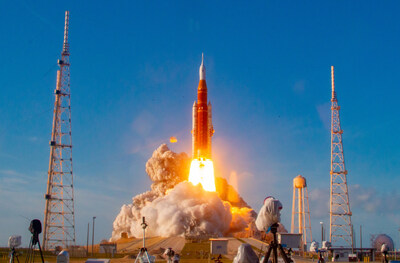
NASA astronauts Reid Wiseman, Victor Glover and Christina Koch, as well as Canadian Space Agency astronaut Jeremy Hansen, will fly Integrity on a 10-day lunar journey.
"We're honored to support NASA in restoring a capability vital to our nation's interests and future," said Steve Parker, president and chief executive officer of Boeing Defense, Space & Security. "Boeing and our Space Launch System partners are committed to NASA's mission to return astronauts to the moon, to establish a sustained lunar presence, and continue our exploration of deep space."
The core stage demonstrated several important operations, including the pre-launch fueling of both tanks, actuating the hydraulic system, igniting the engines, running thrust vector control programs in flight, depleting the fuel tanks, shutting down the engines, and conducting successful separation and disposal maneuvers.
"Today we witnessed our friends embark on a historic mission aboard our rocket," said John Shannon, vice president, Boeing's Exploration Systems business. "Our focus has been on prioritizing the quality of the vehicle and the safety of the crew as they begin their journey. This rocket is designed to withstand incredible forces while speeding through the atmosphere, and it performed exactly as intended. I want to extend my heartfelt thanks to our dedicated team and partners for their hard work in making this part of the mission a success."
The core stage of the rocket stands at 212 feet (almost 65 meters) and consists of a 196,000-gallon liquid oxygen tank and a 537,000-gallon liquid hydrogen tank. It also includes an intertank section that joins the two fuel reservoirs, a forward skirt that connects to the upper stage, and an engine section at the bottom with
The Boeing team is preparing the next core stages for the Artemis III to V missions, which are already in production at Michoud and Kennedy.
A leading global aerospace company and top
Boeing Media Relations
media@boeing.com

 View original content to download multimedia:https://www.prnewswire.com/news-releases/boeing-built-space-launch-system-core-stage-powers-first-crewed-artemis-mission-around-the-moon-302732293.html
SOURCE Boeing
FAQ
AI-generated questions and answers. How Rhea-AI works. Not financial advice.