
Korean Air Commits to Up to 50 Boeing Widebodies to Strengthen Future Long-Haul Fleet
Boeing [NYSE: BA] and Korean Air have announced a significant deal for up to 50 widebody airplanes.
Sentiment and the balance of points
Rhea-AI Sentiment reads the wording of the document, how positive or negative its language is on a 1 to 5 scale. The balance of points shown with the takes weighs what the document actually discloses, so the two can disagree, for example when a trial that missed its main goal is described in upbeat language.
Rhea-AI Summary
Boeing [NYSE: BA] and Korean Air have announced a significant deal for up to 50 widebody airplanes. The agreement includes 20 777-9s and 20 787-10s, with options for 10 additional 787-10s. This strategic move aims to support Korean Air's growth plans and fleet renewal, enhancing its capacity for high-demand routes to Europe and North America, as well as regional Asian routes.
The 777-9 can accommodate 426 passengers in a two-class configuration with a range of 13,500 km, while the 787-10 can carry up to 336 passengers with a range of 11,730 km. Both aircraft models offer significant improvements in fuel efficiency and reduced carbon emissions, aligning with Korean Air's commitment to sustainable aviation.
Positive
- Korean Air's commitment to purchase up to 50 Boeing widebody airplanes, including 20 777-9s and 20 787-10s
- The deal supports Korean Air's planned growth and fleet renewal strategy
- Improved fuel efficiency and reduced carbon emissions of the new aircraft models
- Enhanced passenger capacity and range for high-demand routes
- Strengthening of Boeing's relationship with a major airline customer
Negative
- None.
Details
News Market Reaction – BA
The recorded move for BA in the trading session of this news was -0.43%.
Data tracked by StockTitan Argus. Session date unavailable.
AI-generated analysis. How Rhea-AI works. Not financial advice.




FARNBOROUGH,
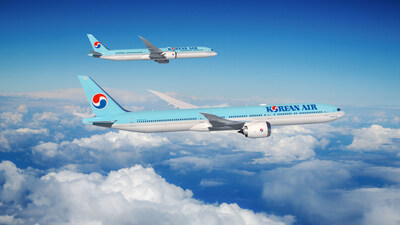
Korean Air's selection of the 777-9 and 787-10 supports planned growth and renewal of its fleet in size, range and capacity to reach high-demand markets in
"The addition of the Boeing 777-9 and 787-10 aircraft marks a significant milestone in our strategic objective to expand and upgrade our fleet," said Walter Cho, Chairman and CEO of Korean Air. "This investment underscores our commitment to providing a best-in-class flying experience. These new airplanes will elevate passenger comfort and enhance operational efficiency, while significantly reducing carbon emissions, supporting our long-term commitment to sustainable aviation."
When finalized and posted to Boeing's Orders & Deliveries website, Korean Air will be the latest customer to purchase the world's largest and most fuel-efficient twin engine jet.
The 777-9 can seat 426 passengers in a two-class configuration with a range of 13,500 km (7,285 nautical miles) and the 787-10 can carry up to 336 passengers with a range of 11,730 km (6,330 nautical miles).
"We are honored Korean Air has selected our largest, most efficient widebody airplanes to add capacity to its global network," said Stephanie Pope, president and CEO of Boeing Commercial Airplanes. "Boeing airplanes have played an integral role with Korean Air over the past 50 years, and the 777X and 787 Dreamliner will continue to support the airline's long-term goals for sustainability and continued growth."
The 777-9 features advanced technologies from the 787 Dreamliner family, including new carbon-fiber composite wings and engines that will enable the airplane to achieve
Recently rated the #2 airline in the world by airlineratings.com, Korean Air continues to optimize its global route network and looks to maintain its status as a leading global carrier. The airline will feature new business class suites and Wi-Fi capability onboard its new 787-10s, further enhancing its award-winning onboard service.
Korean Air's Aerospace Division currently supplies components for the 787 program, including the model's unique raked wing-tip. The supplier also produces parts for a number of Boeing airplanes including the 737 MAX, 767 and 777.
As a leading global aerospace company, Boeing develops, manufactures and services commercial airplanes, defense products and space systems for customers in more than 150 countries. As a top
Contact
Boeing Media Relations
media@boeing.com
Korean Air Global Communications
globalpr@koreanair.com
 View original content to download multimedia:https://www.prnewswire.com/news-releases/korean-air-commits-to-up-to-50-boeing-widebodies-to-strengthen-future-long-haul-fleet-302202551.html
SOURCE Boeing
FAQ
AI-generated questions and answers. How Rhea-AI works. Not financial advice.