
BofA Report: Financial Wellbeing of Employees at U.S. Companies Hits Four-Year High, Even as Cost-of-Living Pressures Persist
Bank of America (NYSE: BAC) released its 2026 Workplace Benefits Report on July 21, 2026, showing employee financial wellbeing at U.S. companies has risen to a four-year high, with 55% of workers feeling good or excellent, up 11 points from 2023.
Sentiment and the balance of points
Rhea-AI Sentiment reads the wording of the document, how positive or negative its language is on a 1 to 5 scale. The balance of points shown with the takes weighs what the document actually discloses, so the two can disagree, for example when a trial that missed its main goal is described in upbeat language.
Rhea-AI Summary
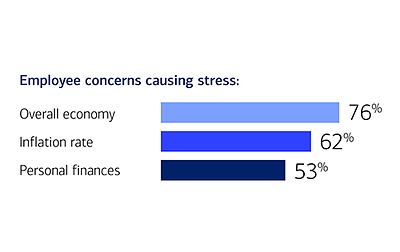
Bank of America (NYSE: BAC) released its 2026 Workplace Benefits Report on July 21, 2026, showing employee financial wellbeing at U.S. companies has risen to a four-year high, with 55% of workers feeling good or excellent, up 11 points from 2023. Despite this rebound, 76% of employees report the economy causes stress, 62% cite inflation, and 75% say cost of living challenges their financial security. The report highlights a perception gap, as 71% of employers rate workforce financial wellbeing as good or excellent, versus 55% of employees. Retirement confidence increased to 73%, a 6‑point gain from 2025, and Gen Z workers now start saving for retirement at an average age of 24 compared with 34 for Boomers. Nearly 60% of employees hit their emergency savings goal in 2026, and credit card debt prevalence fell to 45%, down 11 points year over year.
Details
News Market Reaction – BAC
On Jul 21, the day this news came out, BAC closed 1.32% above the previous close.
Data tracked by StockTitan Argus for the Jul 21 session.
Key Figures
- Employee financial wellbeing
- 55%
- 2026 report; four-year high
- Increase from 2023
- 11 points
- Employee financial wellbeing
- Retirement confidence
- 73%
- Employees who feel savings are on track
- Retirement confidence gain
- 6 points
- 2026 versus 2025
- Economic stress
- 76%
- Employees citing the economy as a stressor
- Inflation stress
- 62%
- Employees citing inflation as a stressor
- Cost-of-living challenge
- 75%
- Employees citing cost of living as a financial-security challenge
- Credit card debt
- 45%
- Employees reporting credit card debt; down 11 points year-over-year
Historical Context
-
Redemption of $6.15 billion in senior notes at 100% of principal
-
Second-quarter 2026 results were released with an investor conference call
-
Nine senior hires expanded regional investment banking coverage across U.S. markets
-
Redemption of $2.6 billion in senior bank notes
-
Merrill Managed Account Advisors surpassed $1 trillion in client assets
24h Move is the share-price change in the day after each event; other market factors may also have contributed.
Key Terms
401(k) financial
health savings account (hsa) financial
AI-generated analysis. How Rhea-AI works. Not financial advice.




Key points
- Financial wellbeing of employees at
U.S . companies rebounds to a four-year high, with55% reporting they feel good or excellent. - While overall debt-related stress dropped year-over-year, economic anxiety remains a top financial stressor.
- Retirement confidence climbs, with
73% of employees feeling on track, a 6-point gain from 2025.
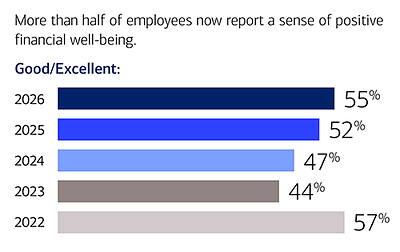
The report finds that overall employee financial wellbeing reached a four-year high of
The report also reveals a disconnect: while
"We're seeing real progress for American workers as overall financial wellness steadily rebounds to a four-year high," said Stacy Bucchere, Managing Director of Workplace Benefits Client Management at Bank of America. "However, employees are still navigating complex financial circumstances that require proactive support from employers to help build long-term stability."
Retirement confidence climbs, younger workers start saving earlier
"Saving for retirement remains a top priority for American workers, and more are feeling on track toward their retirement savings goals," said Kai Walker, Managing Director of Workplace Benefits Research. "Perhaps most encouraging is that the youngest generation in the workforce is starting to save for retirement a full decade earlier than their older peers."
The report's findings show that:
70% of employees cite retirement savings as a top financial goal.73% of employees feel confident that their savings are on track for retirement, a 6-point gain from 2025.- Gen Z employees are beginning to save at an average age of 24, compared to Boomers who started at an average age of 34.
The report also uncovered an underutilized savings opportunity for many employees. While more than 6 in 10 employers currently offer a healthcare plan with access to a Health Savings Account (HSA) – and more than
Employees make progress on immediate financial goals
Though saving for retirement remains a top priority for American workers, employees are also working toward short-term financial goals, including building emergency savings, which is a top priority for
Employees have also made progress on paying down debt. Stress around debt has decreased 6 points since 2025, and the percentage of employees who say they have credit card debt is now
Workplace benefits are a decisive differentiator
As the labor market remains highly competitive in 2026, employee retention is a top business priority. The report indicates that more than 1 in 3 employees have left or considered leaving their job in the past year.
Comprehensive benefits packages are proving to be a competitive advantage:
39% of employees report that they remain loyal to their current employer specifically because of a competitive benefits package.48% of employers who have successfully attracted top talent in the past year credit their workplace benefits as a leading factor.- 9 out of 10 employers who offer financial wellness programs report reaping measurable returns, including higher employee satisfaction, improved productivity, deeper engagement and enhanced retention.
"These findings demonstrate the mutual value of financial wellness programs to both employees and employers," said John Quinn, Managing Director of Workplace Benefits Product & Platform Management at Bank of America. "In today's labor market, workplace benefits are no longer just a recruitment checklist item; they're a key to stronger workforces. This is especially true for small businesses that report having a harder time engaging top talent. A strong benefits offering can help even the playing field."
The report found that many employers are not yet leveraging emerging technology like AI to assess and enhance benefits offerings. While
Frequently asked questions
Question: Where can I find the full Workplace Benefits Report?
Answer: The full 2026 Workplace Benefits Report (PDF) can be found in the Bank of America Newsroom.
Question: What is Workplace Benefits at Bank of America?
Answer: Bank of America Workplace Benefits provides guidance and solutions that help businesses support their employees' short- and long-term goals. Our dedicated team of experts has years of experience and supports companies with plan selection, setup and ongoing maintenance, making the process seamless for plan sponsors.
Question: What Workplace Benefits solutions and services does Bank of America offer its clients?
Answer: Through retirement and benefit plans1, health benefit accounts2, employee banking solutions2, stock plan services1 and more, seamlessly integrated across its full set of financial capabilities, employees have a more holistic view of their financial lives, so they get the benefits most relevant to what they need today and aligned to their goals for tomorrow.
Workplace Benefits Report Methodology
Escalent surveyed a national sample of 941 employees who are working full-time and participate in 401(k) plans, and 806 employers who offer both a 401(k) plan and have sole or shared responsibility for decisions made in the plan. The survey was conducted between December 4, 2025, and January 26, 2026. To qualify, employees had to be current participants in a 401(k) plan, and employers had to offer a 401(k) plan option. Neither was required to work with Bank of America, which was not identified as the sponsor of the study.
Bank of America Institute
Bank of America Institute is dedicated to uncovering powerful insights that move business and society forward. Established in 2022, the Institute is a think tank that draws on data and analyses from across the bank and the world to provide timely and original perspectives on the economy, sustainability, and global transformation. The Institute leverages the depth and breadth of the bank's proprietary data, from nearly 70 million consumer and small business clients, four point five two trillion dollars
Bank of America
Bank of America is one of the world's leading financial institutions, serving individual consumers, small and middle-market businesses and large corporations with a full range of banking, investing, asset management and other financial and risk management products and services. The company provides unmatched convenience in
Workplace Benefits is the institutional retirement and benefits business of Bank of America Corporation ("BofA Corp.") operating under the name "Bank of America." Investment advisory and brokerage services are provided by wholly owned non-bank affiliates of BofA Corp., including Merrill Lynch Pierce, Fenner & Smith Incorporated (also referred to as "MLPF&S" or "Merrill"), a dually registered broker-dealer and investment adviser and Member SIPC. Banking activities may be performed by wholly owned banking affiliates of BofA Corp., including Bank of America, N.A., Member FDIC.
Visit BofA Fast Facts for more information about the company.
Reporters may contact
Anu Ahluwalia, Bank of America
Phone: 1.646.855.3375
anu.ahluwalia@bofa.com
MAP# 9016405
Important disclosures
Investment products
Are Not FDIC Insured | Are Not Bank Guaranteed | May Lose Value |
Footnotes
1 Investment products are available from Merrill Lynch, Pierce, Fenner & Smith Incorporated.
2 Bank products are available from Bank of America, N.A., and affiliated banks.
 View original content to download multimedia:https://www.prnewswire.com/news-releases/bofa-report-financial-wellbeing-of-employees-at-us-companies-hits-four-year-high-even-as-cost-of-living-pressures-persist-302829819.html
SOURCE Bank of America Corporation
FAQ
AI-generated questions and answers. How Rhea-AI works. Not financial advice.