
Buffalo Potash Announces Assay Results from Summer Drilling Program and Confirms High-Grade Potash Mineralization at Disley
Two operational wells added assay data at no incremental drilling cost, while all five production-module wells are now drilled.
Sentiment and the balance of points
Rhea-AI Sentiment reads the wording of the document, how positive or negative its language is on a 1 to 5 scale. The balance of points shown with the takes weighs what the document actually discloses, so the two can disagree, for example when a trial that missed its main goal is described in upbeat language.
Rhea-AI Summary
Buffalo Potash (BLPTF) reported Disley drilling results, with its Source Well intersecting 20.5m of net sylvinite grading 39.4% potassium chloride.
The Belle Plaine interval hosting the Initial Production Module's (IPM) first solution mining plane measured 5.5m at 36.9% potassium chloride. The Disposal Well intersected 16.2m grading 32.6%. Both operational wells supplied assay data at no incremental drilling cost. All five IPM wells are drilled, with completions and equipping underway before brine circulation. Buffalo says development remains on budget and on schedule, targeting first production in Q1 2027.
Buffalo intends to update its mineral resource estimate and preliminary economic assessment using the new data, then use geological and future IPM operating data for expansion feasibility studies. A proposed Canadian tax deduction could be reflected in the updated assessment but has not been enacted.
How this balance works
Rhea-AI gives every point it takes from this document a weight. Minor counts 1, Moderate 3 and Major 9, so one Major point outweighs several Minor ones. The bar adds up the weights on each side, and when neither side holds more than 65% of the total the balance reads Mixed.
It reads the document as published, with the same rules for every company, and it does not look at what the market expected or at how the stock traded, so a point can be objectively good on a day the stock falls.
Rhea-AI Sentiment measures something else, the tone of the wording.
Hollow bars mark forward-looking points. How the balance works
Positive
- Moderate pointSource Well intersected 20.5m of net sylvinite grading 39.4% potassium chloride.
- Moderate pointAll five IPM wells are drilled; completions and equipping are underway before brine circulation.
- Moderate point. Forward-looking: it has not happened yet and may not happen.First production is targeted for Q1 2027; Buffalo says IPM development remains on budget and schedule.
- Minor pointBelle Plaine mining-plane interval in the Source Well measured 5.5m grading 36.9% potassium chloride.
- Minor pointDisposal Well intersected 16.2m of net sylvinite grading 32.6% potassium chloride.
4 minor points
- Minor pointTwo assayed drillholes added geological data at no incremental drilling cost.
- Minor pointEnvironmental impact assessment is not required following Saskatchewan's determination that the IPM is not a development.
- Minor point. Forward-looking: it has not happened yet and may not happen.Updated resource estimate and preliminary economic assessment are planned to incorporate the new drillhole data.
- Minor point. Forward-looking: it has not happened yet and may not happen.Disley East and West feasibility studies are intended to draw on geological and future IPM operating data.
Negative
- Moderate pointIPM development decision lacks a feasibility study of mineral reserves demonstrating economic and technical viability.
- Moderate pointHorizontal Line-Drive mining has not operated at commercial scale, creating a disclosed performance risk.
- Minor point. Forward-looking: it has not happened yet and may not happen.IPM production risks include differing recoveries, costs and production rates, and production that does not become sustainable or profitable.
- Minor point. Forward-looking: it has not happened yet and may not happen.Updated resource estimate, economic assessment and feasibility study are not certain to be completed.
- Minor point. Forward-looking: it has not happened yet and may not happen.Proposed Productivity Mega Deduction has not been enacted; its enactment as proposed is uncertain.
AI-generated analysis. How Rhea-AI works. Not financial advice.




Highlights
- 15-10 Source Well - located on the Initial Production Module ("IPM") pad - intersected 20.5m of net sylvinite grading
39.4% sylvite (KCl); - Belle Plaine Member at 15-10 - the Member hosting the IPM's first solution mining plane - intersected 5.5m of net sylvinite grading
36.9% KCl; - 2-14 Disposal Well - approximately 1,600m east of the IPM - intersected 16.2m of net sylvinite grading
32.6% KCl; - Both wells were drilled as operating infrastructure for the IPM and cored with
100% recovery over approximately 108m each, adding two modern assayed drillholes to the Disley Project at no incremental drilling cost; and - IPM development remains on budget and on schedule: drilling of all five wells are complete, completions and equipping are underway ahead of Phase 3 (brine circulation), and first production is targeted for Q1 2027.
Saskatoon, Saskatchewan--(Newsfile Corp. - October 14, 2026) - Buffalo Potash Corporation (TSXV: BUFF) (OTCQB: BLPTF) (FSE: VU5) (the "Company" or "Buffalo") is pleased to announce assay results from cores taken in the 15-10 well (the "Source Well") and the 2-14 well (the "Disposal Well") at the IPM on the Company's flagship Disley property in Saskatchewan (the "Disley Project").
Both wells were drilled this summer as part of Phase 1 of the IPM build-out (see the Company's news releases dated July 29, 2026 and August 18, 2026). Their primary role is operational - supplying and disposing of brine for the IPM - but the Company cored each well through the potash-bearing Members of the Prairie Evaporite Formation during drilling. The results confirm high-grade sylvinite at the site of Buffalo's first mining plane and add two new control points to support a feasibility study for Disley East and Disley West.
Mr. Steve Halabura, P.Geo., Chief Executive Officer and Director of the Company, commented: "We drilled the 15-10 and 2-14 wells to do a job for the IPM, but we were never going to pass up the chance to core through the potash on the way down. These results put high-grade sylvinite right where we are building our first mining plane, and they line up with what we saw at 7-10 earlier this year. Every well we drill at Disley now does double duty - it builds the operation and it builds our understanding of the deposit for Disley East and West."
Mr. Quinton Hardage, P.Eng., PMP, President and Chief Operating Officer of the Company, commented: "Buffalo's focus is on bringing the IPM into production. With all five wells in the ground, our team is working through completions and equipping ahead of brine circulation. Seeing high-grade potash mineralization directly above our mining plane is valuable confirmation as we prepare for the brine circulation phase."
Assay Results
Core from both wells was sampled and submitted to SRC Geoanalytical Laboratories for potash ICP analysis. Results by Member are summarized in Table 1, alongside the Company's 7-10 confirmation hole drilled earlier in 2026 (see March 25, 2026 announcement). Given that the beds are flat-lying in proximity to the drill holes, sample thicknesses are the same as Member and bed/seam true thicknesses.
Table 1: Disley Project Assay Results by Member
| Hole | From | To | Member † | Thickness | KCl |
| (name) | (ft) | (ft) | (name) | (m) | (%) |
| 15-10 Source Well | 1,452.5 | 1,458.5 | UPL | 6.0 | |
| 15-10 Source Well | 1,462.2 | 1,465.2 | LPL | 3.0 | |
| 15-10 Source Well | 1,471.0 | 1,476.5 | BP | 5.5 | |
| 15-10 Source Well | 1,495.0 | 1,501.0 | EST | 6.0 | |
| 2-14 Disposal Well | 1,456.3 | 1,460.3 | UPL | 4.0 | |
| 2-14 Disposal Well | 1,461.1 | 1,466.3 | LPL | 5.2 | |
| 2-14 Disposal Well | 1,473.0 | 1,478.0 | BP | 5.0 | |
| 2-14 Disposal Well | 1,494.0 | 1,496.0 | EST | 2.0 |
(†) Notes: Patience Lake: the uppermost potash-bearing Member; subdivided into upper ("UPL") and lower ("LPL") intervals
Belle Plaine ("BP"): situated stratigraphically below Patience Lake;
Esterhazy ("EST"): the deepest of the three potash-bearing members; targeted Member for mining at adjacent K+S Bethune and Mosaic Belle Plaine potash solution mines
K2O is typically used for geological purposes, whereas KCl is typically used for production of potash with the conversion factor between the two being multiplying K2O by 1.583 to get KCl %
Path to Updated PEA and Feasibility Study
The 15-10 and 2-14 assay results were not included in the NI 43-101 Mineral Resource Estimate underpinning the Company's Preliminary Economic Assessment ("PEA"). Buffalo intends to commission an updated Mineral Resource Estimate and updated PEA for the Disley Project, which would incorporate the new drillhole data from the 15-10 and 2-14 wells.
An updated PEA would also allow the Company to reflect proposed changes to Canada's tax regime since the current PEA's effective date. On September 15, 2026, the Government of Canada announced the proposed Productivity Mega Deduction. It would permit an immediate deduction for eligible capital property, including certain mine structures, processing equipment, and Canadian development expenses, acquired or incurred on or after that date. The PEA's after-tax economics were prepared before this announcement and do not reflect the proposed measure, which has not yet been enacted.
Buffalo intends to use the expanded geological and future operating dataset from the IPM as the foundation for a feasibility study on the additional Disley West and Disley East expansions. There is no certainty that an updated Mineral Resource Estimate, updated PEA or feasibility study will be completed, or that the Productivity Mega Deduction will be enacted as proposed.(2)
IPM Development Update
On September 25, 2026, Buffalo completed the third and final horizontal well at the IPM, concluding the drilling program with all five wells in place as designed (see September 25, 2026 announcement). Each of the three 565m horizontal laterals achieved approximately
Disley Project - General Overview
The Disley Project is located approximately 50 kilometers northwest of Regina and covers 10,610 hectares of Crown and Freehold mineral rights. The property is situated immediately to the east of the K+S Bethune potash solution mine and north of the Mosaic Belle Plaine potash solution mine - both of which are among the largest producing potash solution mines in the world. In the opinion of management, the Disley Project is in one of the most favorable areas of Saskatchewan for potash solution mining (see Figure 1) as evidenced by the success of these neighboring operations.(1)
On May 22, 2026, Buffalo released the results of its maiden NI 43-101 Mineral Resource Estimate and PEA for the Disley Project, prepared by Micon International Co Limited. The PEA outlined a phased, modular development plan contemplating full-scale production of up to 1,125,000 tonnes per annum ("TPA") of potash across three solution mining facilities, with an estimated after-tax net present value (NPV) of US
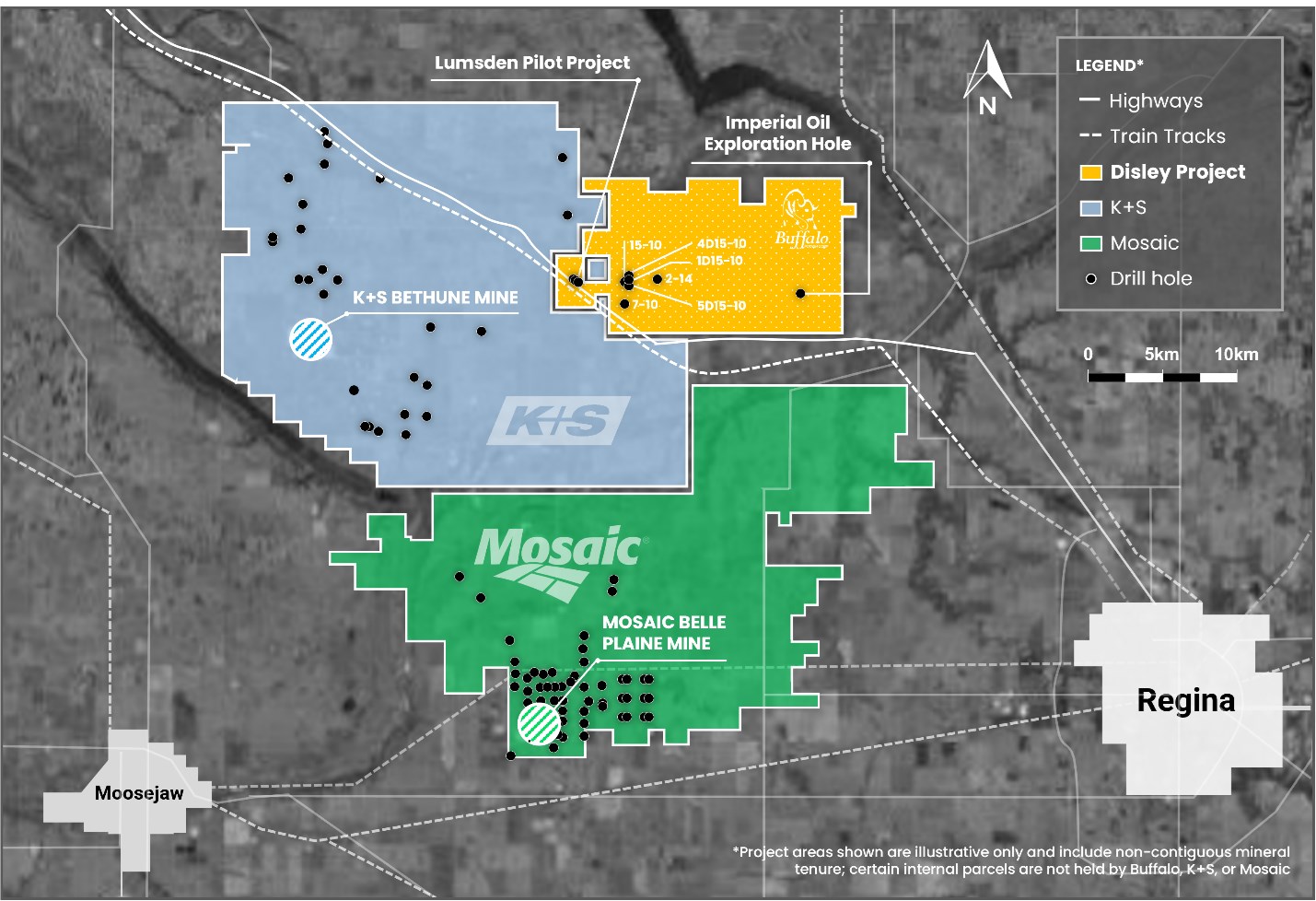
Figure 1: The Disley Property Situated Amongst Major Potash Solution Mines(1)
To view an enhanced version of this graphic, please visit:
https://images.newsfilecorp.com/files/12107/318893_6faa785a241c8ad9_001full.jpg
About Buffalo Potash
Buffalo Potash is an emerging Saskatchewan-based potash developer pursuing a modular approach to selective solution mining through its patented Horizontal Line-Drive (HLD) technology. Buffalo is advancing the Disley Project - located adjacent to two of the most prominent currently producing potash solution mines in the world - with the objective of establishing capital-efficient, lower-impact potash production in one of the world's leading potash jurisdictions.
Qualified Person
The technical information in this news release has been reviewed and approved by Douglas F. Hambley, PhD, PE, P.Eng., PG, an independent consultant to the Company, who is a Qualified Person within the meaning of National Instrument 43-101 - Standards of Disclosure for Mineral Projects. This news release does not contain an updated mineral resource estimate, a new mineral reserve estimate, or economic analysis beyond information previously disclosed in the NI 43-101 technical report for the Disley Project filed under the Company's profile on SEDAR+ at www.sedarplus.ca. Readers are referred to that technical report, prepared by Micon International Co Limited, for complete details of the Mineral Resource Estimate and Preliminary Economic Assessment, including all data verification, methodology, assumptions, and qualifications.
All related and pertinent information has also been reviewed for this news release by Jared Galenzoski, P.Geo., FIMMM, as an independent consultant to the Company who is a Qualified Person within the meaning of National Instrument 43-101 - Standards of Disclosure for Mineral Projects. Mr. Galenzoski is an expert in several potash-related fields including the drilling of potash horizontal wells and solution mining operations.
Contact
Steve Halabura P.Geo. | Chief Executive Officer & Director
Email: steve@buffalopotash.ca | Phone: 1-306-220-7715
Neither the TSX Venture Exchange nor its Regulation Services Provider (as that term is defined in the policies of the TSX Venture Exchange) accepts responsibility for the adequacy or accuracy of this release.
Notes
(1) The K+S Bethune potash solution mine and the Mosaic Belle Plaine potash solution mine (together, the "Adjacent Properties") may each be considered an "adjacent property" (within the meaning of NI 43-101) to the Company's Disley Project. The Company has no interest in either of the Adjacent Properties. The Company believes this context is useful in illustrating the proven endowment of the district, while noting that mineralization on adjacent or nearby properties is not indicative of mineralization on the Company's Disley Project. There is no guarantee that the Disley Project will yield comparable results to either of these mines.
(2) The PEA was prepared by Micon International Co Limited in accordance with National Instrument 43-101 Standards of Disclosure for Mineral Projects and is preliminary in nature. The PEA is preliminary in nature and includes inferred mineral resources, which are considered too speculative geologically to have the modifying factors and economic considerations applied to them that would enable them to be categorized as mineral reserves. Mineral resources that are not mineral reserves do not have demonstrated economic viability. There is no certainty that the results of the PEA will be realized. Readers are encouraged to read the technical report filed under the Company's profile on SEDAR+ at www.sedarplus.ca in its entirety, including all qualifications, assumptions, and exclusions that relate to the PEA.
(3) Production Decision Cautionary Statement: The Company's decision to proceed with development of the IPM is not based on a feasibility study of mineral reserves demonstrating economic and technical viability. No mineral reserves have been established at the Disley Project, and the PEA is preliminary in nature (see Note 2). Historically, mineral projects advanced to production without first establishing mineral reserves supported by a feasibility study have a higher risk of economic and technical failure. Specific risks associated with the Company's production decision include, but are not limited to: 1) grade, continuity, or thickness of mineralization that differs from the Mineral Resource Estimate; 2) performance of the Company's Horizontal Line-Drive mining method, which has not been operated at commercial scale, that is not as anticipated; 3) recoveries, production rates, or capital and operating costs that differ materially from the PEA; and 4) production during the IPM that does not become sustainable or profitable, which would materially and adversely affect the Company's ability to generate revenue and cash flow.
Forward-Looking Information
This news release contains "forward-looking information" and "forward-looking statements" (collectively, "forward-looking information") within the meaning of applicable Canadian securities legislation. Forward-looking information is generally identifiable by the use of words such as "believes," "may," "plans," "will," "anticipates," "intends," "could," "estimates," "expects," "forecasts," "projects," or similar expressions, and the negative of such expressions.
Forward-looking information in this news release includes, but is not limited to, statements regarding: the IPM remaining on budget and on schedule; the timing, sequencing and completion of equipping at the IPM and the commencement of the brine circulation phase; the establishment of a solution mining plane at the IPM using the Company's patented Horizontal Line-Drive mining method; the anticipated timing of first production from the IPM; the significance of the 15-10 and 2-14 assay results, including their relevance to the IPM mining plane; the Company's intention to commission an updated Mineral Resource Estimate and an updated PEA; the proposed Productivity Mega Deduction; the anticipated timing and phasing of development and commercial production for the IPM, Disley East and Disley West; the results, assumptions and projections contained in or derived from the Mineral Resource Estimate and PEA; the Company's reliance on the Saskatchewan Ministry of Environment's determination under The Environmental Assessment Act; expectations regarding the Disley Project's potential for solution mining; and the Company's broader development plans and strategy for the Disley Project.
Forward-looking information is based on management's reasonable assumptions, estimates, analysis, and opinions made in light of its experience, perception of historical trends, current conditions, and expected future developments, as well as other factors that management believes are relevant and reasonable in the circumstances as of the date such statements are made. These assumptions include, but are not limited to: geological continuity, potash grade and thickness between and beyond drillholes; that assay results from individual wells are representative of the broader deposit; the applicability of historical data; completion and equipping proceeding on schedule and within budget; costs of production; the commencement of brine circulation; production ramp-up rates and timing for the IPM; the receipt of required permits and approvals; the Ministry of Environment determination remaining in effect; and the Productivity Mega Deduction being enacted substantially as proposed.
Forward-looking information is subject to known and unknown risks, uncertainties, and other factors that may cause actual results, performance, or achievements of the Company to differ materially from those expressed or implied by such forward-looking information. Such risks and uncertainties include, but are not limited to: the inherent uncertainty of PEA-level studies and the possibility that actual capital costs, operating costs, and production rates differ materially from estimates; the limited number of drill holes and the risk that assay results from individual wells are not representative of the broader deposit; the risk that an updated Mineral Resource Estimate, updated PEA or feasibility study is not completed, is delayed, or produces materially different results from the current estimates; the risk that the Productivity Mega Deduction is not enacted, is enacted in a modified form, or does not apply to the Company's expenditures as anticipated; risks related to exploration and development activities; the risk that the IPM does not generate operating data sufficient to support a feasibility study; risks related to the development, commissioning, and operation of novel mining technology, including that the Company's HLD mining method has not been operated at commercial scale and that successful completion of the drilling phase does not guarantee successful performance during brine circulation or commercial production; risks inherent to solution mining operations and new or emerging technologies; regulatory approvals and permitting timelines; commodity price volatility; availability of capital; and general economic, market and business conditions.
Although the Company has attempted to identify important factors that could cause actual results to differ materially from those contained in forward-looking information, there may be other factors that cause results not to be as anticipated, estimated, or intended. There can be no assurance that such information will prove to be accurate, as actual results and future events may differ materially from those anticipated in such forward-looking information. Accordingly, readers should not place undue reliance on forward-looking information. The forward-looking information contained herein is made as of the date of this news release, and the Company disclaims any obligation to update or revise such information, except as required by applicable securities laws.

To view the source version of this press release, please visit https://www.newsfilecorp.com/release/318893
FAQ
AI-generated questions and answers. How Rhea-AI works. Not financial advice.
What did Buffalo Potash's Disley drilling assays show?
The Source Well intersected 20.5m of net sylvinite grading 39.4% potassium chloride, while the Disposal Well intersected 16.2m grading 32.6%. The Source Well's Belle Plaine interval, which hosts the first solution mining plane, measured 5.5m grading 36.9%.
When does Buffalo Potash target first production at Disley?
Buffalo targets first IPM production in Q1 2027. All five wells are drilled, and completions and equipping are underway ahead of the brine circulation phase.
How could Canada's proposed tax deduction affect Buffalo Potash's updated Disley assessment?
An updated preliminary economic assessment could reflect the proposed Productivity Mega Deduction, which is absent from the current assessment's after-tax economics. The proposal would permit immediate deductions for eligible capital property and Canadian development expenses acquired or incurred on or after September 15, 2026. It has not been enacted.
What drilling milestones did Buffalo Potash complete for Disley's horizontal wells?
Buffalo completed the third and final horizontal IPM well on September 25, 2026. Each of the three 565m horizontal laterals achieved approximately 95% contact with the target clay seam, and 11-stage packer systems were installed along all three wells.