
BP Silver Corp. Intersects 10.0 Meters Grading 183.62 g/t Silver and 0.59 g/t Gold (239.65 g/t Silver Equivalent), Including 2.0 Meters Grading 506.50 g/t Silver and 1.08 g/t Gold (600 g/t Silver Equivalent) at Cosuño Silver Project, Bolivia
Both holes ended in mineralization, while further drilling is required to establish the system’s extent, continuity and economic potential.
Sentiment and the balance of points
Rhea-AI Sentiment reads the wording of the document, how positive or negative its language is on a 1 to 5 scale. The balance of points shown with the takes weighs what the document actually discloses, so the two can disagree, for example when a trial that missed its main goal is described in upbeat language.
Rhea-AI Summary
BP Silver (BPSCF) reported additional Phase 2 drilling results from two holes at the Jalsuri North target in Bolivia’s Cosuño project. Hole CO-0019 returned 10.0 meters grading 183.62 g/t silver and 0.59 g/t gold from 3.0 meters, equivalent to 239.65 g/t silver. This included 2.0 meters grading 506.50 g/t silver and 1.08 g/t gold.
CO-0019 also returned 100.0 meters grading 1.25% zinc, or 2.49% zinc equivalent, from 2.0 to 102.0 meters. CO-0016 returned 96 meters grading 1.37% zinc, or 1.91% zinc equivalent, from 4.0 to 100.0 meters. Both holes ended in mineralization. BP Silver interprets the results as evidence of a potentially larger mineralized system at depth; further drilling is required to establish its extent, continuity and economic potential. Equivalent grades combine multiple metals using assumed prices and recoveries, rather than measuring recoverable metal or economic value.
Positive
- Minor pointCO-0019 returned 10.0 meters at 183.62 g/t silver and 0.59 g/t gold from 3.0 meters.
- Minor pointCO-0019’s included 2.0 meters graded 506.50 g/t silver and 1.08 g/t gold from 4.0 meters.
- Minor pointCO-0019’s 5.0-meter interval from 4.0 to 9.0 meters graded 294.00 g/t silver and 0.81 g/t gold.
- Minor pointCO-0019 returned 100.0 meters at 1.25% zinc and 2.49% zinc equivalent from 2.0 to 102.0 meters.
- Minor pointCO-0019’s included 84 meters graded 1.47% zinc and 1.59% zinc equivalent from 18 to 102 meters.
6 minor points
- Minor pointCO-0016 returned 96 meters at 1.37% zinc and 1.91% zinc equivalent from 4.0 to 100.0 meters.
- Minor pointCO-0016’s included 21 meters graded 2.42% zinc and 3.45% zinc equivalent from 50 to 71 meters.
- Minor pointCO-0016’s 3.0-meter interval graded 110.60 g/t silver and 0.17 g/t gold from 13.0 to 16.0 meters.
- Minor pointCO-0016’s 2.0-meter interval graded 56.75 g/t silver, 5.65% zinc and 0.714% copper from 52.0 to 54.0 meters.
- Minor pointCO-0016’s final 2.0 meters averaged 4.18% zinc and 3.44 g/t silver from 98.0 to 100.0 meters.
- Minor point. Forward-looking: it has not happened yet and may not happen.Both holes ended in mineralization; the company sees potential for the system to extend deeper.
Negative
- Minor point. Forward-looking: it has not happened yet and may not happen.Further drilling is required to determine mineralization’s full extent, continuity and economic potential.
- Minor pointEquivalent grades assume 90% recoveries for all metals; no metallurgical testing has established recoveries.
AI-generated analysis. How Rhea-AI works. Not financial advice.


Both Drill Holes CO-0016 and CO-0019 End in Zinc Mineralization; CO-0019 Intersects 100.0 Meters Grading
Vancouver, British Columbia--(Newsfile Corp. - October 28, 2026) - BP Silver Corp. (TSXV: BPAG) (OTCQB: BPSCF) ("BP Silver" or the "Company") announces additional assay results from two diamond drill holes completed at the Jalsuri North Target as part of its Phase 2 diamond drilling program (the "Program") at the Cosuño Silver Project ("Cosuño") in Bolivia. Drilling continues to intersect significant silver mineralization in addition to broad intervals of zinc mineralization.
HIGHLIGHTS
- High-grade silver-gold mineralization: Drill hole CO-0019 intersected 10.0 meters ("m") grading 183.62 g/t silver and 0.59 g/t gold (239.65 g/t silver equivalent), including 2.0 m grading 506.50 g/t silver and 1.08 g/t gold (600.04 g/t silver equivalent) starting at 3.0 m depth.
- Additional high-grade silver-gold mineralization: Within the upper mineralized zone, a 5.0 m interval from 4.0 to 9.0 m returned 294.00 g/t silver and 0.81 g/t gold (369.68 g/t silver equivalent).
- Broad zinc mineralization: CO-0019 also intersected a broad lower zone grading
2.49% zinc equivalent over 100.0 m.
(See Table 1 and 2 and Figure 3.)
Dr. Stewart D. Redwood, Director and Qualifying Person, stated: "These two holes at Jalsuri North are mineralized along their entire lengths, with zinc associated with lead, and intersect high-grade silver structures associated with gold, bismuth, copper, antimony, tin and, in some cases, zinc. The geochemical results reveal distinct metal zonation, likely related to variations in temperature within the hydrothermal system. These holes are step-outs to the northwest along strike from hole CO-0015, reported on October 20, 2026, and further demonstrate the continuity of mineralization across the Jalsuri North zone. Similar to CO-0015, both holes are hosted in basaltic andesite and exhibit veinlet, breccia, vug-fill, patchy and disseminated mineralization consistent with an intermediate-sulfidation epithermal system."
SUMMARY
Assay results have been received for two additional drill holes, CO-0016 and CO-0019, completed at the Jalsuri North Target as part of the Company's Phase 2 diamond drilling program (Figure 3, Table 1 and 2).
Drill holes CO-0016 and CO-0019 intersected zinc-mineralization throughout their entire lengths. Notably, CO-0019 also intersected a near-surface 10 m interval of high-grade silver and gold mineralization, in addition to other pathfinder metals. Both holes ended in mineralization, demonstrating the potential for mineralization to continue at depth and further supporting the polymetallic potential of the Jalsuri North target.
Mineralization is interpreted to represent the upper and/or distal levels of an intermediate-sulfidation epithermal system developed adjacent to the extensive Cosuño lithocap. The geological setting suggests the potential for a larger mineralized system at depth.
In detail the multi-phase, structurally controlled, mineralization occurs in several forms, including breccia-hosted, veinlets, fillings within vesicles in the lavas, disseminations, replacement mineralization, and mineralization within the lower sedimentary conglomerate matrix. The mineral assemblage consists primarily of sphalerite and pyrite, with minor chalcopyrite and galena, accompanied by quartz, calcite, barite, and white clay minerals, including smectite and/or dickite.
Tim Shearcroft, Founder and CEO, stated: "Intersecting 10 meters grading more than 183 g/t silver, including 2 meters grading over 500 g/t silver, is extremely encouraging. Equally important, both holes intersected broad zinc mineralization and ended in mineralized rock. These results reinforce our view that Jalsuri North may host a substantial polymetallic system with significant potential for further expansion."
Jalsuri North Target
Drill hole CO-0016 intersected a broad zone of polymetallic mineralization within andesitic volcanic rocks which returned 96 m grading
The hole also returned two narrow silver-rich intervals:
- 3.0 m grading 110.60 g/t silver, 0.17 g/t gold,
0.76% zinc,0.31% copper and 273 ppm bismuth (186.40 g/t silver equivalent) from 13.0 to 16.0 m. - 2.0 m grading 56.75 g/t silver,
5.65% zinc and0.714% copper (243.45 g/t silver equivalent) from 52.0 to 54.0 m.
Near the bottom of the hole, the final 2.0 meters, from 98.0 to 100.0 meters, averaged
Further drilling is required to determine the continuity of the mineralization and its relationship to the broader emerging polymetallic system.
Drill hole CO-0019 intersected 10.0 m grading 183.62 g/t silver, 0.59 g/t gold and 233 ppm bismuth (239.65 g/t silver equivalent) from 3.0 to 13.0 m, including 2.0 m grading 506.50 g/t silver and 1.08 g/t gold (600.04 g/t silver equivalent) from 4.0 to 6.0 m (Table 1 and Figure 2).
Mineralization is predominately hosted within a broad andesitic volcanic sequence containing two distinct styles of mineralization (Figure 3).
Deeper Zinc-Lead-Silver Mineralization:
At depth, the hole intersected a broad zone of zinc-lead-silver mineralization, indicative of metal zonation within the hydrothermal system with higher-temperature silver-gold mineralization surrounded by lower-temperature zinc-rich halos.
Mineralization continues to the bottom of the hole. Further drilling is required to determine its full extent, continuity, and economic potential.
| Hole No | From m | To m | Interval m | Ag g/t | Au g/t | Zn % | Bi g/t | Sb g/t | Pb % | Cu % | AgEq g/t |
| CO-0016 | 4 | 100 | 96 | 7.17 | 0.03 | 1.37 | 10 | 33 | 0.065 | 0.055 | 44.69 |
| Inc | 13 | 16 | 3 | 110.6 | 0.17 | 0.76 | 273 | 562 | 0.079 | 0.31 | 186.4 |
| CO-0019 | 3 | 13 | 10 | 183.62 | 0.59 | 0.03 | 233 | 323 | 0.102 | 0.049 | 239.65 |
| Inc | 4 | 6 | 2 | 506.5 | 1.08 | 0.04 | 498 | 865 | 0.122 | 0.028 | 600.04 |
Table 1. Silver-dominated intersections with associated gold (Au), bismuth (Bi), copper (Cu), lead (Pb), zinc (Zn), antimony (Sb); and silver equivalent (AgEq).
| Hole No | From m | To m | Interval m | Ag g/t | Au g/t | Zn % | Bi g/t | Sb g/t | Pb % | Cu % | ZnEq % |
| CO-0016 | 4 | 100 | 96 | 7.17 | 0.03 | 1.37 | 10 | 33 | 0.065 | 0.055 | 1.91 |
| Inc | 50 | 71 | 21 | 12.38 | 0.04 | 2.42 | 4 | 43 | 0.1 | 0.148 | 3.45 |
| CO-0019 | 2 | 102 | 100 | 21.79 | 0.08 | 1.25 | 25 | 48 | 0.106 | 0.013 | 2.49 |
| Inc | 18 | 102 | 84 | 2.49 | 0.02 | 1.47 | 1 | 10 | 0.11 | 0.006 | 1.59 |
Table 2. Zinc-dominated intersections with associated silver (Ag), gold (Au), bismuth (Bi), copper (Cu), lead (Pb), antimony (Sb); and zinc equivalent (ZnEq).
Notes to Table 1:
(1) Silver equivalent ("AgEq") and zinc equivalent ("ZnEq") grades were calculated using 2025 average metal prices reported by the U.S. Geological Survey: US
(2) Recoveries of
(3) Reported intervals represent core lengths. True widths have not yet been determined.
(4) Silver intersections were calculated using a cutoff grade of 10 g/t silver, with sub-intervals reported at 30, 60 and 90 g/t silver. Reported intervals may include internal dilution.
(5) Intersections calculated at cutoff grades of
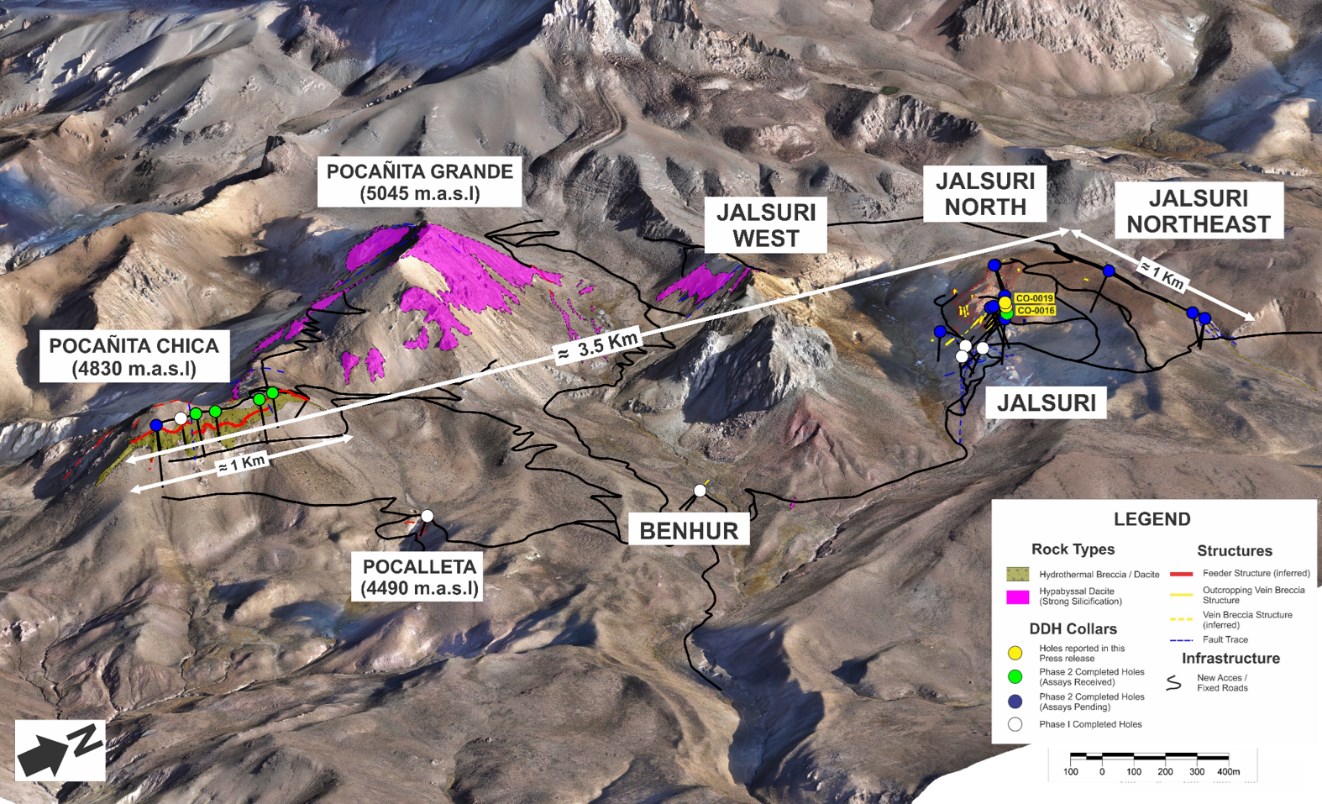
Figure 1. Cosuño Project 3D Plan View Map Showing Drill Collars.
To view an enhanced version of this graphic, please visit:
https://images.newsfilecorp.com/files/11890/321391_32dc4574048f0805_004full.jpg
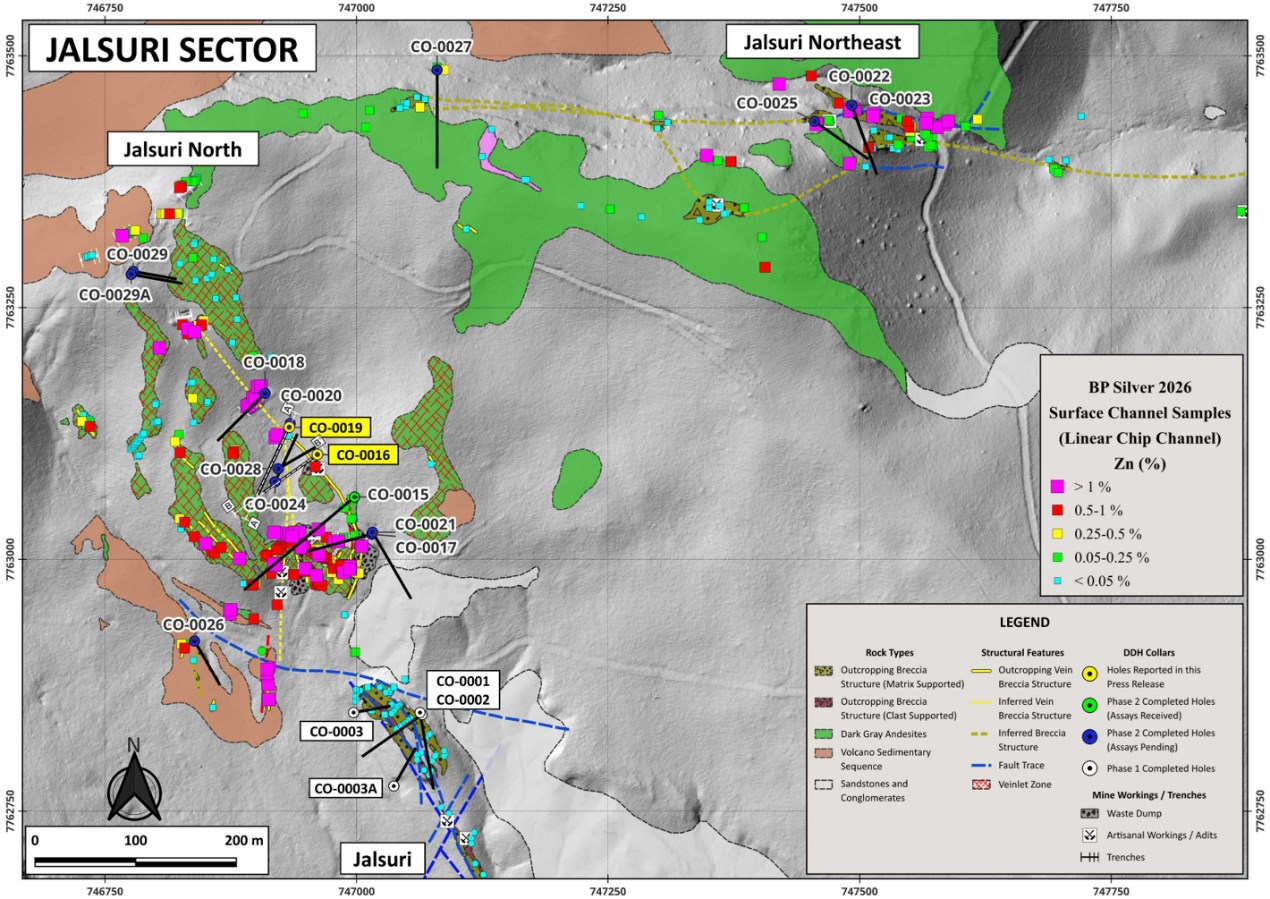
Figure 2. Jalsuri North Plan Map Showing Cross-Section Lines.
To view an enhanced version of this graphic, please visit:
https://images.newsfilecorp.com/files/11890/321391_32dc4574048f0805_005full.jpg
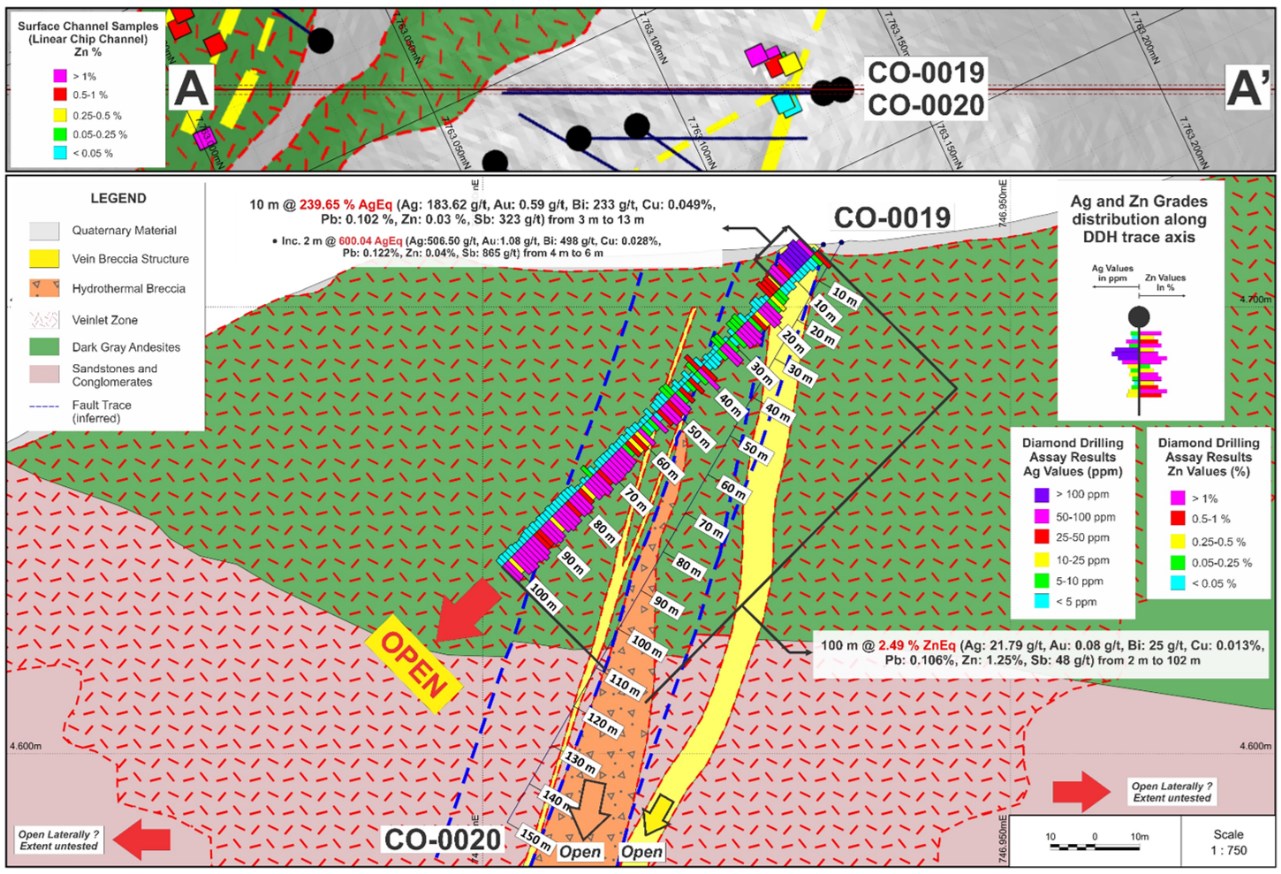
Figure 3. Cross-Section of Drill Hole CO-0019.
To view an enhanced version of this graphic, please visit:
https://images.newsfilecorp.com/files/11890/321391_32dc4574048f0805_006full.jpg
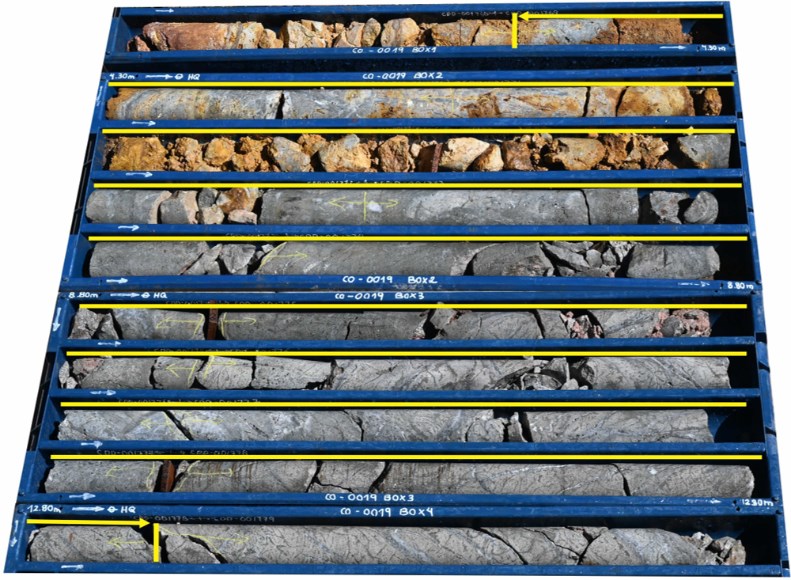
Figure 4. Hole CO-0019: From 4.0 to 13.0 m, 10 m @ 254.21 g/t silver equivalent (194.69 g/t silver, 0.63 g/t Au, 256 ppm Bi,
To view an enhanced version of this graphic, please visit:
https://images.newsfilecorp.com/files/11890/321391_32dc4574048f0805_007full.jpg
Qualified Person
The technical information contained in this news release has been reviewed and approved by Dr. Stewart D. Redwood, PhD, FIMMM, a Director of the Company and a Qualified Person as defined under National Instrument 43-101 - Standards of Disclosure for Mineral Projects. As Dr. Redwood is a director of the Company, he is not independent under National Instrument 43-101.
QA/QC
The work program was designed and supervised by Gonzalo Lemuz, P.Geo, the Company's Chief Operating Officer, who was responsible for all aspects of the work, including the Quality Assurance and Quality Control (QAQC) program. On-site personnel at the Project rigorously collect and track samples which are then security sealed and shipped to ALS laboratory in Oruro for sample preparation. The core samples were prepared by ALS at their laboratory in Oruro, Bolivia and the sample pulps were shipped to their laboratory in El Callao, Peru for analysis. ALS is accredited to ISO/IEC 17025:2017 and ISO9001:2015. ALS is independent of BP Silver. Silver and multi-elements were analysed by aqua regia digestion and ICP-MS finish. Gold was analysed by fire assay and AA finish. BPAG inserted certified standard reference materials (CSRM), blanks and duplicates to monitor QAQC. All diamond drill holes were drilled in HQ-diameter core. The average core recovery was
About BP Silver Corp.
BP Silver Corp. is a Canadian exploration company focused on advancing high-grade silver projects in Bolivia. The Company's flagship asset, the Cosuño Project, is strategically located in the prolific Bolivian silver belt, a region with a rich mining history and significant untapped discovery potential. With a strong technical team and a disciplined exploration strategy, BP Silver is positioned to unlock value for its shareholders through the discovery and development of major silver deposits.
For further information please contact:
Tim Shearcroft, Chief Executive Officer
604-256-5096
Info@BPSilverCorp.com
Cautionary Statement Regarding Forward-Looking Information:
Information set forth in this news release contains forward-looking statements. These statements reflect management's current estimates, beliefs, intentions and expectations; they are not guarantees of future performance. The Company cautions that all forward-looking statements are inherently uncertain and that actual performance may be affected by a number of material factors, many of which are beyond the Company's control. Such factors include, among other things: future prices and the supply of silver and other precious and other metals; future demand for silver and other valuable metals; inability to raise the money necessary to incur the expenditures required to retain and advance the property; environmental liabilities (known and unknown); general business, economic, competitive, political and social uncertainties; results of exploration programs; risks of the mineral exploration industry; delays in obtaining governmental approvals; and failure to obtain necessary regulatory or shareholder approvals. There can be no assurance that such statements will prove to be accurate, as actual results and future events could differ materially from those anticipated in such statements. Accordingly, readers should not place undue reliance on forward-looking statements. The Company disclaims any intention or obligation to update or revise any forward-looking statements, whether as a result of new information, future events or otherwise, except as required by law.
NEITHER THE TSX VENTURE EXCHANGE NOR ITS REGULATION SERVICES PROVIDER (AS THAT TERM IS DEFINED IN POLICIES OF THE TSX VENTURE EXCHANGE) ACCEPTS RESPONSIBILITY FOR THE ADEQUACY OR ACCURACY OF THIS RELEASE.

To view the source version of this press release, please visit https://www.newsfilecorp.com/release/321391
FAQ
AI-generated questions and answers. How Rhea-AI works. Not financial advice.
What silver and gold grades did BP Silver report in hole CO-0019 at Cosuño?
CO-0019 intersected 10.0 meters grading 183.62 g/t silver and 0.59 g/t gold from 3.0 to 13.0 meters. The interval included 2.0 meters grading 506.50 g/t silver and 1.08 g/t gold from 4.0 to 6.0 meters.
How are BP Silver’s Cosuño metal-equivalent grades calculated?
The calculations use 2025 average metal prices reported by the U.S. Geological Survey and assumed recoveries of 90% for all metals. No metallurgical testing has established recoveries. These equivalent grades are exploration tools, not estimates of recoverable metal content, net smelter returns or economic value.
Do BP Silver’s reported Cosuño drill intervals represent true mineralized widths?
The reported intervals are core lengths; true widths have not yet been determined. Silver intersections use a cutoff of 10 g/t silver, while zinc intersections use a cutoff of 0.10% zinc. Reported intervals may include internal dilution.