Bruker Announces $500 Million in Multi-Year Orders from Two Global Healthcare Companies for Supply of High-Performance Superconductors for MRI
Bruker Announces $500 Million in Multi-Year Orders from Two Global Healthcare Companies for Supply of High-Performance Superconductors for MRI
Bruker (Nasdaq: BRKR) BEST division announced two multi-year supply agreements with two global healthcare OEMs totaling approximately $500 million in expected future BEST revenues, with one agreement extending up to seven years.
HANAU, Germany--(BUSINESS WIRE)--
The Bruker Energy & Supercon Technologies (BEST) division, a segment of Bruker Corporation (Nasdaq: BRKR), today announced two multi-year supply agreements for Bruker’s latest superconductors, which are used by global radiology companies to build their next generations of magnetic resonance imaging (MRI) magnets.
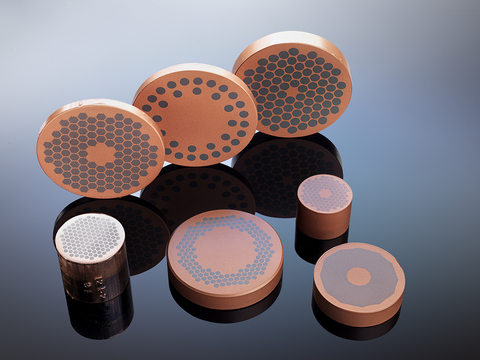
Typical niobium-titanium-copper composite superconductors suitable for MRI magnets.
The combined order value of the two agreements is approximately $500 million in expected future BEST revenues, with different agreement duration periods, with one agreement extending up to seven years. These recently concluded agreements represent expansions of previous superconductor supply framework agreements. Under the expanded agreements, BEST will deliver its high-performance superconductors, designed to meet highest MRI magnet performance and quality requirements, primarily to MRI magnet production sites in the United States and the United Kingdom, from Bruker’s resilient supply chain and superconductor manufacturing sites in Europe and the US.
Bruker’s advanced superconductors also support new helium-free MRI magnet architectures in maintaining demanding field stability and homogeneity requirements. BEST’s world-leading expertise in various LTS and HTS superconducting materials and technologies serves global markets for magnets and other superconducting devices, which are utilized in MRI, Proton Therapy, NMR and EPR spectroscopy, preclinical MRI, magnetic confinement fusion, emerging superconducting wind turbines, high-energy physics, and important other deep-tech superconductivity applications.
“Our OEM customers depend on performance-leading MRI systems that deliver state-of-the-art image quality with minimal downtime and at competitive cost of ownership,” said Burkhard Prause, the President & CEO of BEST. “The expanded agreements demonstrate the confidence of major OEM customers in our capabilities in superconductor innovation, quality, and resilient supply chains, all required to keep them at the leading edge of technology and customer satisfaction. In particular, novel helium-free magnets are a new market driver, making MRI easier to site, more cost-effective and sustainable. Our latest superconductors address exacting requirements for stability and homogeneity, while enabling consistent, high-volume manufacturing. The expanded agreements continue important partnerships and ensure stability and growth in our superconductor business in the years to come.”
About Bruker Corporation – Leader of the Post-Genomic Era (Nasdaq: BRKR)
Bruker is enabling scientists and engineers to make breakthrough post-genomic discoveries and develop new applications that improve the quality of human life. Bruker’s high-performance scientific instruments and high value analytical and diagnostic solutions enable scientists to explore life and materials at molecular, cellular, and microscopic levels. In close cooperation with customers, Bruker is enabling innovation and customer success in post-genomic life science molecular and cell biology, in disease biology and translational research, in specialty diagnostics, in applied and biopharma applications, as well as in industrial and cleantech research and QC, and in next-gen semiconductor metrology in support of AI. Bruker offers differentiated, high-value life science and diagnostics systems and solutions in preclinical imaging, clinical phenomics research, proteomics and multiomics, spatial and single-cell biology, functional structural and condensate biology, as well as in clinical microbiology, molecular diagnostics and therapeutic drug monitoring. For more information, please visit www.bruker.com.
Investor Contact:
Joe Kostka
Director, Investor Relations
Bruker Corporation
T: +1 (978) 313-5800
E: Investor.Relations@bruker.com
Media Contact:
Stefan Lang
Director, Sales & Marketing
Bruker EAS GmbH
T: +49 173 7599461
E: pr@bruker.com
Source: Bruker Corporation
Key Terms
superconductorstechnical
Materials that can carry electricity with essentially no energy loss when cooled below a certain temperature; they also push out magnetic fields, which lets them float magnets and create very strong, stable magnetic fields. For investors, superconductors matter because they can slash power losses, enable orders-of-magnitude faster or more efficient electronics and powerful magnets used in medical imaging, transport and quantum computing, but commercial value depends on cost, operating temperature and how easily the materials can be manufactured at scale.
mrimedical
Magnetic resonance imaging (MRI) is a medical scan that uses magnetic fields and radio waves to create detailed pictures of the inside of the body, like a high-resolution camera for tissues and organs. Investors care because MRI drives demand for imaging machines, hospital services, diagnostics and can be central to clinical trial results and regulatory decisions—changes in MRI use or technology can affect revenue, capital spending and reimbursement in healthcare and medical device markets.
niobium-titanium-coppertechnical
An engineered superconducting material made of niobium and titanium filaments embedded in a copper matrix, designed to carry electric current with almost no resistance when cooled to very low temperatures. Investors pay attention because it is a critical input for high-value technologies—such as MRI scanners, fusion and particle-physics magnets, and certain quantum devices—so changes in supply, production capacity or demand can materially affect the costs and revenue prospects of companies that make or use it, much like a key ingredient affects a food manufacturer's business.
proton therapymedical
A cancer treatment that uses a beam of charged particles (protons) to deliver radiation precisely to a tumor while limiting damage to surrounding healthy tissue; think of it as a GPS-guided beam that stops where the tumor is instead of blasting through everything. It matters to investors because proton therapy requires very expensive equipment, long-term facility investment and depends on clinical outcomes and insurance reimbursement to generate revenue, so advances in effectiveness, cost or access can materially affect providers' financial prospects.
nmrtechnical
NMR (nuclear magnetic resonance) is a laboratory technique that uses magnetic fields to reveal the detailed structure and composition of molecules, much like how an MRI shows images inside the body. Investors care because NMR data underpins claims about a drug’s makeup, purity, or how a molecule binds to its target, so it affects the strength of research results, regulatory filings, and product quality assurances.
epr spectroscopytechnical
EPR spectroscopy is a laboratory technique that detects and analyzes unpaired electrons in molecules or materials, revealing details about chemical structure, metal centers, free radicals, and molecular interactions. For investors, EPR results can validate scientific claims about a drug, catalyst or material—similar to a metal detector revealing hidden components—helping assess a technology’s credibility, manufacturing consistency, safety risks and likely regulatory or commercial outcomes.