
Bruker Unveils New NMR Products and Workflow Solutions at ENC 2026
Bruker (Nasdaq: BRKR) unveiled new NMR hardware, software, and automated workflows at ENC 2026 to boost sensitivity, throughput, and reproducibility across research and applied NMR.




Introductions span console electronics, quantitative NMR software, 80 MHz benchtop FT‑NMR, solid‑state and dissolution DNP, and automated protein and RNA workflows.
ASILOMAR, Calif.--(BUSINESS WIRE)-- At the Experimental Nuclear Magnetic Resonance Conference (ENC), Bruker Corporation (Nasdaq: BRKR) today announced new NMR products and workflow solutions designed to expand performance, sensitivity, and automation across research and applied NMR. The introductions span console electronics, quantitative chemistry, benchtop FT-NMR, solid-state and dissolution Dynamic Nuclear Polarization (DNP), and digital workflows that support reproducible, unattended, and data-driven automation.
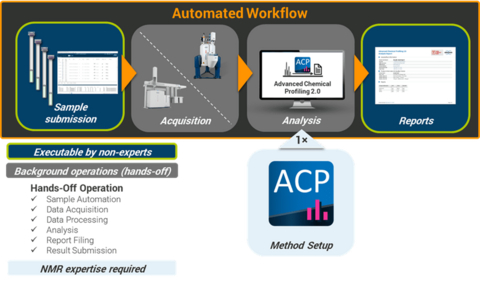
Advanced Chemical Profiling 2.0 enables fully automated workflows
The high-performance AVANCE NEO‑X NMR electronics allows laboratories to upgrade their console generation without disrupting established workflows. The AVANCE NEO‑X console supports liquids, solids, and microimaging NMR with a modular design for evolving experimental requirements.
For quantitative NMR in chemistry, small‑molecule pharmaceutical and industrial applications, the next-gen Advanced Chemical Profiling 2.0 (ACP 2.0) software delivers an automated workflow from acquisition through reporting. By reducing manual interpretation, ACP 2.0 supports accurate quantification of multicomponent spectra across Bruker benchtop and high‑field NMR systems.
The Fourier 80 Duo establishes 80 MHz as an affordable standard for labs transitioning from 60 MHz instruments. With gradient-¹H/¹³C capabilities, solvent suppression and inverse spectroscopy capabilities, the benchtop Fourier 80 Duo delivers high-quality 1D/2D FT-NMR spectra for chemistry.
Bruker is expanding its DNP portfolio with new standard‑bore DNP probes for solid‑state NMR that enable ultra‑high sensitivity on 600 and 800 MHz standard‑bore magnets, as well as on 1.0 and 1.2 GHz systems. These technologically very demanding SB-DNP probes support biosolids applications with HCN designs and extend high-field solid-state DNP for materials applications through fixed-channel configurations. Complementing these solid‑state DNP capabilities, the Dynamis dissolution DNP system enables liquids applications, which were impractical with conventional sensitivity limits. With up to 30,000x ¹³C signal enhancement and 5x–10x faster polarization, the Dynamis supports reproducible, higher‑throughput solution‑state NMR and metabolic MRI studies in catalysis or chemical kinetics.
Bruker also introduces enhanced NMR solutions for structural biology, laboratory automation, and data-driven research and analytical workflows. NMRtist provides AI‑assisted protein NMR data analysis from multidimensional peak picking through resonance assignment and structure calculation also for non-NMR-experts. The new RNA drug discovery by NMR toolkit offers access to optimized experiments, guided workflows, and resources for RNA structure, dynamics, binding studies, and RNA modification analysis, where NMR is the gold standard for solving RNA structures. In solid-state NMR, 160 kHz magic‑angle‑spinning (MAS) solutions enable high-resolution HCN studies of membrane proteins, protein aggregates, and complex biological assemblies.
The Chemspeed automation solutions support scalable and unattended NMR automation by combining standardized sample preparation, automated synthesis or sampling, and online or offline NMR analysis to increase throughput and reduce manual handling. SciY software solutions advance small-molecule data processing and lab digitalization via a vendor‑agnostic backbone that connects instrumentation, automation, and data systems to support traceable workflows, FAIR-ready data, and data-driven decision‑making across AI-assisted or AI-driven R&D or QC laboratories.
“Our ENC 2026 introductions reflect our focus on innovation with impact through NMR technologies and workflows designed to improve productivity, performance and ease-of-use in order to deliver reproducible research and applied results,” said Frank H. Laukien, PhD, President and CEO of Bruker Corporation. “These advances further increase the impact of labs generating unique, high-value NMR insights to work efficiently, automate complex tasks, and complement other methods in structural biology, molecular dynamics, bio-condensates, disordered proteins, membrane proteins and aggregates, as well as in chemistry and small molecule applied, pharma and industrial applications.”
About Bruker Corporation – Leader of the Post-Genomic Era (Nasdaq: BRKR)
Bruker is enabling scientists and engineers to make breakthrough post-genomic discoveries and develop new applications that improve the quality of human life. Bruker’s high-performance scientific instruments and high value analytical and diagnostic solutions enable scientists to explore life and materials at molecular, cellular, and microscopic levels. In close cooperation with our customers, Bruker is enabling innovation, improved productivity, and customer success in post-genomic life science molecular and cell biology research, in applied and biopharma applications, in microscopy and nanoanalysis, as well as in industrial and cleantech research, and next-gen semiconductor metrology in support of AI. Bruker offers differentiated, high-value life science and diagnostics systems and solutions in preclinical imaging, clinical phenomics research, proteomics and multiomics, spatial and single-cell biology, functional structural and condensate biology, as well as in clinical microbiology and molecular diagnostics. For more information, please visit www.bruker.com.
View source version on businesswire.com: https://www.businesswire.com/news/home/20260413061233/en/
Investor Contact:
Joe Kostka
Director - Investor Relations
Bruker Corporation
T: +1 978 313-5773
E: Investor.Relations@bruker.com
Media Contact:
Markus Ziegler
Sr. Director and Head of Group Marketing
Bruker BioSpin
T: +49 172 3733531
E: pr@bruker.com
Source: Bruker Corporation