
BorgWarner Clinches Contracts to Supply Durable, Efficient EGR Coolers to Commercial Vehicle Customer
Rhea-AI Summary
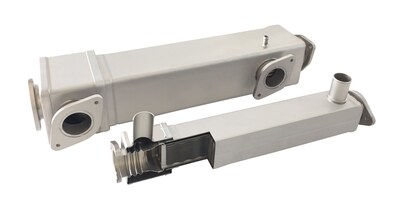
BorgWarner, a global leader in sustainable mobility solutions, has secured contracts to supply exhaust gas recirculation (EGR) coolers to a major North American commercial vehicle customer. The company will provide two variations of its durable EGR cooler, featuring proprietary compact floating core (CFC) and compact monoblock architecture. These technologies offer high reliability, extended product life, and optimized internal design requiring less coolant flow from the engine.
The contracts highlight BorgWarner's strong customer relationships and technological leadership in the market. Production is set to begin in Q4 2027, with implementation across various commercial vehicle applications. The EGR coolers support increased fuel economy needs and help meet stringent emission requirements worldwide.
Positive
- Secured contracts for EGR coolers with a major North American commercial vehicle customer
- Start of production planned for Q4 2027
- Proprietary compact floating core (CFC) architecture offers high reliability and extended product life
- Optimized internal design requires less coolant flow from the engine
- Modular EGR cooler family spans engine sizes from 2.0 to 16.0-liter displacement
- Delivered over 1 million EGR coolers to date
Negative
- None.
News Market Reaction – BWA
In the trading session that priced this news, BWA gained 8.81%, reflecting a notable positive market reaction.
Data tracked by StockTitan Argus on the day of publication.
AI-generated analysis. How Rhea-AI works. Not financial advice.




- Contracts for two different exhaust gas recirculation (EGR) coolers awarded
- Result of strong relationship development and technology leadership
- Proprietary compact floating core architecture enables high levels of reliability, extends product life
"We continue to see tremendous interest in our EGR product portfolio, including coolers, valves and modules, that support increased fuel economy needs and stringent emission requirements across the world," said Dr. Volker Weng, Vice President of BorgWarner Inc. and President and General Manager, Turbos and Thermal Technologies. "These recent program awards are a natural extension of the close working relationship our team has built with this customer and reflect BorgWarner's leadership position in the market as well as our historically strong performance with similar applications."
To support the cooling needs across different engine sizes, BorgWarner is delivering two variations of its durable EGR cooler – one with a proprietary compact floating core (CFC) architecture, and the other using a compact monoblock architecture core to better meet tighter packaging constraints. Developed by BorgWarner to handle the stresses caused by large thermal changes expected in CV engine applications, the CFC enables extended life and reliability. Additionally, by combining hybrid tube heat transfer technology that provides a high level of thermal efficiency with a floating inner core, the CFC architecture achieves a high level of durability in a compact package resulting in less thermal fatigue. Its monoblock architecture is a cost-optimized solution used for many passenger car and mid-range applications to meet target reliability.
BorgWarner's modular EGR cooler family includes four flexible designs that span engine sizes from 2.0 to 16.0-liter displacement. With the exception of the housing and mounting fixtures, the coolers allow for standardization of most of the core components, increasing ease of adapting the technology from one application to another. Since introducing the technology to the market, the company has delivered more than 1 million EGR coolers and created advanced modeling tools to optimize designs, prevent localized boiling and enhance performance.
About BorgWarner
For more than 130 years, BorgWarner has been a transformative global product leader bringing successful mobility innovation to market. With a focus on sustainability, we're helping to build a cleaner, healthier, safer future for all.
Forward-Looking Statements: This press release may contain forward-looking statements as contemplated by the 1995 Private Securities Litigation Reform Act that are based on management's current outlook, expectations, estimates and projections. Words such as "anticipates," "believes," "continues," "could," "designed," "effect," "estimates," "evaluates," "expects," "forecasts," "goal," "guidance," "initiative," "intends," "may," "outlook," "plans," "potential," "predicts," "project," "pursue," "seek," "should," "target," "when," "will," "would," and variations of such words and similar expressions are intended to identify such forward-looking statements. Further, all statements, other than statements of historical fact, contained in this press release regarding matters that we expect or anticipate will or may occur in the future regarding our financial position, business strategy and measures to implement that strategy, including changes to operations, competitive strengths, goals, expansion and growth of our business and operations, plans, references to future success and other such matters, are forward-looking statements. All forward-looking statements are based on assumptions and analyses made by us in light of our experience and our perception of historical trends, current conditions and expected future developments, as well as other factors we believe are appropriate in the circumstances. Forward-looking statements are not guarantees of performance, and the Company's actual results may differ materially from those expressed, projected, or implied in or by the forward-looking statements.
You should not place undue reliance on these forward-looking statements, which speak only as of the date of this press release. Forward-looking statements are subject to risks and uncertainties, many of which are difficult to predict and generally beyond our control, that could cause actual results to differ materially from those expressed, projected or implied in or by the forward-looking statements. These risks and uncertainties, among others, include supply disruptions impacting us or our customers, commodity availability and pricing, and an inability to achieve expected levels of recoverability in commercial negotiations with customers concerning these costs; competitive challenges from existing and new competitors, including original equipment manufacturer ("OEM") customers; the challenges associated with rapidly changing technologies, particularly as they relate to electric vehicles, and our ability to innovate in response; the difficulty in forecasting demand for electric vehicles and our electric vehicles revenue growth; potential disruptions in the global economy caused by wars or other geopolitical conflicts; the ability to identify targets and consummate acquisitions on acceptable terms; failure to realize the expected benefits of acquisitions on a timely basis; the possibility that our 2023 tax-free spin-off of our former Fuel Systems and Aftermarket segments into a separate publicly traded company will not achieve its intended benefits; the failure to promptly and effectively integrate acquired businesses; the potential for unknown or inestimable liabilities relating to the acquired businesses; our dependence on automotive and truck production, which is highly cyclical and subject to disruptions; our reliance on major OEM customers; impacts of any future strikes involving any of our OEM customers and any actions such OEM customers take in response; fluctuations in interest rates and foreign currency exchange rates; our dependence on information systems; the uncertainty of the global economic environment; the outcome of existing or any future legal proceedings, including litigation with respect to various claims, or governmental investigations, including related litigation; future changes in laws and regulations, including, by way of example, taxes and tariffs, in the countries in which we operate; impacts from any potential future acquisition or disposition transactions; and the other risks noted in reports that we file with the SEC, including Item 1A, "Risk Factors," in our most recently filed Annual Report on Form 10-K and/or Quarterly Report on Form 10-Q. We do not undertake any obligation to update or announce publicly any updates to or revisions to any of the forward-looking statements in this press release to reflect any change in our expectations or any change in events, conditions, circumstances, or assumptions underlying the statements.

 View original content to download multimedia:https://www.prnewswire.com/news-releases/borgwarner-clinches-contracts-to-supply-durable-efficient-egr-coolers-to-commercial-vehicle-customer-302210986.html
SOURCE BorgWarner