Rhea-AI Sentiment reads the wording of the document, how positive or negative its language is on a 1 to 5 scale. The balance of points shown with the takes weighs what the document actually discloses, so the two can disagree, for example when a trial that missed its main goal is described in upbeat language.
Report demonstrates how Pathward’s operating model powers financial inclusion through purposeful partnership, growth and governance.
SIOUX FALLS, S.D.--(BUSINESS WIRE)--
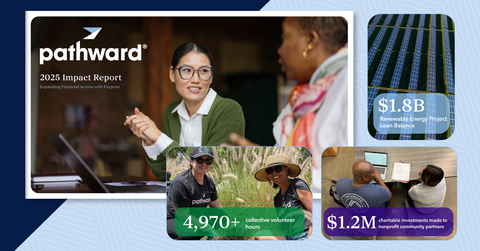
Pathward Financial, Inc. (Nasdaq: CASH) through its subsidiary, Pathward®, N.A. (“Pathward” or the “Company”), today released its 2025 Impact Report. The report highlights Pathward’s deep partner expertise in enabling inclusive banking, payments, lending and tax solutions nationwide, while making progress on the Company’s sustainability efforts.
Pathward released its 2025 Impact Report.
In fiscal year 2025, Pathward expanded financial access by supporting fintech innovators, tax professionals, small to large businesses, and renewable energy developers in markets underserved by traditional banking institutions. Leveraging its national bank charter and operating model, Pathward emphasizes choice and flexibility to enable innovative partnerships with leading fintechs to deliver preferred financial solutions to modern consumers and businesses of all sizes.
“Rooted in our purpose of powering financial inclusion, Pathward continues to anticipate and meet the changing needs of consumers and businesses,” said Pathward CEO Brett Pharr. “We are witnessing a digital transformation that is reshaping the financial services landscape. As a key player in this ecosystem, Pathward is well-positioned to drive innovation, support our partners’ growth and expand access to financial solutions that meet people and businesses where they are, in the ways they prefer.”
The report also highlights Pathward’s sustainability efforts in fiscal year 2025, reflecting positive outcomes for customers and communities alike. These include:
Environmental:
Strategic financing of renewable energy and infrastructure projects that strengthen communities and enhance grid resilience, supported by a continued commitment to transparency through rigorous data collection and assessment of the Company’s environmental footprint
Closing the fiscal year with a $1.8 billion renewable energy project loan balance
Social:
Financing more than $203 million in Small Business Administration loans
Contributing $1.2 million in charitable investments to nonprofit community partners alongside nearly 5,000 collective volunteer hours from Pathward employees
Driving strong employee engagement with 84% of employees surveyed identifying Pathward as a “Great Place to Work,” outperforming the average large U.S.-based company by 27 points
Governance:
Upholding governance practices anchored by board oversight, disciplined risk management, and a consultative compliance approach
Maintaining strong, transparent corporate governance and ethical business practices to facilitate long-term, sustainable growth
“At Pathward, expanding financial access is realized through partnerships that help us meet market needs and glean insights about how to create a more inclusive financial system,” said Pathward Senior Vice President of Communications, Sustainability and Public Policy, Catherine McGlown. “We see the impact of our approach reflected in our partnerships, innovation and the ways we serve our customers. We remain steadfast in turning purpose into practice by expanding access to the financial system and unlocking opportunity for those we serve.”
View Pathward’s 2025 Impact Report on Pathward.com.
About Pathward Financial, Inc.
Pathward Financial, Inc. (Nasdaq: CASH) is a U.S.-based financial holding company driven by its purpose to power financial inclusion. Through our subsidiary, Pathward®, N.A., we strive to increase financial availability, choice and opportunity across our Partner Solutions and Commercial Finance business lines. These strategic business lines provide support to individuals and businesses. Learn more at www.pathwardfinancial.com.
Sources of power that come from naturally replenishing resources—such as sunlight, wind, flowing water, and geothermal heat—rather than fuels that can run out. Investors care because renewable energy can reduce long-term fuel costs, lower regulatory and climate risk, and create growing markets for technology and infrastructure; think of it like putting money into a well that refills itself rather than a one-time fuel tank, offering steadier long-term returns and different risk profiles.
national bank charterregulatory
A national bank charter is a federal license that allows a bank to operate under national rules, take deposits, make loans, and participate in payment systems across the country. Think of it as a nationwide driver’s license for a bank: it sets the standards the bank must follow and places it under federal supervision, which matters to investors because it affects safety, growth opportunities, and regulatory costs that influence the bank’s value.
Small Business Administration loansfinancial
Small Business Administration (SBA) loans are loans made by banks or other lenders but guaranteed in part by the U.S. government to help small companies get financing they might not otherwise receive. Think of the guarantee as a safety net that encourages lenders to lend to smaller, riskier firms; for investors, widespread use of SBA loans signals easier access to capital, potentially stronger small-business survival and growth, and lower lender loss risk on those specific loans.
SCHEDULE 13Gregulatory
A Schedule 13G is a formal document that investors file with the government when they acquire a large ownership stake in a company, usually for investment purposes rather than control. It helps keep the public informed about who owns significant parts of a company's shares, which can influence how the company is managed and how investors make decisions. Filing this schedule is important for transparency and understanding the ownership landscape of publicly traded companies.
SCHEDULE 13G/Aregulatory
A Schedule 13G/A is an amended public filing with the U.S. securities regulator that updates a previous Schedule 13G, disclosing when an individual or group holds a substantial (typically over 5%) stake in a company and is claiming a passive, non‑controlling intent. Investors monitor these updates because rising or falling holdings can signal changing confidence, potential future moves, or shifts in voting power — like watching a public ledger where large shareholders quietly adjust their positions.
8-Kregulatory
An 8-K is a public report companies must file with the U.S. Securities and Exchange Commission to disclose major events or changes that shareholders should know about, such as leadership changes, mergers, financial surprises, or legal developments. It matters to investors because it acts like a breaking-news alert for a company’s health and prospects—providing timely facts that can affect stock value and investment decisions.
Form 4 is a official document that company insiders, such as executives or major shareholders, file with regulators whenever they buy or sell company shares. It provides transparency about how those with inside knowledge are trading, helping investors see if insiders are confident in the company's prospects or may be selling for personal reasons. This information can influence investor decisions by revealing insiders' perspectives on the company's value.
An omnibus incentive plan is a single, flexible program a company uses to give employees and executives different types of pay tied to performance — for example stock options, restricted shares, cash bonuses and other awards — all governed by one set of rules. It matters to investors because it determines how many new shares may be created, how leaders are motivated and how much the company will spend on compensation over time; think of it as a master toolbox that affects both costs and the total share supply.