
Chesapeake Mobilizes a Drill Program at Lucy
Discovery drilling is designed to reach the density needed for a maiden mineral resource estimate.
Sentiment and the balance of points
Rhea-AI Sentiment reads the wording of the document, how positive or negative its language is on a 1 to 5 scale. The balance of points shown with the takes weighs what the document actually discloses, so the two can disagree, for example when a trial that missed its main goal is described in upbeat language.
Rhea-AI Summary
Chesapeake Gold (CHPGF) has begun a fully funded 5,000-metre drilling program at its Lucy gold project in Sinaloa, Mexico. Surface sampling expanded the prospective mineralized footprint from a 700-metre Discovery corridor to 2,000 metres, identifying two distinct corridors whose connection remains undetermined.
The program allocates approximately 2,000 metres to Discovery, with drilling designed to support a first mineral resource estimate, and another 3,000 metres to new targets. These include the Central Zone and geophysical anomalies at Discovery and Western, testing a possible porphyry source for mineralization. Central Corridor trench and channel sampling returned 17.5 metres grading 0.87 grams per tonne gold, with silver, copper and zinc also reported. Discovery trenching returned 40.5 metres grading 0.22 grams per tonne gold. The company expects first drilling assays in Q1 2027, with results released in batches as received.
Positive
- Minor pointLucy’s fully funded 5,000-metre core drilling program has begun with one rig.
- Minor pointSurface sampling expanded the prospective mineralized footprint from 700 metres to 2,000 metres.
- Minor pointCentral sampling returned 17.5 metres at 0.87 g/t gold, 27 g/t silver, 0.20% copper and 1.16% zinc.
- Minor pointThat Central interval includes 7.5 metres at 1.97 g/t gold, 57 g/t silver, 0.42% copper and 2.44% zinc.
- Minor pointDiscovery trenching returned 40.5 metres at 0.22 g/t gold, including 2.5 metres at 1.49 g/t and 1.5 metres at 1.39 g/t.
5 minor points
- Minor point. Forward-looking: it has not happened yet and may not happen.Discovery drilling plans approximately 2,000 metres in 25 holes, designed to support a maiden mineral resource estimate.
- Minor point. Forward-looking: it has not happened yet and may not happen.Discovery step-outs of up to 100 metres along strike and below 150 metres depth will test open mineralization.
- Minor point. Forward-looking: it has not happened yet and may not happen.Central Zone drilling plans eight holes totaling approximately 800 metres to test a potential second mineralized corridor.
- Minor point. Forward-looking: it has not happened yet and may not happen.Discovery and Western drilling plans 6 holes totaling 2,200 metres to evaluate a possible porphyry source.
- Minor point. Forward-looking: it has not happened yet and may not happen.First drilling assays are expected in Q1 2027, with results released in batches as received.
Negative
- Minor pointThe connection between the two mineralized corridors remains undetermined and requires further work.
AI-generated analysis. How Rhea-AI works. Not financial advice.


Vancouver, British Columbia--(Newsfile Corp. - November 2, 2026) - Chesapeake Gold Corp. (TSXV: CKG) (OTCQX: CHPGF) ("Chesapeake" or the "Company") is pleased to announce the property-wide soil geochemistry program has expanded the surface mineralized footprint at its Lucy Project ("Lucy") located in central Sinaloa, Mexico. To date, over 1,000 surface soil and rock geochemistry samples were collected from the Discovery, Central and Western zones. A 5,000 metre in-fill and expansion drill program has been mobilized to test the multiple targets recently identified.
Jean-Paul Tsotsos, Chief Executive Officer, commented, "The systematic and detailed exploration at Lucy has delivered promising results, highlighting the growing scale of this exciting gold project. The first drill rig has been mobilized to expand the Discovery Corridor's mineralization, define mineralization in the Central Corridor, and test prospective underlying IP anomalies on the property."
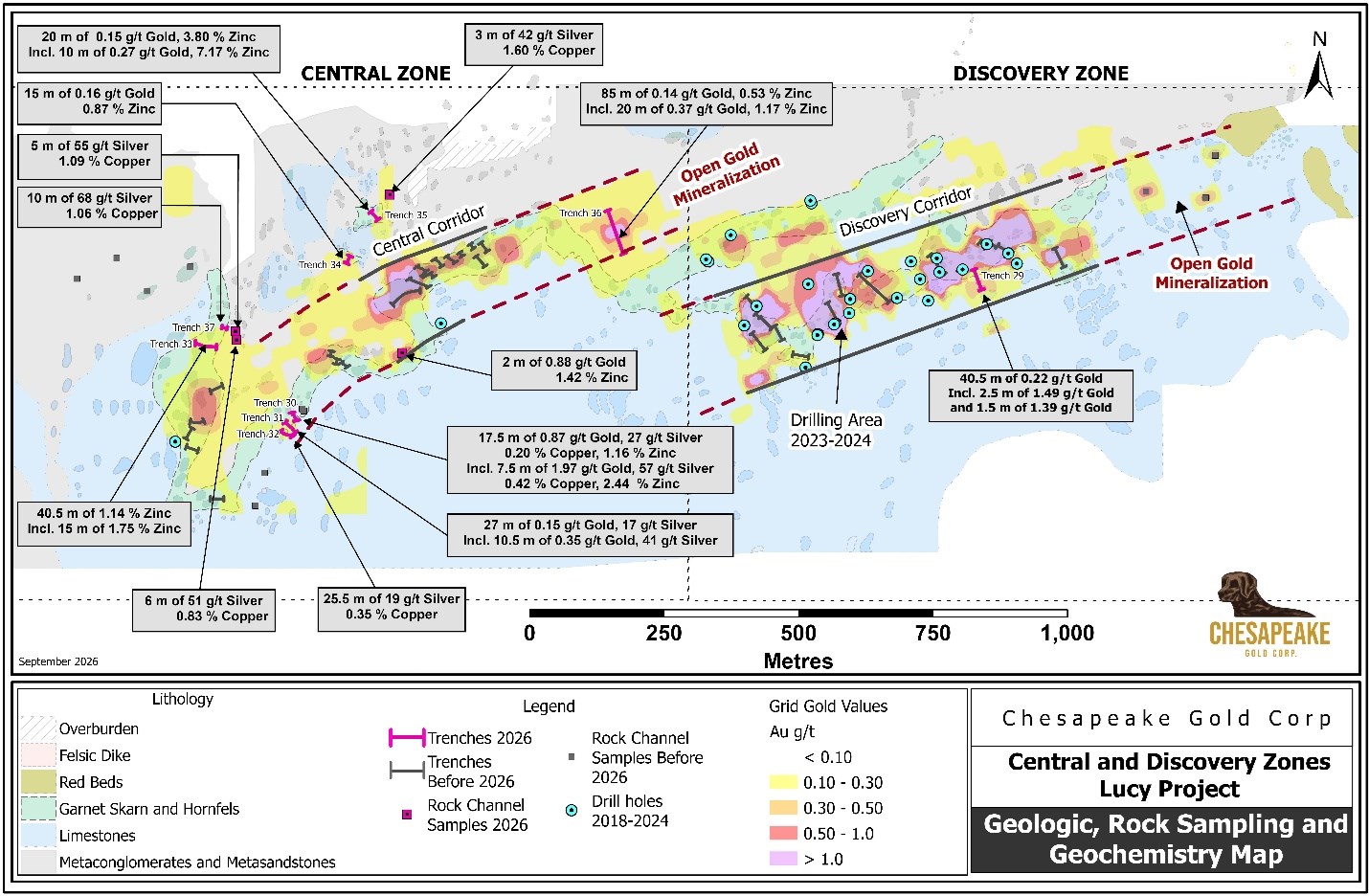
Figure 1: Lucy Exploration Map
To view an enhanced version of this graphic, please visit:
https://images.newsfilecorp.com/files/752/321977_d015050d343d0844_002full.jpg
This year, 622 surface soil and rock geochemistry samples were collected from the Discovery and Central zones. The program extended the prospective Lucy gold mineralization from a 700 metre Discovery corridor to a 2,000 metre surface mineralized footprint. This campaign identified two distinct en echelon mineralized corridors, and further work will determine whether they are connected.
During the soil geochemistry campaign, new trenches and rock channel samples returned 17.5 metres of 0.87g/t gold, 27 g/t silver,
The fully funded 5,000-metre HQ core drill program at Lucy has begun with one rig, with first assays expected in Q1 2027 and results released in batches as received. Approximately 2,000 metres in 25 holes will focus on the Discovery Corridor. Infill drilling at 50-metre spacing will test the 700-metre mineralized strike, and step-outs of up to 100 metres along strike and below 150 metres depth will test where mineralization remains open. Prior intercepts include 6.11 g/t Au over 24 m (LU23-06) (see Chesapeake news release dated October 3, 2023). This drilling in the Discovery Corridor is designed to reach the density needed to support a maiden mineral resource estimate.
An additional 3,000 metres will test new targets. Eight holes totaling approximately 800 metres will drill test the Central Zone, located 600 metres northwest of the Discovery Corridor, defined by gold-in-soil anomalies over 1,000 metres and rock channel samples up to 1.33 g/t gold (see Chesapeake news release dated September 9, 2025). These holes will determine the potential of a second mineralized corridor. Finally, 6 holes totaling 2,200 metres will test two IP-resistivity, chargeability and magnetic anomalies at the Discovery and Western zones to evaluate the possibility of a porphyry source for the skarn mineralization.
The complete assay data table and enlarged revised Lucy exploration map (Figure 1) are available here.
For Further Information:
For more information on Chesapeake's Metates and Lucy projects and its proprietary heap oxidation technology, please visit our website at www.chesapeakegold.com or contact Jean-Paul Tsotsos at invest@chesapeakegold.com or +1 778 731 1362.
Neither TSX Venture Exchange nor its Regulation Services Provider (as that term is defined in policies of the TSX Venture Exchange) accepts responsibility for the adequacy or accuracy of this news release.
Sample Preparation, Analysis and QA/QC Program
All the assays reported by Chesapeake in this news release are from rock channel and soil samples. The rock samples were sent to the ALS Global facility in Zacatecas City, Mexico, for preparation of assay pulps, which were subsequently sent to ALS labs in Vancouver, Canada, for analysis.
All rock samples were prepared using a method whereby the entire sample was crushed to
Samples were analyzed for gold using 30 or 50 g fire assay fusion with an ICP finish (Method Au-ICP22). Silver and other elements were analyzed by 4-acid digestion with an ICP finish (Method ME-ICP61). Gold (>5 ppm) and silver (>100 ppm) over-limits were analyzed by fire assay with a gravimetric finish.
The soil samples were also sent to the ALS Global facility in Zacatecas, where they were prepared using package SCR-41. After drying and sieving to 80 mesh (-180 micron), 50 g samples were analyzed at ALS Labs in Vancouver using the AuME-TL-44 method, which consists of aqua regia digestion and ME-ICP finish for gold and 50 elements.
Certified standards and blanks from CDN Resource Laboratories were inserted into the sample stream as part of the sampling protocol for the QA/QC program.
Qualified Persons
Alberto Galicia, P.Geo, Vice President Exploration and Gary Parkison, CPG, Vice President Development, are Qualified Persons as defined by NI43-101 and have reviewed and approved the technical information in this news release.
About Chesapeake
Chesapeake Gold Corp's flagship asset is the Metates Project ("Metates") located in Durango State, Mexico. Metates hosts one of the largest undeveloped gold-silver deposits in the Americas1 with over 16.77 million ounces of gold at 0.57 grams per tonne (g/t) and 423.2 million ounces of silver at 14.3 g/t within 921.2 million tonnes in the Measured and Indicated Mineral Resource category and a further 2.13 million ounces of gold at 0.47 g/t and 59.0 million ounces of silver at 13.2 g/t within 139.5 million tonnes in the Inferred Mineral Resource category. See the technical report titled "Metates Sulphide Heap Leach Project Phase I" dated January 13, 2023, and news release dated February 22, 2023.
Forward-Looking Statements
This news release contains "forward-looking statements" within the meaning of Canadian securities legislation. Such forward-looking statements include, without limitation, statements with respect to strategic plans, timing and expectations for the Company's exploration and drilling programs at the Company's Lucy project, estimates of mineralization from drilling, geological information projected from sampling results and the potential quantities and grades of the target zones.
Such forward-looking statements or information are based on a number of assumptions, which may prove to be incorrect. Assumptions have been made regarding, among other things: conditions in general economic and financial markets; the price of gold and silver; the availability and costs of mining equipment and skilled labour; accuracy of assay results; geological interpretations from drilling results, timing and amount of capital expenditures related to drilling programs; performance of available laboratory and other related services; future operating costs; and the historical basis for current estimates of potential quantities and grades of target zones.
The actual results could differ materially from those anticipated in these forward looking statements as a result of risk factors, including the timing and content of work programs; results of exploration activities and development of mineral properties; ongoing security concerns and potential operational disruptions due to regional violence; the interpretation and uncertainties of drilling and testing results and other geological data; receipt, maintenance and security of permits and mineral property titles; environmental and other regulatory risks; project costs overruns or unanticipated costs and expenses; availability of funds; failure to delineate potential quantities and grades of the target zones based on historical data, and general market and industry conditions.
Forward-looking statements are based on the expectations and opinions of the Company's management on the date the statements are made. The assumptions used in the preparation of such statements, although considered reasonable at the time of preparation, may prove to be imprecise and, as such, readers are cautioned not to place undue reliance on these forward-looking statements, which speak only as of the date the statements were made. The Company undertakes no obligation to update or revise any forward-looking statements included in this news release if these beliefs, estimates and opinions or other circumstances should change, except as otherwise required by applicable law.
1 Mexico's biggest undeveloped gold deposits. Bnamericas. Published Tuesday, November 24, 2020.
To view the source version of this press release, please visit https://www.newsfilecorp.com/release/321977
FAQ
AI-generated questions and answers. How Rhea-AI works. Not financial advice.
What does Chesapeake Gold’s Lucy drilling program cover?
The 5,000-metre program covers Discovery infill and expansion drilling, Central Zone targets, and geophysical anomalies at Discovery and Western. Approximately 2,000 metres in 25 holes will focus on Discovery; another 3,000 metres will test new targets.
When does Chesapeake Gold expect the first Lucy drilling results?
Chesapeake expects the first drilling assays in Q1 2027. Results will be released in batches as received.
What spacing will Chesapeake Gold use for Lucy Discovery infill drilling?
Discovery infill drilling will use 50-metre spacing to test the 700-metre mineralized strike. Step-outs of up to 100 metres along strike and below 150 metres depth will test where mineralization remains open.