
Credo Introduces Cardinal: A Low‑Power 1.6T Optical DSP Family Engineered for Massive‑Scale AI Fabrics
Credo (NASDAQ: CRDO) introduced Cardinal, a 3nm family of low-power 1.6T optical DSPs designed for massive AI fabrics.
Sentiment and the balance of points
Rhea-AI Sentiment reads the wording of the document, how positive or negative its language is on a 1 to 5 scale. The balance of points shown with the takes weighs what the document actually discloses, so the two can disagree, for example when a trial that missed its main goal is described in upbeat language.




Features World-Class Energy Efficiency in a Highly Integrated Design
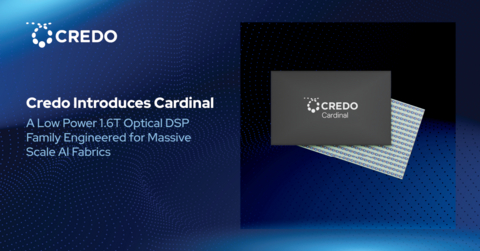
Credo's Cardinal 1.6T optical DSP family addresses the bandwidth, scale, and power requirements of massive AI clusters with a proven low‑power architecture, superior latency with the flexibility to support both retimed 1.6T optics, and ultra‑efficient linear‑receive implementations.
News Highlights:
- Credo has announced its second generation of 1.6T optical DSP family for addressing the bandwidth, scale, and power requirements of massive AI clusters.
- The Cardinal family of devices includes low-power, high-swing integrated EML and silicon photonics drivers.
- The Cardinal family consists of dedicated DSPs for full-retimed and linear receive optics (LRO) applications.
AI compute clusters are pushing the limits of network infrastructure, with high‑radix switches, dense GPU topologies, and massive east‑west traffic patterns. These environments demand optics that deliver maximum bandwidth per watt, extremely low bit error rates, and robust monitoring for uptime and serviceability. Cardinal delivers on each of these fronts enabling 1.6T transceivers with a comprehensive link monitoring toolkit while consuming less than 15W in LRO implementations.
“AI fabrics have shifted the center of gravity for optical design, and Cardinal was developed from day one with those unique requirements in mind,” said Chris Collins, AVP of Sales & Optical Product Marketing at Credo. “By combining a proven low‑power architecture, superior latency with the flexibility to support both retimed 1.6T optics, and ultra‑efficient linear‑receive implementations, Cardinal gives our customers the exact tools they need to scale their AI infrastructure.”
“Credo’s LRO solution in the Cardinal family will be a critical enabler for our teams to deliver ultra-low power optical solutions designed for rack-scale AI infrastructure,” said Jason Wildt, VP/GM, Photonics at Jabil, a global engineering, supply chain, and manufacturing solutions provider. “The power savings and associated thermal benefits are exactly what is needed for high‑density GPU clusters. Cardinal’s LRO option will provide our customers a solution that allows them to pack more performance into their power footprint.”
Key Features of the Cardinal DSP Family for AI Fabrics
- Proven seventh generation DSP architecture
- Dedicated 224G/lane solutions for full retimed and linear receive optics (LRO) applications
- Integrated high‑swing laser drivers for both EML and silicon photonics
- Advanced diagnostics and predictive monitoring for high‑uptime AI fabrics
- Ultra-low latency below 40 ns per direction
To learn more about the Credo products in this release, go to the product pages linked here.
Product Availability
Credo is now sampling the Cardinal DSP family to lead customers.
About Credo
Credo’s mission is to transform connectivity at scale through fast, reliable, and energy-efficient system solutions. Our high-speed copper and optical interconnect products deliver industry-leading power and performance at up to 1.6T to meet the ever-expanding data infrastructure demands of AI.
Our product portfolio includes ZeroFlap (ZF) Active Electrical Cables (AECs) and ZF optical transceivers, OmniConnect memory solutions, and a suite of retimers and DSPs for optical and copper Ethernet and PCIe, all leveraging the PILOT diagnostic and analytics software platform. Credo innovations enable our customers to connect the systems that connect the world.
For more information, please visit https://www.credosemi.com. Follow Credo on LinkedIn.
Credo and the Credo logo are registered trademarks of Credo Technology Group Limited in
View source version on businesswire.com: https://www.businesswire.com/news/home/20260317077875/en/
Media Contact:
Kristin Hehir
kristin.hehir@credosemi.com
Investor Contact:
Dan O’Neil
dan.oneil@credosemi.com
Source: Credo