
Defense Metals Resource Upgrade Drilling Intersects 2.33% TREO over 153 Metres at the Wicheeda Rare Earth Project
Western pit-wall drilling exceeded predicted grades in six of seven holes, while southern-area assays averaged 76% of predictions.
Sentiment and the balance of points
Rhea-AI Sentiment reads the wording of the document, how positive or negative its language is on a 1 to 5 scale. The balance of points shown with the takes weighs what the document actually discloses, so the two can disagree, for example when a trial that missed its main goal is described in upbeat language.
Rhea-AI Summary
Defense Metals (DFMTF) reported final Wicheeda drilling assays, including an interval grading 2.33% total rare earth oxides over 153.2 metres. The results cover ten spring 2026 core holes totalling 1,702 metres at its wholly owned project near Prince George, Canada. Hole WI26-104 delivered the campaign's highest grade-times-width intercept, with assays 34% above predicted inferred-resource block model grades.
Across 19 resource-upgrade holes totalling 2,887 metres, assays averaged 87% of predicted grades. Southern-area assays averaged 76% of predictions, reflecting a local 20-metre northward shift in the mineralized contact. Along the western pit wall, six of seven holes exceeded predictions, with an average increase of 24%. Defense Metals plans to update its geological and resource models to quantify potential changes to the mineral resource estimate; the assay comparisons themselves are not a resource estimate.
How this balance works
Rhea-AI gives every point it takes from this document a weight. Minor counts 1, Moderate 3 and Major 9, so one Major point outweighs several Minor ones. The bar adds up the weights on each side, and when neither side holds more than 65% of the total the balance reads Mixed.
It reads the document as published, with the same rules for every company, and it does not look at what the market expected or at how the stock traded, so a point can be objectively good on a day the stock falls.
Rhea-AI Sentiment measures something else, the tone of the wording.
Hollow bars mark forward-looking points. How the balance works
Positive
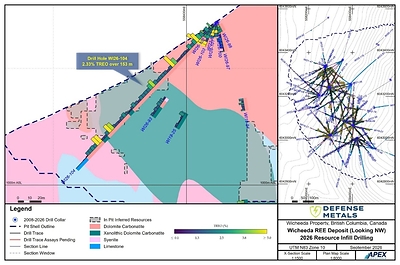
- Minor pointWI26-104 intersected 2.33% TREO over 153.2 metres, with assays 34% above predicted inferred block model grades.
- Minor pointWestern pit-wall assays exceeded predicted grades in six of seven holes, with an average increase of 24%.
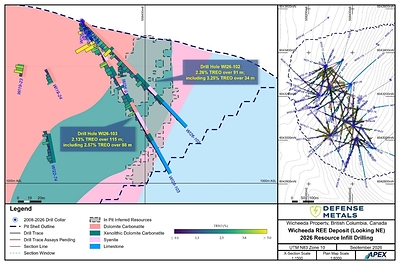
- Minor pointWI26-102 returned 2.26% TREO over 91.4 metres, including 3.25% over 34.3 metres.
- Minor pointWI26-103 returned 2.13% TREO over 115.5 metres, including 2.57% over 87.65 metres.
- Minor pointWI26-111 returned 1.89% TREO over 122.55 metres along the western deposit margin.
8 minor points
- Minor pointWI26-110 returned 1.21% TREO over 182.1 metres, including 2.10% over 54 metres.
- Minor pointWI26-109 returned 1.00% TREO over 134.4 metres, including 1.51% over 66.8 metres.
- Minor pointWI26-107 returned 1.43% TREO over 105 metres, including 1.73% over 54 metres.
- Minor pointWI26-106 returned 1.40% TREO over 66 metres, including 1.84% over 33 metres.
- Minor pointWI26-105 returned 1.29% TREO over 84.4 metres, including 1.77% over 36.5 metres.
- Minor pointWI26-108 returned 1.24% TREO over 67.2 metres, including 2.11% over 26.1 metres.
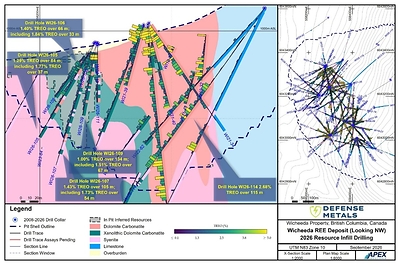
- Minor pointReference-core hole WI26-114 returned 2.68% TREO over 114.7 metres, predominantly through measured-category resource blocks.
- Minor point. Forward-looking: it has not happened yet and may not happen.Defense Metals plans geological and resource model updates to quantify potential mineral resource estimate changes.
Negative
- Moderate pointAssays across 19 resource-upgrade holes totalling 2,887 metres averaged 87% of predicted inferred block model grades.
- Minor pointSouthern-area assays averaged 76% of predicted grades, reflecting a local 20-metre northward mineralized-contact shift.
- Minor pointDrill-assay comparisons with predicted block model grades do not represent a mineral resource estimate.
AI-generated analysis. How Rhea-AI works. Not financial advice.




Robin Jones, Defense Metals VP Projects, commented: "We're exceptionally pleased that all ten drill holes reported in today's news release intersected significant widths of high to moderate grade Rare Earth Element mineralization within the pit confines defined by the 2025 Preliminary Feasibility Study (PFS) and are expected to contribute positively to a resource classification uplift."
The resource infill drilling was designed to upgrade a significant tonnage of inferred resources, constrained within the limits of the current Wicheeda Project Preliminary-Feasibility Study ("PFS") ultimate pit design, to an indicated or better category (see Defense Metals news release dated February 18, 2025). With the receipt of final 2026 resource upgrade drilling assays presented in this news release the Company intends to update its geological and mineral resource block models to quantify the potential changes to Wicheeda Project mineral resource estimate (MRE) because of this new drilling.
Highlights of the 2026 Wicheeda Deposit inferred resource upgrade drilling:
- Of the 19 inferred resource upgrade drill holes totalling 2,887 m drill assays on average were
87% of predicted inferred block model grades - Drill hole WI26-104, which returned the highest-grade x width intercept of the 2026 drill campaign and yielded drill assays
34% higher than predicted inferred block model grades along the southern pit wall - In the western pit wall area 6 of 7 drill holes returned assays that exceeded predicted inferred block model grades with an average increase of
24% suggesting further opportunities for both resource upgrading and expansion in this area with additional drilling
Details of Resource Upgrade Effectiveness
Of the 19 inferred resource upgrade drill holes totalling 2,887 m drill assays on average were
Within the western pit wall area 6 of 7 drill holes returned assays that exceeded predicted inferred block model grades with an average increase of
Within the southern pit area drill holes returned somewhat lower assays,
|
_____________________________ |
|
1 The resource upgrade effectiveness compares actual drilled assay intervals to PFS within pit inferred mineral resource estimate (MRE) block model grades along the drill trace. Drill assay to block model comparisons are presented for reference purposes only and do not represent an MRE. |
Drill Hole Assay Details
The resource upgrade drill holes targeted two specific areas hosting the majority of in pit inferred resources. The results released today include two holes totalling 322 metres targeting the southern PFS ultimate pit wall; in addition to eight holes totalling 1,380 metres along the western pit wall (in addition remaining assay results for WI26-102 see Defense Metals Corp. News release dated August 31, 2026).
South pit wall drill hole highlights include:
Drill holes WI26-102 and WI26-103, drilling outward from inside the Wicheeda Deposit. WI26-102 collared into REE mineralized dolomite carbonatite yielded a higher-grade intercept returning
Drill hole WI26-104 drilling to the southwest and cutting obliquely across the southern margin of the Wicheeda Deposit yielded the most significant grade x width intercept of the entire resource upgrade campaign intersecting a broad interval of mineralized dolomite carbonatite from surface returning
West pit wall highlights include:
West pit wall resource upgrade drilling targeted inferred resources via a fan of seven drill holes collared from a single setup along southwest to northwest azimuths. Drill holes WI26-105 through WI26-111 all intersected mineralized mixed dolomite carbonatite, xenolithic dolomite carbonatite and syenite intervals beneath variable overburden at low elevation along western margin of the Wicheeda Deposit (Figure 3).
A complete list of significant intercepts is presented in Table 1 below; with notable highlights including:
- WI26-109 returning
1.51% TREO over 66.8 m; within a broader interval grading1.00% TREO over 134.4 m; - WI26-110 grading
2.10% TREO over 54 m, within a broader interval averaging1.21% TREO over 182.1 m; - WI26-111 cutting
1.89% TREO over 122.55 m
Table 1. Wicheeda REE Deposit 2026 Final Diamond Drill Intercepts2
|
Hole ID |
From |
To (m) |
Interval |
TREO3 |
Ce2O3 |
La2O3 |
Nd2O3 |
Pr2O3 |
Sm2O3 |
Gd2O3 |
Eu2O3 |
Dy2O3 |
Tb4O7 |
Ho2O3 |
|
WI26-102 |
5.7 |
97.1 |
91.4 |
2.26 |
1.11 |
0.73 |
0.28 |
0.09 |
309 |
152 |
65 |
43 |
13 |
5 |
|
including |
5.7 |
40.0 |
34.3 |
3.25 |
1.58 |
1.10 |
0.36 |
0.13 |
390 |
187 |
82 |
51 |
16 |
6 |
|
WI26-103 |
2.5 |
118 |
115.5 |
2.13 |
1.03 |
0.68 |
0.26 |
0.09 |
324 |
157 |
70 |
40 |
13 |
5 |
|
including |
2.5 |
90.15 |
87.65 |
2.57 |
1.25 |
0.84 |
0.31 |
0.11 |
380 |
181 |
81 |
41 |
15 |
4 |
|
WI26-104 |
3.8 |
157 |
153.2 |
2.33 |
1.13 |
0.78 |
0.27 |
0.10 |
294 |
136 |
63 |
36 |
12 |
4 |
|
WI26-105 |
14.6 |
99 |
84.4 |
1.29 |
0.63 |
0.41 |
0.16 |
0.05 |
184 |
95 |
42 |
39 |
10 |
6 |
|
including |
34 |
70.5 |
36.5 |
1.77 |
0.87 |
0.57 |
0.21 |
0.08 |
238 |
120 |
52 |
46 |
13 |
6 |
|
WI26-106 |
20 |
86 |
66 |
1.40 |
0.69 |
0.44 |
0.17 |
0.06 |
189 |
96 |
42 |
36 |
10 |
5 |
|
including |
20 |
53 |
33 |
1.84 |
0.92 |
0.60 |
0.21 |
0.08 |
229 |
112 |
50 |
35 |
11 |
5 |
|
WI26-107 |
10 |
115 |
105 |
1.43 |
0.70 |
0.46 |
0.18 |
0.06 |
199 |
99 |
43 |
31 |
9 |
4 |
|
including |
10 |
64 |
54 |
1.73 |
0.85 |
0.57 |
0.21 |
0.07 |
227 |
109 |
49 |
29 |
9 |
3 |
|
WI26-108 |
33.8 |
101 |
67.2 |
1.24 |
0.60 |
0.38 |
0.16 |
0.05 |
192 |
115 |
48 |
61 |
14 |
9 |
|
including |
33.8 |
59.9 |
26.1 |
2.11 |
1.02 |
0.67 |
0.26 |
0.09 |
304 |
181 |
74 |
93 |
22 |
14 |
|
WI26-109 |
11.2 |
145.6 |
134.4 |
1.00 |
0.49 |
0.31 |
0.13 |
0.04 |
155 |
81 |
35 |
30 |
8 |
4 |
|
including |
11.2 |
78 |
66.8 |
1.51 |
0.74 |
0.48 |
0.19 |
0.06 |
222 |
111 |
50 |
35 |
10 |
5 |
|
WI26-110 |
33 |
215.1 |
182.1 |
1.21 |
0.59 |
0.37 |
0.16 |
0.05 |
192 |
96 |
43 |
36 |
10 |
5 |
|
including |
33 |
87 |
54 |
2.10 |
1.02 |
0.66 |
0.27 |
0.09 |
302 |
141 |
65 |
48 |
13 |
6 |
|
WI26-111 |
11.45 |
134 |
122.55 |
1.89 |
0.92 |
0.62 |
0.23 |
0.08 |
250 |
120 |
51 |
37 |
11 |
5 |
|
WI26-114 |
111 |
225.7 |
114.7 |
2.68 |
1.30 |
0.90 |
0.31 |
0.11 |
315 |
134 |
56 |
27 |
10 |
3 |
|
_______________________________ |
|
2The true width of REE mineralization is estimated to be 70 |
|
3TREO % sum of CeO2, La2O3, Nd2O3, Pr6O11, Sm2O3, Eu2O3, Gd2O3, Tb4O7, Dy2O3 and Ho2O3. |
Hole WI26-114 which drilled southwest across the northern Wicheeda Deposit cutting predominantly measured category resource blocks and was designed to provide additional reference mineralized dolomite carbonatite drill core. WI26-114 intersected a 117 m interval of continuously mineralized dolomite carbonatite grading
The 2026 Wicheeda Project drill program comprised 31 core drill holes totalling 5,345 m inclusive of:
- 20 holes (3,136 m) of resource upgrade and infill drilling (includes hole WI26-114)
- 7 holes (1,507 m) pit slope geotechnical drilling
- 4 holes (702 m) waste rock geochemical drilling
Methodology and Quality Assurance/Quality Control
The analytical work reported on herein was performed by ALS Canada Ltd. ("ALS") at their
Drill hole assay and inferred block model grades were compared by flagging drill database assay intervals and inferred resource blocks along the trace of each drill hole. The drilled length, number of samples and assay results were then compared to the predicted block model grades as TREO and individual REE on a grade x width basis to generate percentage increase or decrease.
Qualified Person
The scientific and technical information contained in this news release as it relates to the Wicheeda Project has been reviewed and approved by Kristopher J. Raffle, P.Geo. (B.C.), Principal and Consultant of APEX Geoscience Ltd. of
About Defense Metals Corp. and the Wicheeda Rare Earth Element Project
Defense Metals Corp. is an advanced rare earth elements ("REE") development company focused on delivering strategically critical metals to the western world defence, high-technology, and clean energy supply chains. The Company's primary asset is its
The Wicheeda Project is one of the most advanced, undeveloped REE deposits in North America or Europe, featuring a robust mineral resource and mining reserve, as detailed in the Company's 2025 Preliminary Feasibility Study ("PFS"; refer to Company News Release April 7th, 2025) prepared in accordance with National Instrument 43-101 Standards of Disclosure for Mineral Projects. The PFS shows the economic potential of the deposit and supports future project development.
Defense Metals is committed to advancing the Wicheeda Project through the Feasibility Study stage, permitting, and ultimately into production, positioning the Company to become a reliable supplier of critical REEs that are essential to modern defence systems, advanced manufacturing, and energy-efficient technologies.
The PFS for the Wicheeda Rare Earth Element Project is preliminary in nature and includes numerous assumptions regarding metallurgy, capital and operating costs, and market conditions. Mineral reserves and the economic outcomes, as projected in the PFS, are subject to significant uncertainties, and there is no certainty that the results of the PFS will be realized. Additional studies, including a Feasibility Study, and permitting, are required before a production decision can be made for the Wicheeda Project.
For further information, please visit www.defensemetals.com or contact:
Ali Mahdavi
SVP Corporate Development
Email: am@spinnakercmi.com
+1.416.962.3300
Mark Tory
President and CEO
Email: mark@defensemetals.com
Neither the TSXV nor its Regulation Services Provider (as that term is defined in the policies of the TSXV) accepts responsibility for the adequacy or accuracy of this news release.
Cautionary Statement Regarding "Forward-Looking" Information
This news release contains "forward‐looking information or statements" within the meaning of applicable securities laws, which may include, without limitation, any statements (expressed or implied) relating to: advancing the Wicheeda Project and the proposed debt settlement. Forward-looking statements are typically identified by words such as "plan," "believe," "expect," "anticipate," "intend," "outlook," "estimate," "forecast," "project," "continue," "could," "may," "might," "possible," "potential," "predict," "should," "would" and other similar words and expressions, but the absence of these words does not mean that a statement is not forward-looking. All statements in this news release, other than statements of historical facts, that address events, contribution or developments that the Company expects to occur, are forward-looking statements. Although the Company believes the expectations expressed in such forward-looking statements are based on reasonable assumptions, such statements are not guarantees of future performance and actual results may differ materially from those in the forward-looking statements. Such statements and information are based on numerous assumptions regarding present and future business strategies and the environment in which the Company will operate in the future, including the price of rare earth elements, the anticipated costs and expenditures, the ability to achieve its goals, that general business and economic conditions will not change in a material adverse manner, that financing will be available if and when needed and on reasonable terms. Such forward-looking information reflects the Company's views with respect to future events and is subject to risks, uncertainties and assumptions, including the risks and uncertainties relating to the interpretation of exploration and metallurgical results, risks related to the inherent uncertainty of exploration and development and cost estimates, the potential for unexpected costs and expenses and those other risks filed under the Company's profile on SEDAR+ (www.sedarplus.ca). While such estimates and assumptions are considered reasonable by the management of the Company, they are inherently subject to significant business, economic, competitive and regulatory uncertainties and risks. Factors that could cause actual results to differ materially from those in forward looking statements include, but are not limited to, continued availability of capital and financing and general economic, market or business conditions, adverse weather and climate conditions, failure to maintain or obtain all necessary government permits, approvals and authorizations, failure to maintain or obtain community acceptance (including First Nations), risks relating to unanticipated operational difficulties (including failure of equipment or processes to operate in accordance with specifications or expectations, cost escalation, unavailability of personnel, materials and equipment, government action or delays in the receipt of government approvals, industrial disturbances or other job action, and unanticipated events related to health, safety and environmental matters), risks relating to inaccurate geological, metallurgical, engineering and pricing assumptions, decrease in the price of rare earth elements, the impact of viruses and diseases on the Company's ability to operate, restriction on labour and international travel and supply chains, loss of key employees, consultants, officers or directors, increase in costs, delayed results, litigation, and failure of counterparties to perform their contractual obligations. The Company does not undertake to update forward–looking statements or forward–looking information, except as required by law.

 View original content to download multimedia:https://www.prnewswire.com/news-releases/defense-metals-resource-upgrade-drilling-intersects-2-33-treo-over-153-metres-at-the-wicheeda-rare-earth-project-302901901.html
SOURCE Defense Metals Corp.
FAQ
AI-generated questions and answers. How Rhea-AI works. Not financial advice.
What was Defense Metals' highest grade-times-width result from the 2026 Wicheeda resource-upgrade drilling?
Hole WI26-104 returned 2.33% total rare earth oxides over 153.2 metres, the campaign's highest grade-times-width intercept. It drilled southwest across the deposit's southern margin, and its assays were 34% above predicted inferred block model grades.
How did Defense Metals' Wicheeda drilling compare with predicted resource grades?
Across 19 inferred-resource upgrade holes totalling 2,887 metres, assays averaged 87% of predicted inferred block model grades. Southern-area assays averaged 76% of predictions. Along the western pit wall, six of seven holes exceeded predictions, with an average increase of 24%. These comparisons are not a mineral resource estimate.
What are the estimated true widths of Defense Metals' Wicheeda drill intercepts?
The true width of rare earth mineralization is estimated at 70–100% of the drilled interval. Reported drill lengths therefore are not necessarily the thickness of the mineralized zone.
What drilling did Defense Metals complete at Wicheeda in 2026?
The 2026 Wicheeda program comprised 31 core drill holes totalling 5,345 metres. It included 20 resource-upgrade and infill holes totalling 3,136 metres, seven pit-slope geotechnical holes totalling 1,507 metres, and four waste-rock geochemical holes totalling 702 metres.