
STOCK TITAN

Duke Energy leverages AI to protect customers and combat scams

Rhea-AI Impact
(Neutral)
Rhea-AI Sentiment
(Neutral)
Tags
AI

Duke Energy (NYSE: DUK) is deploying artificial intelligence to detect and help remove scams targeting energy customers across websites, social media and paid ads.

The AI flags open‑source social‑engineering threats, including fake ads and impostor helplines, and the company reports recent takedowns after thousands of 2025 scam reports.

Loading...
Loading translation...

Positive

  • None.

Negative

  • None.

News Market Reaction

+0.73%
1 alert
+0.73% News Effect

On the day this news was published, DUK gained 0.73%, reflecting a mild positive market reaction.

Data tracked by StockTitan Argus on the day of publication.

Key Figures

Current price: $125.20 2025 adjusted EPS: $6.31 2024 adjusted EPS: $5.90 +5 more
8 metrics
Current price $125.20 Pre-news price context for DUK on announcement day
2025 adjusted EPS $6.31 Full-year 2025 adjusted EPS from 8-K filed 2026-02-09
2024 adjusted EPS $5.90 Full-year 2024 adjusted EPS comparison from same 8-K
2026 EPS guidance $6.55 to $6.80 Adjusted EPS guidance range introduced in 8-K on 2026-02-09
Five-year capital plan $103 billion Planned capital investments over five years outlined in 8-K
PremierNotes shelf size $4,000,000,000 Aggregate offering price under Form S-3 PremierNotes registration
Electric customers 8.6 million Number of electric utility customers served as cited in article
Electric capacity 55,100 megawatts Owned energy capacity cited for Duke Energy’s electric utilities

Market Reality Check

Price: $126.71 Vol: Volume 5,794,117 is 25% a...
normal vol
$126.71 Last Close
Volume Volume 5,794,117 is 25% above the 20-day average of 4,653,184, indicating elevated interest ahead of/around this AI-focused update. normal
Technical Price at 125.20 is trading above the 200-day MA of 120.44, reflecting a generally supportive longer-term trend.

Peers on Argus

DUK is up 1.26%, while momentum scanner flags EXC, PCG and AEP with stronger ups...
3 Up

DUK is up 1.26%, while momentum scanner flags EXC, PCG and AEP with stronger upside moves of 4–7%. Broader utilities strength exists, but the AI scam-protection news appears more company-specific than a pure sector rotation.

Common Catalyst Several peers (AEP, EXC) also reported earnings or corporate updates, suggesting a mix of company-specific catalysts across regulated utilities.

Historical Context

5 past events · Latest: Feb 10 (Neutral)
Pattern 5 events
Date Event Sentiment Move Catalyst
Feb 10 Earnings results Neutral +1.6% Reported Q4 and full-year 2025 financials and hosted investor presentation.
Feb 05 Reputation ranking Positive +1.0% Named among Fortune’s World’s Most Admired Companies with improved ranking.
Feb 05 Workforce investment Positive +1.0% Announced $500,000 in grants to NC community colleges for energy workforce.
Feb 02 Demand response Carolinas Neutral -1.5% Thanked Carolinas customers for conserving energy during extreme cold conditions.
Feb 02 Demand response Florida Neutral -1.5% Highlighted Florida system capacity and customer conservation during unusually cold weather.
Pattern Detected

Recent Duke Energy headlines, including earnings, reputation awards and community investments, have mostly coincided with modest positive price reactions.

Recent Company History

Over the past weeks, Duke Energy has reported full-year 2025 results, maintained a steady flow of customer-focused and reputational news, and highlighted system resilience during extreme cold. Earnings on Feb. 10 and recognition by Fortune on Feb. 5 both saw modest positive reactions around +1%, while conservation-related messages on Feb. 2 coincided with a -1.53% move. Today’s AI-driven scam detection initiative extends the pattern of customer and reliability initiatives that complement the core earnings story.

Regulatory & Risk Context

Active S-3 Shelf · $4,000,000,000
Shelf Active
Active S-3 Shelf Registration 2025-09-30
$4,000,000,000 registered capacity

An effective Form S-3ASR dated 2025-09-30 covers up to $4,000,000,000 in PremierNotes, with a maximum net principal outstanding of $2,000,000,000. The notes are unsecured, floating-rate demand instruments, and at least one related prospectus supplement (Form 424B3 on 2025-12-22) has been filed.

Market Pulse Summary

This announcement highlights Duke Energy’s use of AI to scan websites, social media and paid ads for...
Analysis

This announcement highlights Duke Energy’s use of AI to scan websites, social media and paid ads for scam activity, reinforcing its customer-protection posture. It complements recent earnings disclosure, a multi-year $103 billion capital plan and ongoing grid and reliability initiatives. Investors monitoring the story may focus on how such digital-security efforts support customer trust across the company’s 8.6 million electric customers and interact with broader financing tools like the $4,000,000,000 PremierNotes program.

Key Terms

artificial intelligence, social engineering, cryptocurrency, floating rate, +4 more
8 terms
artificial intelligence technical
"Duke Energy is advancing its commitment to customer safety by deploying artificial intelligence (AI) to detect scams"
Artificial intelligence is the ability of computers and machines to perform tasks that typically require human thinking, such as understanding language, recognizing patterns, or making decisions. For investors, it matters because AI can enhance efficiency, uncover new insights, and enable smarter strategies, potentially impacting the value and performance of companies that develop or utilize this technology.
social engineering technical
"for open-source social engineering threats, helping to protect customers from fraudulent schemes"
Social engineering is the practice of manipulating people into revealing confidential information, granting access, or taking actions that compromise security, often by posing as a trusted person or using urgent, persuasive stories. For investors it matters because these scams can lead to direct financial loss, theft of sensitive corporate data, disrupted operations, or damage to a company’s reputation — similar to a con artist who tricks a business into handing over its keys.
cryptocurrency financial
"insist on prepaid cards or cryptocurrency, methods Duke Energy does not accept"
Cryptocurrency is a type of digital money that uses special computer codes to secure transactions and control the creation of new units. Unlike traditional cash, it exists only electronically and isn't issued or regulated by any government or bank. For investors, it represents a new form of asset that can be used for transactions or held as an investment, often with the potential for high gains but also significant risks.
floating rate financial
"Variable Denomination Floating Rate Demand Notes ("PremierNotes") under a Form S-3 registration"
An interest rate on a loan, bond or deposit that is not fixed but resets at regular intervals based on a reference market rate plus a set margin, so the payments rise or fall as overall interest rates change. For investors, floating-rate instruments act like a weather vane: they can protect income when rates climb by increasing payouts, but they introduce unpredictable cash flow and price movement when rates fall or shift, affecting expected yield and valuation.
demand notes financial
"Variable Denomination Floating Rate Demand Notes ("PremierNotes") under a Form S-3"
Demand notes are short-term IOUs a borrower issues that must be repaid whenever the holder asks for their money back. For investors, they act like a savings account you can cash out anytime but carry credit risk—if the borrower can’t pay when asked—or interest-rate risk, so they matter for liquidity planning and safety when evaluating a company’s short-term funding and repayment ability.
prospectus regulatory
"The registration covers up to $4,000,000,000 aggregate offering price ... The prospectus discloses consolidated indebtedness"
A prospectus is a detailed document that explains a company's plans for offering new shares or investments to the public. It’s important because it provides potential investors with key information about the company’s business, risks, and how they might make money, helping them decide whether to invest. Think of it as a guidebook for understanding what you're buying into.
return on equity financial
"The agreement outlines a return on equity of 9.99% using a capital structure"
Return on equity shows how effectively a company uses its shareholders' money to generate profit. It is calculated by dividing the company's net profit by its shareholders' equity, indicating how much profit is earned for each dollar invested by owners. Higher return on equity suggests the company is good at turning investments into earnings, which can be an important factor for investors assessing its profitability and efficiency.
rate base financial
"It also sets a South Carolina retail rate base of $2.2 billion"
Rate base is the dollar value of the physical assets and capital a regulated utility uses to deliver its service — things like power plants, pipes, or equipment. Regulators use that value as the starting point to set prices the utility can charge by allowing a specific percentage return on that base, so a larger or higher-valued rate base usually means higher permitted revenues and therefore directly affects investor earnings and the company's ability to raise capital.

AI-generated analysis. Not financial advice.

  • AI technology proactively scans websites, social media and paid ads to detect scams
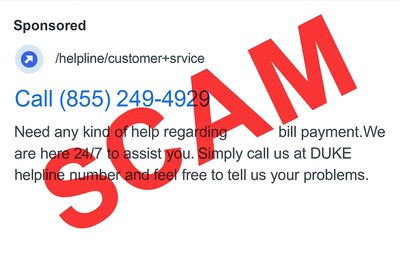
CHARLOTTE, N.C., Feb. 12, 2026 /PRNewswire/ -- Duke Energy is advancing its commitment to customer safety by deploying artificial intelligence (AI) to detect scams targeting energy customers. This innovative technology scans websites, social media and paid advertisements for open-source social engineering threats, helping to protect customers from fraudulent schemes.

"As scammers become more sophisticated, Duke Energy is proactively working to protect customers from bad actors. Our commitment is to protect our communities and create a secure platform when managing their energy account. If something doesn't feel right, slow down, verify and report it – our team is here to help."

– Jessica Bishop, Duke Energy Senior Vice President of Customer Services Operations

What's new

  • Proactive detection: AI scans digital channels for open‑source social‑engineering threats – including fake ads and impostor helplines – and flags them for removal with the hosting platforms.
  • Realworld examples: Recent takedowns include a paid search ad impersonating Duke Energy with a bogus customer service number.

Why it matters now

  • Seasonal spike: Duke Energy saw thousands of scam reports across its service areas in 2025, with a notable spike in February, when many customers are seeking bill assistance.
  • Industry mobilization: The company joined Piedmont Natural Gas, the Better Business Bureau and other utilities for the 10th annual Utility Scam Awareness Day in November to help customers slow down, verify and stop scams.

How customers can protect themselves

  • Slow down if a payment request feels urgent or threatening.
  • Verify using only the official phone number or website listed on your Duke Energy bill.
  • Report suspected scams to Duke Energy and law enforcement: Use Duke Energy's Scam Reporting Tool, the BBB's Find and Report a Scam and the FTC's Consumer Advice resources.

Red flags: Scammers may demand immediate payment, threaten service cutoff or insist on prepaid cards or cryptocurrency, methods Duke Energy does not accept. The company will never specify how you must pay or threaten instant disconnection.

Duke Energy

Duke Energy (NYSE: DUK), a Fortune 150 company headquartered in Charlotte, N.C., is one of America's largest energy holding companies. The company's electric utilities serve 8.6 million customers in North Carolina, South Carolina, Florida, Indiana, Ohio and Kentucky, and collectively own 55,100 megawatts of energy capacity. Its natural gas utilities serve 1.7 million customers in North Carolina, South Carolina, Tennessee, Ohio and Kentucky.

Duke Energy is executing an ambitious energy transition, keeping customer reliability and value at the forefront as it builds a smarter energy future. The company is investing in major electric grid upgrades and cleaner generation, including natural gas, nuclear, renewables and energy storage.

More information is available at duke-energy.com and the Duke Energy News Center. Follow Duke Energy on X, LinkedIn, Instagram and Facebook, and visit illumination for stories about the people and innovations powering our energy transition.

24-Hour: 800.559.3853

Cision View original content to download multimedia:https://www.prnewswire.com/news-releases/duke-energy-leverages-ai-to-protect-customers-and-combat-scams-302686573.html

SOURCE Duke Energy

FAQ

How does Duke Energy's new AI tool detect scams and protect customers (DUK) as of Feb 12, 2026?

The AI proactively scans websites, social media and paid ads for open-source social‑engineering threats. According to Duke Energy, flagged items include fake ads and impostor helplines, which the company then requests hosting platforms to remove to reduce customer exposure.

What prompted Duke Energy (DUK) to deploy AI for scam detection in early 2026?

A surge in scam reports across service areas in 2025, including a February spike, prompted the move. According to Duke Energy, thousands of reports and seasonal bill‑assistance fraud risks drove the decision to add proactive AI detection.

How can Duke Energy customers verify suspected scams after the company launched AI protections?

Customers should verify using only the official phone number or website on their Duke Energy bill. According to Duke Energy, customers should slow down, confirm billing details, and use the company's Scam Reporting Tool or law enforcement to report incidents.

What payment methods do scammers demand that Duke Energy (DUK) warns customers against?

Scammers often demand prepaid cards, cryptocurrency, or immediate payment and may threaten cutoff; Duke Energy does not accept those methods. According to Duke Energy, the company never specifies a single payment method or demands instant disconnection.

Did Duke Energy (DUK) take any real-world enforcement actions using the AI system by Feb 12, 2026?

Yes, the company reports takedowns including a paid search ad impersonating Duke Energy with a bogus customer service number. According to Duke Energy, flagged content was removed after platform takedown requests.

How does Duke Energy (DUK) recommend customers report scams and get help?

Report suspected scams via Duke Energy's Scam Reporting Tool, the BBB's Find and Report a Scam, or the FTC resources. According to Duke Energy, customers can also contact the company or local law enforcement for assistance and verification.
Duke Energy Corp

NYSE:DUK

DUK Rankings

DUK Latest News

DUK Latest SEC Filings

DUK Stock Data

99.70B
666.95M
Utilities - Regulated Electric
Electric & Other Services Combined
Link
United States
CHARLOTTE
