
Equifax National Market Pulse Data Shows U.S. Consumer Top-Line Debt Stabilizing at $18.25 Trillion in Q2 2026 With Delinquencies Improving Across Categories
Equifax (NYSE: EFX) released its Market Pulse Second Quarter U.S. Consumer Credit Trends report, showing total U.S. consumer debt at $18.25 trillion in June 2026.
Rhea-AI Summary
Equifax (NYSE: EFX) released its Market Pulse Second Quarter U.S. Consumer Credit Trends report, showing total U.S. consumer debt at $18.25 trillion in June 2026. This represents a 2.1% year-over-year increase and only a 0.32% rise from Q1 2026, indicating moderating growth.
According to Equifax, about 74% of consumer debt is mortgage-related. First mortgage balances were $12.845 trillion in June, up 1.9% YoY, while HELOC balances rose 12.5% YoY to $444.8 billion. Non-mortgage portfolios are shifting as bankcard balances climbed to $1.1085 trillion (up 8.2% from June 2024) and auto loans to $1.626 trillion, while student loan balances declined to $1.287 trillion (down 3.1% YoY).
Equifax reports that delinquencies across auto, bankcard, unsecured personal loans, and mortgages showed broad month-over-month and year-over-year improvement. First mortgage 90+ day delinquencies remain above historic mid-2025 lows but fell 3.6% between May and June 2026, suggesting ongoing normalization.
Positive
- None.
Negative
- None.
Details
News Market Reaction – EFX
On Aug 12, the first trading day after this news, EFX closed 0.82% below the previous close.
Data tracked by StockTitan Argus for the Aug 12 session.
Key Figures
- Total consumer debt
- $18.25 trillion
- Q2 2026
- Year-over-year debt growth
- 2.1%
- Total U.S. consumer debt in Q2 2026
- Quarter-over-quarter debt growth
- 0.32%
- Q2 2026 versus Q1 2026
- Mortgage debt share
- 74%
- Share of total consumer debt
- HELOC growth
- 12.5%
- Year-over-year in Q2 2026
- Bankcard debt growth
- 8.2%
- June 2024 to Q2 2026
- First mortgage delinquency growth
- 40.6%
- 90+ DPD year-over-year from historic mid-2025 lows
- First mortgage delinquency improvement
- 3.6%
- Decrease since May 2026
Historical Context
-
Survey found fabricated candidate information challenges alongside mixed AI hiring effects
-
Earnings growth, acquisition agreement, AI cost target increase and shareholder returns
-
Consumer financial health index declined amid reported middle-class pressure
-
Scheduled Q2 results release and conference call times
-
Definitive Mexico credit-bureau acquisition agreement announced with $750 million enterprise value
24h Move is the share-price change in the day after each event; other market factors may also have contributed.
Key Terms
heloc financial
90+ days past due financial
dpd financial
bankcard debt financial
AI-generated analysis. How Rhea-AI works. Not financial advice.




Credit Card and Auto Debt Balance Growth Outpaces Student Loans Amid Broad Delinquency Relief
Highlights:
- Total
U.S . consumer debt reached$18.25 trillion 2.1% year-over-year increase primarily driven by mortgage and revolving bankcard debt. - Delinquency rates showed broad improvement across automotive, bankcard, and mortgage sectors, suggesting a significant stabilization trend in consumer portfolios.
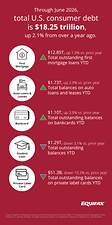
Continued Annual Debt Growth Driven by Mortgage and Revolving Card Debt
Total
"We are witnessing a period where top-line consumer data suggests retail and mortgage credit is stabilizing," said Emmaline Aliff, Advisory Leader at Equifax. "Total consumer debt only increased slightly in the second quarter of 2026, heavily anchored by first mortgages and a renewed reliance on credit cards. Although consumers accumulated seasonal credit card debt last November and December and paid the balances down in the first quarter, they took on more debt in the second quarter, though mortgage debt remains the majority of total consumer debt obligations."
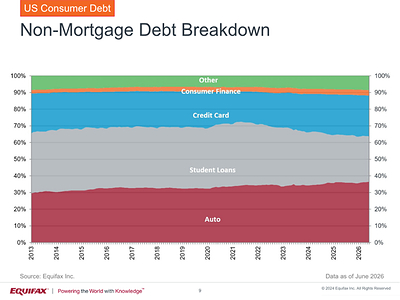
Structural Shifts in Non-Mortgage Portfolios as Auto and Card Balances Stand to Eclipse Student Loan Debt
While auto loans, student loans, and bankcards continue to dominate roughly
"Historically, total student loan debt balances were consistently higher than auto debt and almost twice as much as bankcard debt," said Aliff. "The changing proportions of the non-mortgage categories reflect a macro shift, where student loan stabilization is being offset by further reliance on credit to manage the budgetary pressures of rising household and vehicle costs."
Delinquencies Broadly Stabilized Across Consumer Portfolios as Mortgage Delinquencies Improve from May
Delinquency rates across automotive, bankcard, and unsecured personal loan portfolios all registered measurable downward trajectories on both a month-over-month and year-over-year basis. This broader stabilization also extended to the mortgage sector. Though first mortgage 90+ days past due (DPD) delinquencies rose
Month-Over-Month and Year-Over-Year Results
Total Consumer Debt Balances
Month | Total Consumer Debt | MoM Change (%) | YoY Change (%) |
April 2026 | 0.2 % | 2.8 % | |
May 2026 | +0.0 % | 2.4 % | |
June 2026 | 0.1 % | 2.1 % |
First Mortgage Balances
Month | First Mortgage Balances | MoM Change (%) | YoY Change (%) |
April 2026 | 0.1 % | 2.6 % | |
May 2026 | -0.1 % | 2.2 % | |
June 2026 | -0.2 % | 1.9 % |
Home Equity Lines of Credit (HELOC) Balances
Month | HELOC Balances ($B) | MoM Change (%) | YoY Change (%) |
April 2026 | 0.9 % | 13.0 % | |
May 2026 | 1.2 % | 12.7 % | |
June 2026 | 1.0 % | 12.5 % |
Auto Loan Balances
Month | Auto Loan Balances ($B) | MoM Change (%) | YoY Change (%) |
April 2026 | 0.4 % | 2.0 % | |
May 2026 | 0.6 % | 2.3 % | |
June 2026 | 0.7 % | 2.8 % |
Bankcard Balances
Month | Bankcard Balances ($B) | MoM Change % | YoY Change (%) |
April 2026 | 0.6 % | 3.7 % | |
May 2026 | 0.3 % | 3.7 % | |
June 2026 | 1.2 % | 3.9 % |
Student Loans Balances
Month | Student Loan Debt ($B) | MoM Change % | YoY Change (%) |
April 2026 | -0.3 % | -0.9 % | |
May 2026 | -0.4 % | – | |
June 2026 | -0.4 % | -3.1 % |
Equifax has been tracking
ABOUT EQUIFAX INC.
At Equifax (NYSE: EFX), we believe knowledge drives progress. As a global data, analytics, and technology company, we play an essential role in the global economy by helping financial institutions, companies, employers, and government agencies make critical decisions with greater confidence. Our unique blend of differentiated data, analytics, and cloud technology drives insights to power decisions to move people forward. Headquartered in Atlanta and supported by nearly 15,000 employees worldwide, Equifax operates or has investments in 24 countries in North America, Central and South America, Europe, and the Asia Pacific region. For more information, visit Equifax.com.
FOR MORE INFORMATION:
Tiffany Smith for Equifax
mediainquiries@equifax.com
 View original content to download multimedia:https://www.prnewswire.com/news-releases/equifax-national-market-pulse-data-shows-us-consumer-top-line-debt-stabilizing-at-18-25-trillion-in-q2-2026-with-delinquencies-improving-across-categories-302848512.html
SOURCE Equifax Inc.
FAQ
AI-generated questions and answers. How Rhea-AI works. Not financial advice.