
Survey: Half of Americans Say They Turn to AI for Medical Advice, with a Majority Trusting the Guidance
eHealth (Nasdaq:EHTH) released survey results on how insured Americans use AI for medical advice and insurance education.
Sentiment and the balance of points
Rhea-AI Sentiment reads the wording of the document, how positive or negative its language is on a 1 to 5 scale. The balance of points shown with the takes weighs what the document actually discloses, so the two can disagree, for example when a trial that missed its main goal is described in upbeat language.
Rhea-AI Summary
eHealth (Nasdaq:EHTH) released survey results on how insured Americans use AI for medical advice and insurance education. Nearly half have used AI for medical guidance, and over a third changed or skipped care based on AI advice. Many respondents also struggle to define basic health insurance terms.
Details
News Market Reaction – EHTH
On Jun 10, the day this news came out, EHTH closed 0.61% below the previous close.
Data tracked by StockTitan Argus for the Jun 10 session.
AI-generated analysis. How Rhea-AI works. Not financial advice.




Among insured Americans who use artificial intelligence (AI) for medical advice,
The survey of over 1,000 Americans found that:
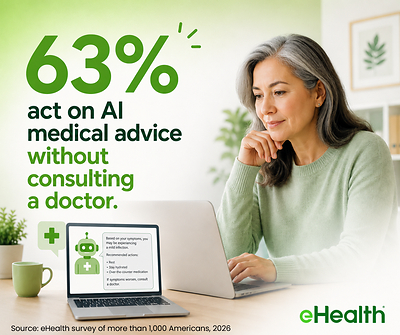
49% of insured Americans have used AI tools for medical advice, and63% of these have acted on the guidance they received without consulting a doctor.34% of insured Americans have used AI to help them understand how health insurance works, either while shopping for coverage or to help them understand their plan benefits.82% of insured Americans who used AI for medical advice say they trust the information they received, including29% who "completely trust" it.91% of insured Americans who used AI to understand health insurance trust the information they received, including42% who "completely trust" it.
"By regularly gathering feedback from American health insurance consumers, eHealth has developed a deep understanding of their experiences, preferences, and the factors that shape how they navigate healthcare and coverage," said Derrick Duke, CEO of eHealth. "These findings provide fascinating insights into how consumers are increasingly using AI to access medical advice, sometimes without consulting with a health professional. At eHealth, we are focused on using AI to support consumers before and after they enroll in a health insurance plan, while also recognizing the vital role our licensed insurance agents play in providing personalized guidance to support improved peace of mind and financial security."
Additional highlights from the new report:
Health insurance terminology
75% of Americans are confident in their ability to understand key health insurance terms, including25% who are "very confident."- Yet
61% cannot accurately define "coinsurance," and56% cannot accurately define "deductible." 45% cannot correctly define "out-of-pocket maximum," and42% cannot define "premium."33% cannot correctly define "copayment."- Only
17% can correctly define all five of these key health insurance terms.
Underutilizing covered free benefits and skipping care
53% of insured Americans have avoided medical care in the past 12 months due to cost concerns, with32% saying they avoided care two or more times for that reason.56% of insured Americans have skipped annual wellness checkups at least once in the past five years.44% have skipped preventive tests or screenings recommended by their doctor in the past five years.50% of women age 30 and older know that mammograms are recommended beginning at age 40.21% of men age 30 and older know that prostate exams are recommended beginning at age 50.46% of people aged 18 to 44 don't know when colonoscopies are recommended or mistakenly believe they are recommended at age 50 or older.
AI's impact on medical care use
73% of those who turn to AI for medical advice say information they received changed their decision to seek medical care, including36% reporting that the advice led them to not get care.82% of AI users say they trust the medical advice given to them by AI, with29% "completely trusting" the advice from AI;17% "mostly distrust" the advice, while1% "completely distrust" it.
Read the full report.
eHealth's report is based on census-balanced surveys of more than 1,000 Americans drawn from the general population. The survey was conducted by a third-party survey vendor between May 4 and 8, 2026. The margin of error is +/-
About eHealth
For nearly 30 years, eHealth, Inc. (Nasdaq: EHTH) has helped millions of Americans find the healthcare coverage that fits their needs at a price they can afford, using data, artificial intelligence and a consumer-first approach to help people quickly and effectively compare insurance options. As a leading independent licensed insurance agency and advisor, eHealth offers access to plans from more than 180 health insurers, including national and regional companies, supporting consumers during their working years and retirement. eHealth's team of licensed insurance agents helps match consumers with the insurance plans, services, and support they need to live healthier, more financially secure lives. For more information, visit eHealth or follow us on LinkedIn, Facebook, Instagram, and X.
eHealth media inquiries: pr@ehealth.com

 View original content to download multimedia:https://www.prnewswire.com/news-releases/survey-half-of-americans-say-they-turn-to-ai-for-medical-advice-with-a-majority-trusting-the-guidance-302796219.html
SOURCE eHealth, Inc.
FAQ
AI-generated questions and answers. How Rhea-AI works. Not financial advice.