
Eastport Confirms REE-Mineral Discovery, Supporting Potential For Large-Scale REE Deposit, with SEM007 Intersecting 347m at 0.20% TREO
Three reported Phase 1 holes have intersected continuous rare-earth mineralisation over hundreds of metres.
Sentiment and the balance of points
Rhea-AI Sentiment reads the wording of the document, how positive or negative its language is on a 1 to 5 scale. The balance of points shown with the takes weighs what the document actually discloses, so the two can disagree, for example when a trial that missed its main goal is described in upbeat language.
Rhea-AI Summary
Eastport Critical Metals (EVIIF) reported additional rare-earth drilling results from Semarule in Botswana, with mineralisation extending hundreds of metres in two holes. SEM007 returned 346.6m at 0.20% total rare earth oxides (TREO) from 1m, including 14.5m at 0.47% TREO from 110.97m. SEM006 returned 322.5m at 0.13% TREO from 27.5m. Magnetic rare earth oxides averaged 29% of TREO in SEM007.
Three reported Phase 1 holes have intersected continuous mineralisation over hundreds of metres within a roughly 5km by 3km syenite complex. The highest-grade intersection reported to date remains SEM005's 47.5m at 0.64% TREO from 20m. A mineralogical study is under way to identify host minerals and support future metallurgical testing. Eastport plans Phase 2 work to test near-surface grade variability and whether mineralisation and grades differ at greater depths.
How this balance works
Rhea-AI gives every point it takes from this document a weight. Minor counts 1, Moderate 3 and Major 9, so one Major point outweighs several Minor ones. The bar adds up the weights on each side, and when neither side holds more than 65% of the total the balance reads Mixed.
It reads the document as published, with the same rules for every company, and it does not look at what the market expected or at how the stock traded, so a point can be objectively good on a day the stock falls.
Rhea-AI Sentiment measures something else, the tone of the wording.
Hollow bars mark forward-looking points. How the balance works
Positive
- Moderate pointSEM007 intersected 346.6m at 0.20% TREO from 1m.
- Moderate pointSEM006 intersected 322.5m at 0.13% TREO from 27.5m.
- Minor pointSEM007's higher-grade interval returned 14.5m at 0.47% TREO from 110.97m.
- Minor pointMagnetic rare earth oxides averaged 29% of TREO in SEM007.
- Minor pointPreviously reported SEM005 returned 47.5m at 0.64% TREO from 20m, the highest-grade intersection to date.
2 minor points
- Minor point. Forward-looking: it has not happened yet and may not happen.Mineralogical study under way will better define host minerals and support future metallurgical testing.
- Minor point. Forward-looking: it has not happened yet and may not happen.Planned Phase 2 work will test near-surface grade variability and mineralisation and grades at greater depths.
Negative
- None.
AI-generated analysis. How Rhea-AI works. Not financial advice.




- Semarule represents a large, at surface rare earth-bearing multi-layered syenite intrusion, ~40km from the capital of Botswana, Gaborone
- Three Phase 1 Holes now reported (SEM005, SEM006 & SEM007) all three confirming continuous mineralisation over hundreds of metres across a ~5km x 3km (~15km2) Syenite complex reflecting the material scale and size of the Semarule system
- SEM006 and 007 tested the eastern side of the Semarule Hill syenite
- Hole SEM007 intersected 347m of Total Rare Earth Oxides (TREO) at
0.20% from surface. Magnetic Rare Earth Oxides (MREO) comprising dysprosium, terbium, neodymium and praseodymium (Dy,Tb, Nd, Pr), account for an average29% of TREO in SEM07 - Mineralisation hosted in altered mafic syenite; a mineralogical study is under way to better define host minerals and to support future metallurgical test work
Vancouver, British Columbia--(Newsfile Corp. - October 14, 2026) - Eastport Critical Metals Corp. (TSXV: EVI) (OTCQB: EVIIF) ("Eastport" or the "Company") is pleased to announce continued positive assay results from the diamond drill program at the Semarule Project ("Semarule" or the "Project"), prospective for rare-earth elements ("REE"), in south-central Botswana. Semarule is located approximately 40km north-west of the capital city, Gaborone.
Drill Hole SEM007:
- 347m at
- 14.5m at
0.47% TREO from 110.5m, of which MREO are28.4% of TREO
Daniel Major, Chief Executive Officer, commented;
"Following the success of SEM005, holes SEM006 & SEM007 have again returned hundreds of metres of rare earth mineralisation within a ~15km2 large syenite complex, continuing to support the material scale of the Semarule system.
SEM007 returned 347m at
The drilling thus far, supported by the ongoing mineralogical study and geophysics is supporting mineralisation being associated with altered mafic syenite. Planned Phase 2 developments will look to follow that geology to test the grade variability near-surface or whether the mineralisation and grade profile differ materially at even greater depths.
This has been an excellent start to our exploration campaign. Confirming another mineral discovery within the Eastport asset base further reflects the exceptional geological environment within Botswana."
Background
The eight hole Semarule diamond drilling progam was designed to target both the exposed syenite geology and the geophysical gravity anomaly cross section (see Figure 1). The Semarule rare earths project hosts several sizeable mineralised syenite-alkaline granite intrusions, including the Semarule Syenite Hill, exposed over a 5 x 3 km area and consisting of syenite with carbonatite dykes.
Archaean Gaborone granite underlies the Semarule area and is host to the intrusions, suggesting that the Semarule syenite resulted from in situ metasomatism or fractionation of the host granite, followed by intrusions of syenite. The syenites host the REE mineralisation, and the results to date confirm that the more mafic syenite intrusions report elevated REE concentrations.
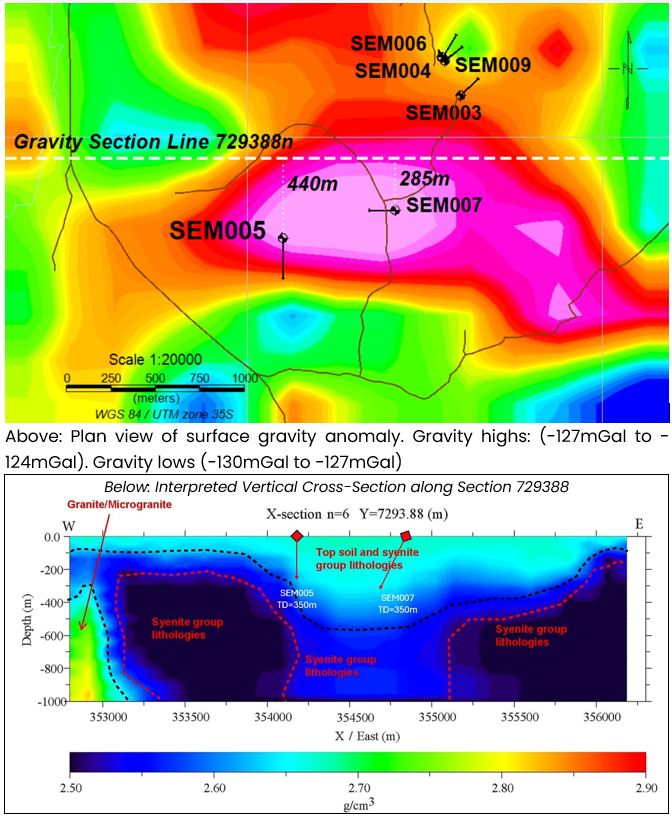
Figure 1: Ground Gravity Geophysics Survey and Cross-Section
SEM005 and SEM007 are projected onto the section and refer to plan view.
To view an enhanced version of this graphic, please visit:
https://images.newsfilecorp.com/files/8324/318800_eastportfig1.jpg
Based on the exploration completed to date at the Project, including the recent drilling results, reported by the Company support the exploration model that Semarule prospect hosts a significant REE anomaly. The highest grade mineralized intersection reported to date is in hole SEM005, which returned a 47.5m at
The importance of these findings is that mafic-rich syenites host some of the world's largest REE deposits, including Norra Karr, Lovozero, Strange Lake, Chishan, Longbaoshan and Wicheeda. In these deposits fractional crystallisation, leads to concentration of incompatible elements such as Niobium, Zirconium, and Yttrium in the residual melt, eventually forming REE-bearing minerals. The drilling results received to date confirm the presence of a large REE system with TREO grades reported to over 300 metres in each of the three drill holes reported to date.
The Semarule results to date are supported by historical exploration drilling undertaken by the Botswana Geoscience Institute (BGI)[1] who positioned two boreholes to test geochemical and geophysical anomalies. BGIS dillhole SEM_BH_001 was positioned on a surface geochemical anomaly of ±13,000ppm TREE in mafic-rich syenite. BGI reported that SEM_BH_001 showed prominent enrichment in the mafic rich syenites with 14 samples from 25 samples showing over 3,000 ppm TREE, and with one outlier sample taken from weathered syenite at 11m downhole returning ±36,000ppm TREE (note BGI reported Total Rare Earth Elements (TREE) before they are converted into their oxide forms which report on average
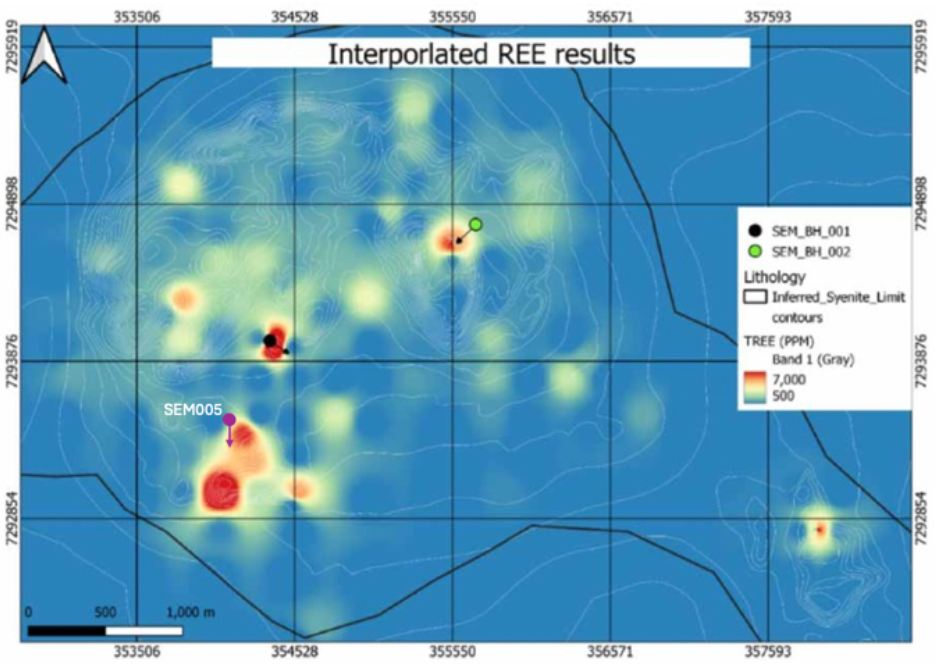
Figure 2 : Rare earth elements interpolated Geochem results, with drilled boreholes.1
To view an enhanced version of this graphic, please visit:
https://images.newsfilecorp.com/files/8324/318800_eastport2.jpg
The significant calculated rare earth oxide downhole depth intersections for drill holes SEM006 and SEM007 are provided in Tables 1 and 2.
Assay results provided by certified laboratory SGS South Africa Pty Ltd ("SGS") using the ICP/IMS Combination Package (method codes ICP90A/IMS90A), for standard 2.5m length quartered NQ diameter (47.6mm) core samples in the case of SEM006 and with variable sample lengths up to 3.8m based on geological variations for hole SEM007. Sampling was conducted over the entire length of each hole.
Table 1: Drill hole SEM007 significant calculated rare earth oxide downhole depth intersections
| From | Length | TREO% | LREO% | HREO% | MREO% |
| 1m | 346.6m | ||||
| 110.97m | 14.5m | ||||
| Nd₂O₃ + Pr₆O₁₁ | Dy₂O₃ | Tb₄O₇ | Y₂O₃ | ||
| 1m | 346.6m | 506ppm | 39ppm | 9ppm | 160ppm |
| 110.97m | 14.5m | 1141ppm | 62ppm | 15ppm | 216ppm |
Table 2: Drill hole SEM006 significant calculated rare earth oxide downhole depth intersections
| From | Length | TREO% | LREO% | HREO% | MREO% |
| 27.5m | 322.5m | ||||
| Nd₂O₃ + Pr₆O₁₁ | Dy₂O₃ | Tb₄O₇ | Y₂O₃ | ||
| 27.5m | 322.5m | 295ppm | 25ppm | 5ppm | 95ppm |
QA/QC
Eastport's Semarule diamond core drill program utilised a NQ size drill bit (47.6 mm core diameter). Collars are located using a hand-held GPS (projection: UTM zone 35 south, WGS84 datum). Core was captured and placed in aluminium core trays and then transported from site to Lobatse, Botswana by Eastport personnel. In Lobatse, the core was XRF scanned using a Vanta Evident hand-held XRF (serial number 994113), measured, logged, ¼ cut and sampled. All cutting used a diamond bladed rock saw.
Each ¼ core sample was collected in unmarked clear plastic bags. Sample tags were stapled inside the plastic bag. Five samples were then placed inside a poly-weave bag, sealed and transported by Eastport personnel to Aramax Couriers in Gaborone, Botswana. The batches were then delivered overnight to the laboratory of SGS South Africa in Randfontein, RSA. All samples are export controlled by the Botswana Government using export permits.
Sample rejects are discarded but sample pulps will be returned to Eastport Ventures Botswana within sixty days of reporting the analytical results. These pulps will be used for quality control procedures.
At SGS South Africa, samples are checked against the submittal form and sample list. The company receives verification of the number and correct sequencing of the samples.
Each entire sample is crushed using a Boyd crusher. The crusher is cleaned using barren material and air after each sample. The crushed sample is then split using an RSD splitter and 250g is subsequently milled down to -75 micron passing
Five grams of the milled sample is used for ICP analysis using SGS procedure ICP90A/IMS90A. SGS South Africa is accredited to international quality standards of ISO17025.
Qualified Person
The technical information in this news release has been reviewed and approved by Nicholas O'Reilly MIMMM (QMR) MAusIMM MSc DIC, an independent consultant and Qualified Person under National Instrument 43-101 - Standards of Disclosure for Mineral Projects.
About Eastport Critical Metals Corp. (TSXV: EVI) (OTCQB: EVIIF)
Eastport is a critical minerals development company advancing six projects in Botswana, with cumulative historical and current expenditures approaching CAD
The Company's additional projects include Selebi East, a nickel-copper-cobalt project located seven kilometres east of the historic Selebi Mines; the Semarule Rare Earth Elements Project, positioned within the Gaborone-Molepolole corridor; the Foley Uranium Project, adjoining the Letlhakane uranium deposit; the Jwaneng diamond project and the Keng Project, which targets nickel, copper and PGEs on the northern margin of the Molopo Farms Complex.
Botswana is widely regarded as one of Africa's strongest mining jurisdictions, combining the continent's highest GDP per capita with a 50-year track record of large-scale mineral development since the Orapa diamond discovery in 1967. The country ranks among the top performers globally on the Fraser Institute's Investment Attractiveness Index and is the highest-rated jurisdiction in Africa on the Policy Perception Index. These rankings reflect Botswana's stable regulatory environment, consistent rule of law, and long-standing support for responsible mineral development – factors that have underpinned significant investment and major M&A activity in the natural resources sector in recent years.
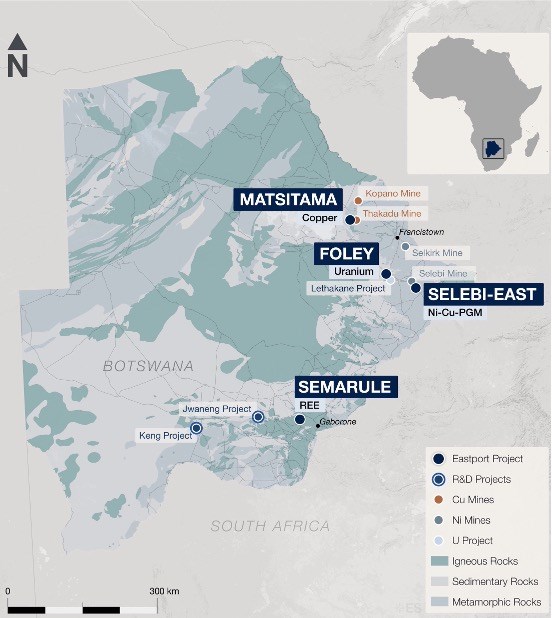
To view an enhanced version of this graphic, please visit:
https://images.newsfilecorp.com/files/8324/318800_51893102b4f3f8bd_004full.jpg
On behalf of the Board of Directors
"Daniel Major"
Daniel Major, Chief Executive Officer
Eastport Critical Metals Corp.
For further information about Eastport, please contact:
Daniel Major, Chief Executive Officer
info@eastportcmc.com
Disclaimer for Forward-Looking Information
This news release includes certain statements and information that may constitute forward-looking information within the meaning of applicable Canadian securities laws. Forward-looking statements relate to future events or future performance and reflect the expectations or beliefs of management of the Company regarding future events. Generally, forward-looking statements and information can be identified by the use of forward-looking terminology such as "intends" or "anticipates", or variations of such words and phrases or statements that certain actions, events or results "may", "could", "should", "would" or "occur". This information and these statements, referred to herein as "forward‐looking statements", are not historical facts, are made as of the date of this news release and include without limitation, statements regarding discussions of future plans, estimates and forecasts and statements as to management's expectations and intentions with respect to, among other things: the intended use of proceeds raised under the Offering; the Company delivering value to its shareholders through its critical metal's portfolio; the Company's exploration and development programs; the advancement of multi-asset drill campaigns across key critical metals and the timing thereof; and the receipt of final approval of the Offering from the TSXV.
These forward‐looking statements involve numerous risks and uncertainties and actual results might differ materially from results suggested in any forward-looking statements. These risks and uncertainties include, among other things: delays in obtaining or failure to obtain final approval from the TSXV for the Offering; fluctuations in commodity prices for critical metals, including copper, uranium and rare earth elements; the Company's ability to successfully execute its exploration and development programs; risks inherent in mineral exploration activities; the Company's ability to meet anticipated timelines for its multi-asset drill campaigns; operational risks and technical challenges associated with exploration activities in Botswana; and changes in the Company's business plans impacting the intended use of proceeds raised under the Offering.
In making the forward-looking statements in this news release, the Company has applied several material assumptions, including without limitation, that: the Company will obtain the required regulatory approvals for the Offering; the Company's exploration and development programs will proceed as planned; commodity prices for critical metals will remain at levels sufficient to support continued exploration activities; the Company will continue to have access to the necessary permits, equipment and qualified personnel to conduct its exploration programs; the Company's critical metals portfolio will continue to present viable opportunities for value creation; and the Company will use the proceeds of the Offering as currently anticipated. Although management of the Company has attempted to identify important factors that could cause actual results to differ materially from those contained in forward-looking statements or forward-looking information, there may be other factors that cause results not to be as anticipated, estimated or intended. There can be no assurance that such statements will prove to be accurate, as actual results and future events could differ materially from those anticipated in such statements. Accordingly, readers should not place undue reliance on forward-looking statements and forward-looking information. Readers are cautioned that reliance on such information may not be appropriate for other purposes. The Company does not undertake to update any forward-looking statement, forward-looking information or financial outlook that are incorporated by reference herein, except in accordance with applicable securities laws.
Neither the TSXV nor its Regulation Services Provider (as that term is defined in the policies of the TSXV) accepts responsibility for the adequacy or accuracy of this news release.
[1] http://www.bgi.org.bw/sites/default/files/BGI_Annual_Report_2023.pdf
To view the source version of this press release, please visit https://www.newsfilecorp.com/release/318800
FAQ
AI-generated questions and answers. How Rhea-AI works. Not financial advice.
What rare-earth drilling results did Eastport report for Semarule?
SEM007 returned 346.6m at 0.20% TREO from 1m, while SEM006 returned 322.5m at 0.13% TREO from 27.5m. SEM007 also contained a higher-grade interval of 14.5m at 0.47% TREO from 110.97m. TREO means total rare earth oxides.
What does Eastport plan to test next at Semarule?
Eastport plans Phase 2 work to test near-surface grade variability and whether mineralisation and grades differ at greater depths. An ongoing mineralogical study is intended to better define the minerals hosting the rare earths and support future metallurgical testing.