
Firefly Aerospace Announces Alpha Block II Configuration Upgrade for Flight 8
Firefly Aerospace (Nasdaq: FLY) announced a Block II configuration upgrade for its Alpha rocket to improve reliability, producibility, and launch operations for commercial, civil, and national security missions.
Sentiment and the balance of points
Rhea-AI Sentiment reads the wording of the document, how positive or negative its language is on a 1 to 5 scale. The balance of points shown with the takes weighs what the document actually discloses, so the two can disagree, for example when a trial that missed its main goal is described in upbeat language.
Rhea-AI Summary
Firefly Aerospace (Nasdaq: FLY) announced a Block II configuration upgrade for its Alpha rocket to improve reliability, producibility, and launch operations for commercial, civil, and national security missions. Alpha will increase in length from approximately 97 ft to 104 ft, adopt consolidated in-house batteries and avionics, and use optimized liquid oxygen and RP-1 tanks with improved thermal protection. Alpha Flight 7, launching in the coming weeks, will fly current hardware with several Block II subsystems in shadow mode to gain flight heritage ahead of the full Block II rollout on Alpha Flight 8.
The first stage for Flight 7 has been delivered to Vandenberg Space Force Base and final integration, static fire, and launch preparations are underway.
Positive
- Alpha length increased from ~97 ft to 104 ft
- Consolidated in-house batteries and avionics across spacecraft and rockets
- Optimized LOX and RP-1 tanks with improved thermal protection
- Block II designed to support responsive national security missions
Negative
- None.
Details
News Market Reaction – FLY
On Jan 13, the day this news came out, FLY closed 8.11% below the previous close.
Data tracked by StockTitan Argus for the Jan 13 session.
Key Figures
- Alpha current length
- approximately 97 feet
- Existing Alpha configuration before Block II upgrade
- Alpha Block II length
- 104 feet
- Planned Alpha length after Block II upgrade on Flight 8
- Alpha Flight 7
- Flight 7
- Last flight in current configuration; tests Block II subsystems
- Alpha Flight 8
- Flight 8
- First flight with full Block II configuration
- Alpha launches to date
- first six Alpha launches
- Operational history informing Block II design updates
- Hardware tests
- hundreds of hardware tests
- Testing basis for reliability and manufacturability improvements
- Golden Dome missions
- Golden Dome
- Example national security mission supported by Alpha Block II
- Vandenberg launch site
- Vandenberg Space Force Base
- Location of Flight 7 launch preparations
Historical Context
-
Added to Russell 2000 and 3000 benchmarks, boosting visibility and demand.
-
New COO with Boeing background to scale operations and reliability focus.
-
Added Volta’s wireless power tech to Blue Ghost Mission 2 lunar lander.
-
Announced participation in multiple defense and space investor conferences.
-
Q3 2025 revenue growth, larger credit facility, and new NASA contracts.
24h Move is the share-price change in the day after each event; other market factors may also have contributed.
Key Terms
automated fiber placement technical
avionics technical
thermal protection system technical
liquid oxygen technical
hypersonic testing technical
static fire technical
payload faring technical
AI-generated analysis. How Rhea-AI works. Not financial advice.




Block II upgrade designed to increase reliability and expand Alpha’s capability to support responsive launches across the globe
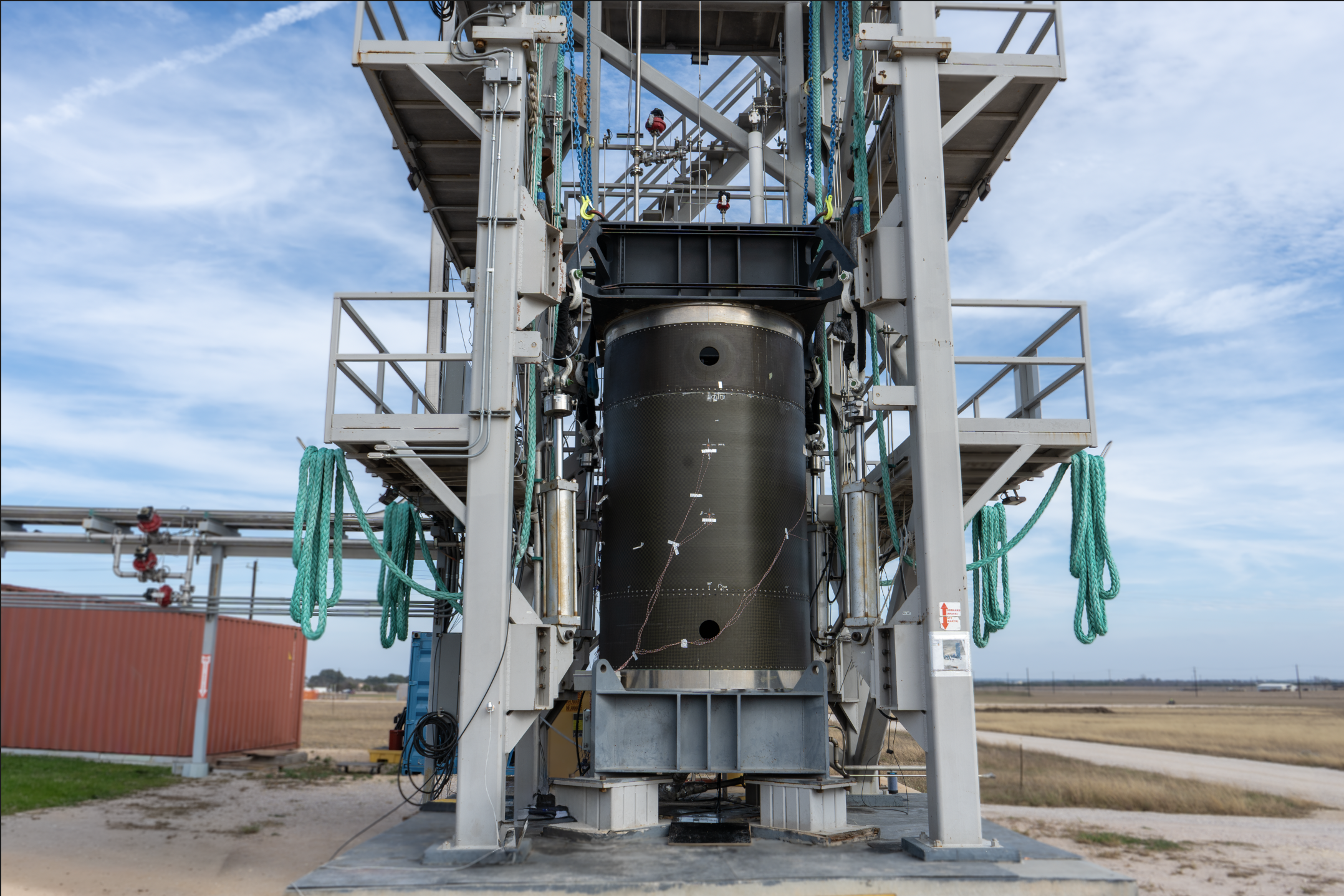
CEDAR PARK, Texas, Jan. 13, 2026 (GLOBE NEWSWIRE) -- Firefly Aerospace (Nasdaq: FLY), a market leading space and defense technology company, announced a Block II configuration upgrade for its Alpha rocket with a focus on enhancing reliability, streamlining producibility, and improving launch operations to further support commercial, civil, and national security mission demand.
Firefly’s upcoming Alpha Flight 7, targeted to launch in the coming weeks, will be the last flown in the current configuration and will serve as a test flight with multiple Block II subsystems in shadow mode to gain flight heritage and validate lessons learned ahead of the full Block II upgrade on Alpha Flight 8.
“The Block II upgrade has been part of Firefly’s strategic growth plan to meet the evolving needs of the growing global launch market and further supports Firefly’s culture of continuous improvement with a focus on enhanced safety, quality, and reliability,” said Jason Kim, CEO of Firefly Aerospace. “Firefly worked closely with customers and incorporated data and lessons learned from our first six Alpha launches and hundreds of hardware tests to make upgrades that increase reliability and manufacturability with consolidated parts, key configuration updates, and stronger structures built with automated machinery.”
In addition to improving reliability and production rate, Block II is designed to expand Alpha’s deployable launch capabilities for critical responsive space missions, such as hypersonic testing, national security missions including Golden Dome, and commercial satellite launches for domestic and international customers.
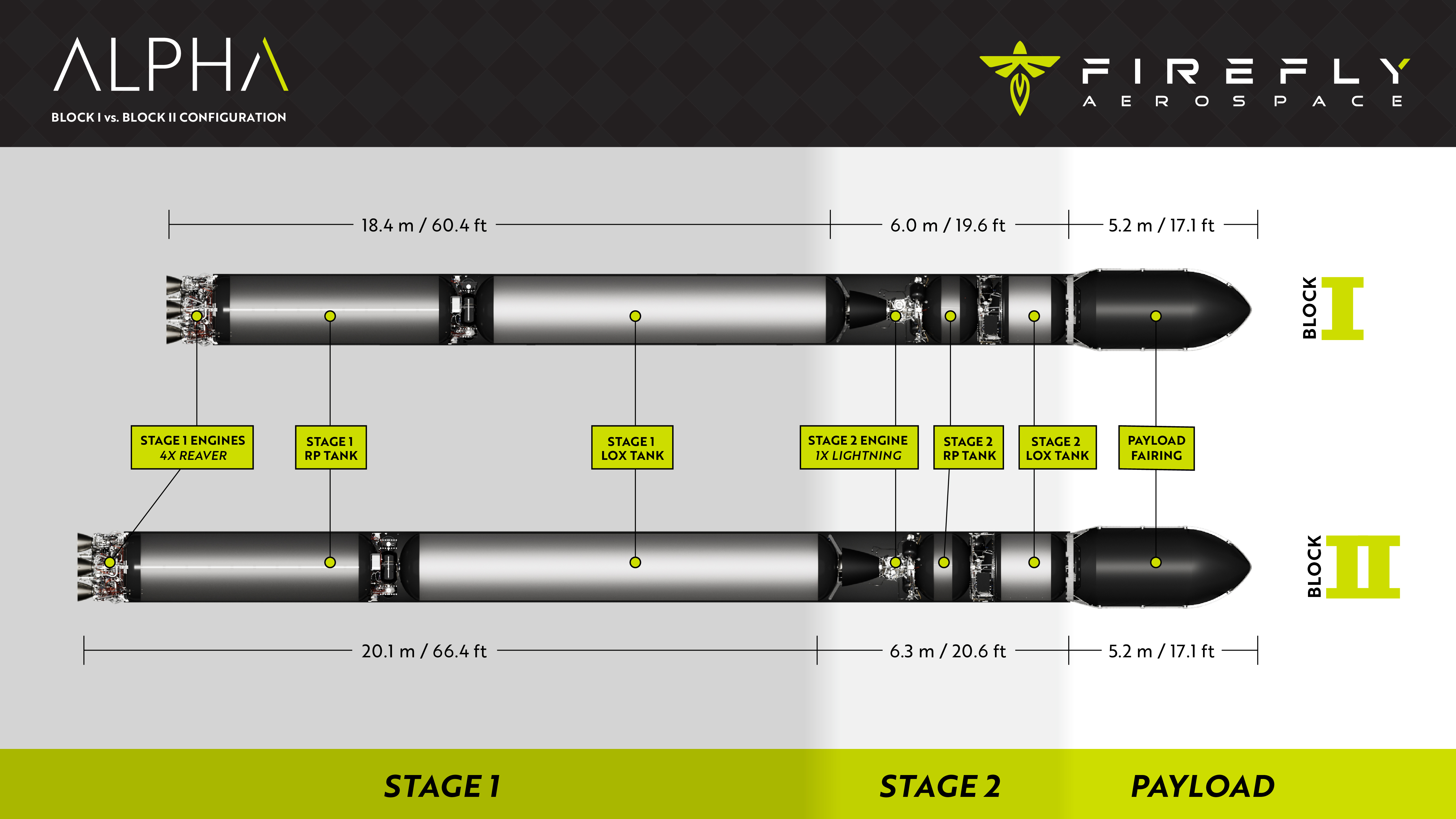
The planned Block II upgrades set to launch on Alpha Flight 8 include the following:
- Increased length and structural strength: Increasing Alpha’s length from approximately 97 feet to 104 feet with optimizations for rapid manufacturing on Firefly’s Automated Fiber Placement machine and increased strength of all carbon composite structures.
- Consolidated in-house batteries and avionics: Replacing off-the-shelf batteries and avionics with a consolidated system built in-house and used across Firefly’s spacecraft and rockets for increased schedule, reliability, and production efficiencies.
- Optimized propellant tanks: Improving thermal protection system for added reliability and optimizing the liquid oxygen and RP-1 tank configurations to increase stage burn time.
Some of these upgrades, including the in-house avionics and thermal improvements, will be tested on Alpha Flight 7. The first stage of the vehicle was recently delivered to Firefly’s launch site at the Vandenberg Space Force Base, and the Firefly team is now conducting final integration with the second stage and payload faring ahead of the static fire and launch.
“In addition to supporting customer objectives, Firefly is utilizing Flight 7 as an opportunity to test key systems ahead of the full Block II upgrade on Flight 8,” said Adam Oakes, Vice President of Launch at Firefly Aerospace. “This approach allows us to accelerate our planned Block II timeline and validate the improvements designed to enable more mass savings, optimize production, and increase reliability across the entire Alpha vehicle. Our flight-proven Reaver and Lightning engines and carbon composite structures continue to be the backbone of this rocket, so that core technology doesn’t change.”
About Firefly Aerospace
Firefly Aerospace is a space and defense technology company that enables government and commercial customers to launch, land, and operate in space – anywhere, anytime. As the partner of choice for responsive space missions, Firefly is the only commercial company to launch a satellite to orbit with an approximate 24-hour notice. Firefly is also the only company to achieve a fully successful landing on the Moon. Established in 2017, Firefly’s engineering, manufacturing, and test facilities are co-located in central Texas to enable rapid innovation. The company’s small- to medium-lift launch vehicles, lunar landers, and orbital vehicles are built with common flight-proven technologies to enable speed, reliability, and cost efficiencies for each mission from low Earth orbit to the Moon and beyond. For more information, visit www.fireflyspace.com.
Forward-Looking Statements
This press release contains “forward-looking statements” including, but not limited to, statements regarding the expected timetable for Alpha Flight 7 and the benefits of the Alpha Block II upgrade and other statements regarding Firefly’s future expectations, beliefs, plans, objectives, financial conditions, assumptions, future events, or performance that are not historical facts. In some cases, you can identify forward-looking statements because they contain words such as “may,” “will,” “expects,” “plans,” “anticipates,” “could,” “would,” “intends,” “believes.” There may also be negative words or other similar terms or expressions that concern our expectations, strategy, plans, or intentions. Not all forward-looking statements contain such identifying words. The inclusion of forward-looking statements should not be regarded as a representation that such plans, estimates, or expectations will be achieved. Readers are cautioned not to place undue reliance on the forward-looking statements contained herein, which speak only as of the date hereof. These statements are based on management’s current expectations, assumptions, and beliefs concerning future developments, which are inherently subject to uncertainties, risks, and changes in circumstances that are difficult to predict. We cannot assure you that the events reflected in the forward-looking statements will occur; actual events could differ materially from those described in the forward-looking statements. In addition to the risks and uncertainties of our ordinary business operations and conditions in the general economy and markets in which we compete, the forward-looking statements in this press release are subject to the risks, uncertainties, and other factors disclosed in our filings with the U.S. Securities and Exchange Commission, including our Form S-1 Registration Statement as amended and our Form 10-Q for the quarterly period ended September 30, 2025, which risks, uncertainties, and other factors could cause actual events to differ materially from those described in the forward-looking statements. Any forward-looking statement speaks only as of the date as of which such statement is made, and except as required by law, we undertake no obligation to update or revise publicly any forward-looking statements whether because of new information, future events; etc.
Media Contact
press@fireflyspace.com
Photos accompanying this announcement are available at:
https://www.globenewswire.com/NewsRoom/AttachmentNg/a3aaf6ab-b9fd-4845-b3ed-e300c78faab8
https://www.globenewswire.com/NewsRoom/AttachmentNg/70f164bc-436c-4bb3-8bc4-ef047f3602d4

FAQ
AI-generated questions and answers. How Rhea-AI works. Not financial advice.