
GRAIL Reports Full Results From NHS-Galleri Trial Demonstrating Substantial Reduction in Stage IV Cancer Diagnoses at 2026 ASCO Annual Meeting
Rhea-AI Summary
GRAIL (Nasdaq: GRAL) reported full NHS-Galleri trial results at the 2026 ASCO Meeting. In 142,250 adults screened annually with the Galleri blood test plus standard screening versus standard screening alone, the primary endpoint—a reduction in combined Stage III/IV diagnoses in 12 cancers—was not met.
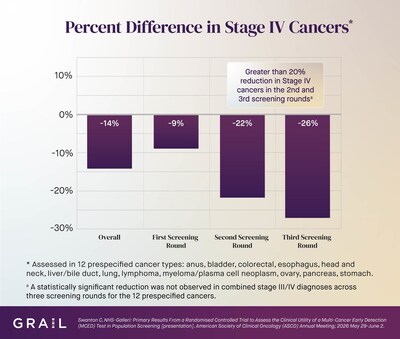
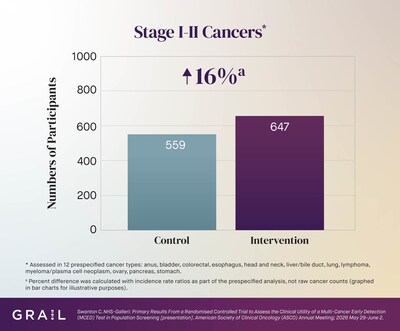
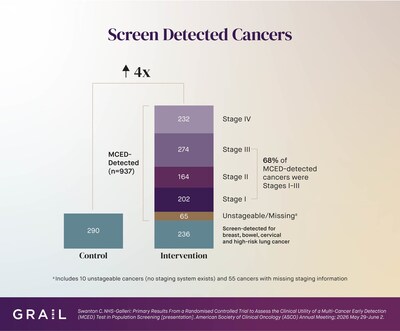
However, a pre-specified secondary endpoint showed Stage IV diagnoses for these cancers fell by 9%, 22% and 26% in the first, second and third rounds, for a 14% overall reduction. Stage I-II diagnoses rose 16%, screen-detected cancers increased four-fold, emergency-presenting cancers declined 25%, and no serious related adverse events were reported.
Positive
- Stage IV diagnoses in 12 prespecified cancers fell 14% overall, up to 26% in round three
- Stage I-II cancer diagnoses for 12 prespecified cancers increased by 16% after three rounds
- Screen-detected cancers increased four-fold when Galleri was added to standard screening
- Cancers diagnosed after emergency presentation decreased by 25% with Galleri screening
- Galleri test specificity was 99.55%, with a low 0.45% false positive rate
- Positive predictive value reached 52.0% overall and 58.0% in the first round
- No serious related adverse events were reported over three screening rounds
Negative
- Primary endpoint of reducing combined Stage III/IV cancers was not met (IRR 1.03, p=0.6324)
- Combined Stage III/IV diagnoses increased 19% in the first prevalent screening round
- Episode sensitivity was 54.7% for 12 prespecified cancers and 30.7% across all cancers
Key Figures
Historical Context
| Date | Event | Sentiment | 24h Move | Catalyst |
|---|---|---|---|---|
| May 27 | Inducement RSU grants | Neutral | +3.5% | Announced RSU inducement grants to 56 new non-executive employees under incentive plan. |
| May 26 | Conference participation | Neutral | +3.6% | Disclosure of upcoming presentation at Goldman Sachs Global Healthcare Conference with webcast access. |
| May 21 | Conference participation | Neutral | -1.0% | Announcement of Jefferies Global Healthcare Conference appearance and webcast availability. |
| May 05 | Earnings and pipeline | Positive | +15.3% | Reported Q1 2026 revenue growth, Galleri volume expansion, strong cash, and FDA PMA acceptance. |
| Apr 30 | Conference participation | Neutral | -0.8% | Announced BofA Securities healthcare conference presentation with webcast access for investors. |
24h Move is the share-price change in the day after each event; other market factors may also have contributed.
Recent stock reactions have been positive to both earnings and routine corporate updates, with no recorded negative post-news moves in the last five events.
Over the last months, GRAIL has focused investor attention on Galleri and large clinical programs. An 8-K on May 5, 2026 highlighted Q1 revenue of $40.8M, strong Galleri growth, and FDA PMA acceptance, which coincided with a +15.35% move. Conference presentations and an inducement grant release around late April–May generally saw modest positive or neutral reactions. Today’s NHS-Galleri readout fits the ongoing narrative of scaling Galleri with large real-world datasets.
Key Terms
multi-cancer early detection medical
positive predictive value medical
specificity medical
cancer signal of origin medical
incidence rate ratio medical
secondary endpoint medical
randomized, controlled trial medical
AI-generated analysis. How Rhea-AI works. Not financial advice.




No Reduction Observed in Combined Primary Endpoint of Stage III/IV Cancers in Aggregate; However, Decreases Observed Beyond the Prevalent Screening Round
Annual Galleri® Blood Test Reduced Stage IV Diagnoses of 12 Prespecified Cancers by
Galleri Increased Cancer Detection Rate by Four-Fold When Added to Standard of Care Screening and Reduced Cancer Diagnosis Through Emergency Presentation by
Annual Testing With Galleri Increased Stage I-II Cancer Diagnoses by
GRAIL to Host Analyst Call From 2026 ASCO Annual Meeting
The NHS-Galleri trial is the first and only randomized, controlled trial of a multi-cancer early detection (MCED) test and evaluated annual screening with the Galleri ® test in
"The goal of multi-cancer early detection is to find more cancers earlier, when they are more treatable and potentially curable, so that patients have the chance of living longer and more productive lives," said Josh Ofman, MD, MSHS, President and CEO-Elect at GRAIL. "The NHS-Galleri trial provides a wealth of data that support the use of the Galleri test to reduce the burden of metastatic Stage IV cancer and increase the number of cancers found earlier through screening at population scale. Importantly, Galleri found more Stage I and II cancers than all cancers found through NHS' existing single cancer screenings combined. By the third round of screening in this trial, Stage IV cancer diagnoses fell by more than a quarter, when treatment with curative intent may be possible."
Finding Cancers Earlier
The NHS-Galleri trial evaluated a combined primary endpoint of Stage III and IV diagnoses in a pre-specified group of 12 deadly cancers2 when the Galleri test was added to standard of care screening in
Sir Harpal Kumar, Chief Scientific Officer and President, Global Clinical and Medical Affairs at GRAIL, explained the reasons behind the Stage III and IV result: "We saw a substantial decrease in Stage IV cancers, but this was outweighed by an overall increase in the number of Stage III cancers, particularly in the prevalent screening round. We believe the Stage III increase was driven in part by a number of Stage IV cancers being shifted to earlier stages, including at Stage III, and the fact that many more cancers overall were found earlier through screening in the intervention arm, while the equivalent cancers may not yet have been diagnosed in the control arm. We would expect to see more of these as yet undiagnosed late stage cancers being found in the control arm with longer follow up. In addition, the trial has revealed just how much undiagnosed and uninvestigated Stage III cancer is already prevalent in the population before any screening commences. Finding these cancers earlier means we can start treating those patients with the urgency needed and, in many cases, with the opportunity of curative intent."
One of the aims of screening is to reduce the incidence of metastatic late stage cancer. In the Galleri arm, Stage IV cancer diagnoses decreased with each year of sequential screening, with a
"As a lung cancer doctor, I see the clinical importance of diagnosing cancer at an earlier stage, when treatment is more likely to be curative," said Professor Charles Swanton, thoracic medical oncologist at University College London Hospital, and one of the NHS-Galleri trial's chief investigators. "The NHS-Galleri trial tested whether adding the Galleri blood test to NHS screening could reduce the combined number of cancers diagnosed at Stage III or IV over three years. The primary endpoint was not met. However, a pre-specified secondary endpoint did show a greater than
Within the overall trend of Stage IV reduction, in an exploratory analysis, meaningful reductions in Stage IV diagnoses were observed in cancer types where 5-year survival is substantially higher when diagnosed at Stage III versus IV. For example, Stage IV diagnoses were reduced by
"For most cancer patients, there is a real difference between being diagnosed and being treated with a possibility of a cure versus being diagnosed at Stage IV and only being offered treatment that could manage symptoms and side effects or potentially prolong life for months or a few years. This is why it is critical to detect cancer at earlier stages, especially before distant metastases. Patients live longer when they are diagnosed before their cancer spreads to other parts of the body," said Sally Werner, RN, BSN, MSHA, Chief Executive Officer at Cancer Support Community, a global nonprofit advocacy organization. "The Galleri study results show promise and bring hope to people concerned about cancer that it might be detected earlier, improving patient outcomes and allowing more patients treatment options that offer potential cures. The fact that this screening is available with a simple blood test that could be done at any healthcare visit could make this a game changer in increased screening and earlier diagnosis, which could reduce a large portion of the persistent cancer disparities we see."
Relative Incidence Rate of Combined Stage III/IV Cancers Decreased After the First Round of Screening in the Pre-Specified Group of 12 Cancers; Relative Incidence Rate of Stage IV Cancers Decreased Each Screening Round.
Stage III/IV Cancers Diagnosed | Stage IV Cancers Diagnosed | |||
Incidence Rate Ratio | Intervention vs Control | Incidence Rate Ratio | Intervention vs Control | |
After 3 Screening Rounds | 1.03 (0.92, 1.14) p=0.6324 | ⬆ | 0.86 (0.744, 0.998) | ⬇ |
First Screening Round (Prevalent) | 1.19 (0.98, 1.43) | ⬆ | 0.91 (0.71, 1.18) | ⬇ |
Second Screening Round (Incident) | 0.95 (0.77, 1.17) | ⬇ | 0.78 (0.57, 1.06) | ⬇ |
Third Screening Round (Incident) | 0.88 (0.73, 1.07) | ⬇ | 0.74 (0.57, 0.95) | ⬇ |
Along with the decrease in Stage IV cancer incidence, Stage I and II cancers diagnosed increased by
Nigel, 70, from the North East of
Finding More Cancers With Robust Performance and Favorable Safety
The addition of the Galleri test to standard-of-care cancer screenings led to a four-fold increase in screen-detected cancers and a
Eric Sue, M.D., a primary care physician of internal medicine at the Sue Medical Group in
The Galleri test's performance – positive predictive value (PPV), specificity and Cancer Signal of Origin (CSO) accuracy – was consistent with the range previously reported from GRAIL's North American studies. Over three screening rounds, 1,801 participants (
"Our current recommended screening tests only find around
There were no serious related adverse events reported in the trial, reaffirming the safety profile of the test.
The results of the NHS-Galleri trial will be submitted for publication in a peer-reviewed medical journal.
"We are deeply grateful to the more than 142,000 participants who took part in this study, as well as to the NHS, The Cancer Prevention Trials Unit at Queen Mary University of
GRAIL to Host Analyst Call From 2026 ASCO Annual Meeting
GRAIL will host an analyst call to discuss clinical study results presented at ASCO tomorrow, Sunday, May 31, 2026, beginning at 4 p.m. PT/6 p.m. CT.
A link to the live webcast and recorded replay will be available at the investor relations section of GRAIL's website at investors.grail.com. Please register for the live event at https://grail-asco-2026-analyst-call.open-exchange.net/.
About the NHS-Galleri Trial (NCT05611632; ISRCTN91431511)
The NHS-Galleri trial is the first and only prospective, randomized, controlled trial to assess the clinical utility and performance of a multi-cancer early detection test for population screening when added to standard care. The trial recruited more than 140,000 asymptomatic participants, aged 50 to 77, and was conducted in partnership with the NHS in
About GRAIL
GRAIL is a healthcare company whose mission is to detect cancer early, when it can be cured. GRAIL is focused on alleviating the global burden of cancer by using the power of next-generation sequencing, population-scale clinical studies, and state-of-the-art machine learning, software, and automation to detect and identify multiple deadly cancer types in earlier stages. GRAIL's targeted methylation-based platform can support the continuum of care for screening and precision oncology, including multi-cancer early detection in symptomatic patients, risk stratification, minimal residual disease detection, biomarker subtyping, treatment and recurrence monitoring. GRAIL is headquartered in
For more information, visit grail.com.
About Galleri®
The Galleri® multi-cancer early detection (MCED) test screens for more than 50 cancer types, including many deadly cancers that currently lack screening options, such as pancreatic, ovarian and liver/bile duct cancers3. The Galleri test is the only MCED test clinically proven through a randomized controlled trial to increase earlier cancer detection (Stage I-III) and reduce Stage IV diagnoses - enabling more patients to have curative treatment4. When added to standard-of-care screening, the Galleri test reduced Stage IV diagnosis by more than
For more information, visit galleri.com.
**A statistically significant reduction was not observed in combined stage III–IV diagnoses across three screening rounds for the 12 deadly cancers.
**Test performance metrics do not represent results of a head-to-head comparative study. Separate studies have different designs, objectives, and participant populations, which limits the ability to draw conclusions about comparative performance.
Important Galleri Safety Information
The Galleri test is recommended for use in adults with an elevated risk for cancer, such as those age 50 or older. The test does not detect all cancers and should be used in addition to routine cancer screening tests recommended by a healthcare provider. The Galleri test is intended to detect cancer signals and predict where in the body the cancer signal is located. Use of the test is not recommended in individuals who are pregnant, 21 years old or younger, or undergoing active cancer treatment.
Results should be interpreted by a healthcare provider in the context of medical history, clinical signs, and symptoms. A test result of No Cancer Signal Detected does not rule out cancer. A test result of Cancer Signal Detected requires confirmatory diagnostic evaluation by medically established procedures (e.g., imaging) to confirm cancer.
If cancer is not confirmed with further testing, it could mean that cancer is not present or testing was insufficient to detect cancer, including due to the cancer being located in a different part of the body. False positive (a cancer signal detected when cancer is not present) and false negative (a cancer signal not detected when cancer is present) test results do occur. Rx only.
Laboratory/Test Information
The GRAIL clinical laboratory is certified under the Clinical Laboratory Improvement Amendments of 1988 (CLIA) and accredited by the College of American Pathologists. The Galleri test was developed — and its performance characteristics were determined — by GRAIL. The Galleri test has not been cleared or approved by the Food and Drug Administration. The GRAIL clinical laboratory is regulated under CLIA to perform high-complexity testing. The Galleri test is intended for clinical purposes.
GRAIL Forward Looking Statements
This press release contains forward-looking statements. In some cases, you can identify these statements by forward-looking words such as "aim," "anticipate," "believe," "continue," "could," "estimate," "expect," "intend," "may," "might," "plan," "potential," "predict," "should," "would," or "will," the negative of these terms, and other comparable terminology. These forward-looking statements, which are subject to risks, uncertainties, and assumptions about us, may include statements related to the potential benefits, uses and impacts of the Galleri test, plans for future follow up of the trial and expectations of future data or results we may see from such follow up, extrapolation of trends in the results, comparability of the results to a real world setting, including the similarity of the incidence rounds to steady state screening, the potential survival benefits of Galleri screening, benefits of population screening with Galleri, the applicability of the NHS-Galleri results to the commercial or FDA versions of the Galleri test, and plans to submit the results for publication, among others.
These statements are only predictions based on our current expectations and projections about future events and trends. There are important factors that could cause our actual results, level of activity, performance, or achievements to differ materially and adversely from those expressed or implied by the forward-looking statements, including those factors and numerous associated risks discussed under the section entitled "Risk Factors" in our Annual Report on Form 10-K for the period ended December 31, 2025. Moreover, we operate in a dynamic and rapidly changing environment. New risks emerge from time to time. It is not possible for our management to predict all risks, nor can we assess the impact of all factors on our business or the extent to which any factor, or combination of factors, may cause actual results, level of activity, performance, or achievements to differ materially and adversely from those contained in any forward-looking statements we may make.
Forward-looking statements relate to the future and, accordingly, are subject to inherent uncertainties, risks, and changes in circumstances that are difficult to predict and many of which are outside of our control. Although we believe the expectations and projections expressed or implied by the forward-looking statements are reasonable, we cannot guarantee future results, level of activity, performance, or achievements. Our actual results, financial condition and success in our business strategies and operations may differ materially from those indicated in the forward-looking statements. Except to the extent required by law, we undertake no obligation to update any of these forward-looking statements after the date of this press release to conform our prior statements to actual results or revised expectations or to reflect new information or the occurrence of unanticipated events.
1 Swanton C. NHS-Galleri: Primary Results From a Randomised Controlled Trial to Assess the Clinical Utility of a Multi-Cancer Early Detection (MCED) Test in Population Screening [presentation]. American Society of Clinical Oncology (ASCO) Annual Meeting; 2026 May 29-June 2.
2 The 12 cancer types include anus, bladder, colorectal, esophagus, head and neck, liver/bile duct, lung, lymphoma, myeloma/plasma cell neoplasm, ovary, pancreas, stomach.
3 Klein EA, Richards D, Cohn A, et al. Clinical validation of a targeted methylation-based multi-cancer early detection test using an independent validation set. Ann Oncol. 2021 Sep;32(9):1167-77. doi: 10.1016/j.annonc.2021.05.806
4 Swanton C. NHS-Galleri: Primary Results From a Randomised Controlled Trial to Assess the Clinical Utility of a Multi-Cancer Early Detection (MCED) Test in Population Screening [presentation]. American Society of Clinical Oncology (ASCO) Annual Meeting; 2026 May 29-June 2.
5 GRAIL, Inc. False positive rate. [Data on file: GR-2025-0256]

 View original content to download multimedia:https://www.prnewswire.com/news-releases/grail-reports-full-results-from-nhs-galleri-trial-demonstrating-substantial-reduction-in-stage-iv-cancer-diagnoses-at-2026-asco-annual-meeting-302786216.html
SOURCE GRAIL, Inc.