
Hadron Energy Strengthens Halo Reactor Engineering Team with Three Senior Component Design and Analysis Leaders
Hadron Energy (Nasdaq: HDRN) added three senior engineering leaders to support development of its Halo micro-modular nuclear reactor.
Sentiment and the balance of points
Rhea-AI Sentiment reads the wording of the document, how positive or negative its language is on a 1 to 5 scale. The balance of points shown with the takes weighs what the document actually discloses, so the two can disagree, for example when a trial that missed its main goal is described in upbeat language.


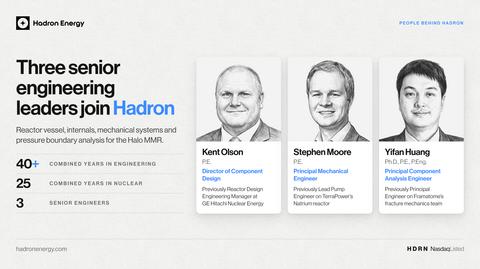
New team of licensed engineers bring experience from GE Hitachi Nuclear Energy's BWRX-300 program, TerraPower's Natrium reactor, Framatome, Candu Energy and the
Hadron’s new team members have designed and analyzed reactor components for some of the most significant reactor projects over the past two decades, including GE Hitachi's BWRX-300 small modular reactor, TerraPower's Natrium reactor and the
The additions give Hadron in-house depth in the disciplines at the core of turning a reactor design into hardware: designing the reactor vessel, internals and mechanical systems, demonstrating the structural integrity of pressure boundary components to ASME Code and NRC requirements, and working with key nuclear suppliers to bring Halo's components into factory production. The team represents the experience needed to move Halo from design to deployment.
"Commercializing a microreactor comes down to the people, and these new additions bring a wealth of knowledge to Hadron in delivering our microreactor," said Sam Gibson, Founder and Chief Executive Officer of Hadron Energy. "Important to Hadron’s reactor design and development objectives, these experts have designed real reactor components, supported regulatory reviews and built hardware through fabrication. They chose Hadron because they want to put that experience behind a light-water microreactor built for factory production and timely deployment. With this team in place, we are moving faster toward a design we can license, build and deliver to the customers who need reliable, around-the-clock power."
"These three engineers cover the disciplines that turn a reactor design into hardware: the design of the reactor vessel, internals and mechanical systems, and the analysis that proves pressure boundary components will perform over the life of the plant," said Eric Williams, Executive Vice President of Engineering at Hadron Energy. "They have written ASME Section III design specifications, supported NRC reviews and worked side by side with fabricators to get components built right. Their experience gives us the technical leadership to drive Halo's design towards completion and execute on our licensing and supply chain plans."
Meet Hadron's New Engineering Leaders
Kent Olson, P.E.
Director of Component Design with 10 years in nuclear and 20 years in engineering. Kent has designed nuclear components for both the
Stephen Moore, P.E.
Principal Mechanical Engineer with 5 years in nuclear and 12 years in engineering. Stephen brings more than a decade of mechanical engineering experience, including five years designing ASME Section III nuclear components at TerraPower. As Lead Pump Engineer, he led the design and oversight of the Natrium reactor's primary and intermediate reactor coolant pumps and prepared ASME Section III, Division 5 design specifications. As a Senior Primary Heat Transport System Design Engineer, he designed reactor components and instrumentation and supported design of pumps, heat exchangers, the reactor vessel and internals. He is a named inventor on multiple
Yifan Huang, Ph.D., P.E., P.Eng.
Principal Component Analysis Engineer with 10 years in the nuclear industry. Dr. Huang is a structural integrity specialist with a decade of experience across BWR, PWR and CANDU reactor systems. He most recently served as a Principal Engineer on Framatome's fracture mechanics team and previously managed more than 30 engineers as Engineering Manager of Reactor Component Integrity at Candu Energy, an AtkinsRealis company. At GE Hitachi Nuclear Energy, he led development of leak-before-break methodology for BWRX-300 piping and earned the company's 2024 Emerging Engineer Award. An adjunct research professor at the University of
Individuals interested in joining the team should visit: https://hadronenergy.com/team#careers
Forward-Looking Statements
This press release contains forward-looking statements within the meaning of U.S. federal securities laws, including, but not limited to, statements regarding regulatory approvals of the Halo MMR, and the engineering, development, licensing, and commercialization of the Halo MMR. Any statements contained herein that are not statements of historical fact may be deemed to be forward-looking statements. The words “anticipate,” “believe,” “continue,” “could,” “estimate,” “expect,” “intends,” “may,” “might,” “plan,” “possible,” “potential,” “predict,” “project,” “should,” “would” and similar expressions may identify forward-looking statements, but the absence of these words does not mean that a statement is not forward-looking. These forward-looking statements are based on certain assumptions and analyses made by the management of Hadron Energy in light of their experience and perception of historical trends, current conditions, and expected future developments, as well as other factors they believe are appropriate in the circumstances, and involve a number of risks and uncertainties, some of which are beyond Hadron Energy’s control, that may cause actual results or performance to be materially different from those expressed or implied by these forward-looking statements. Should one or more of these risks or uncertainties materialize, or should any of the assumptions being made prove incorrect, actual results may vary in material respects from those projected in these forward-looking statements. Hadron Energy undertakes no obligation to update or revise any forward-looking statements, whether as a result of new information, future events or otherwise, except as may be required under applicable securities laws.
View source version on businesswire.com: https://www.businesswire.com/news/home/20261026891516/en/
Investor and Media Contact
Hadron Energy Investor Center: https://www.hadronenergy.com/investor-relations
Samuel Gibson, Chief Executive Officer
sgibson@hadronenergy.com
Rory Rumore, CoreIR
rory@coreir.com
Source: Hadron Energy, Inc.