
Robust credit market liquidity powers increasingly competitive transactions market
JLL (NYSE:JLL) reports that robust credit market liquidity is reviving global commercial real estate transactions, with its Global Bid Intensity Index now well above year-ago levels.
Sentiment and the balance of points
Rhea-AI Sentiment reads the wording of the document, how positive or negative its language is on a 1 to 5 scale. The balance of points shown with the takes weighs what the document actually discloses, so the two can disagree, for example when a trial that missed its main goal is described in upbeat language.
Rhea-AI Summary
JLL (NYSE:JLL) reports that robust credit market liquidity is reviving global commercial real estate transactions, with its Global Bid Intensity Index now well above year-ago levels. June saw the sharpest monthly improvement in bidding in a year, and July delivered the second-highest count of unique bidders on record.
According to JLL, its Credit Intensity Index remains materially above prior 2021 highs, even after some moderation in loan-to-value ratios and lender volumes. The gap between strong lender competition and asset bidding is narrowing, suggesting a healthier, more predictable transaction environment despite headwinds from higher bond yields and borrowing costs.
Details
News Market Reaction – JLL
On Aug 25, the day this news came out, JLL closed 1.40% above the previous close.
Data tracked by StockTitan Argus for the Aug 25 session.
Key Figures
- Credit Intensity Index
- 112
- July
- Prior record benchmark
- 2021
- Credit Intensity Index comparison
- Liquidity foundation
- two years
- Credit liquidity build-up
- Annual revenue
- $26.1 billion
- JLL company information
- Global operations
- over 80 countries
- JLL company information
- Global workforce
- more than 112,000
- As of June 30, 2026
Historical Context
-
$435 million Boston office tower sale to Oxford Properties
-
Record Q2 results and higher full-year adjusted EPS growth target
-
AI-exposed markets showed resilience despite technology employment declines
-
$617 million arranged for Grubb Properties-managed real estate vehicles
-
Survey found leaders expected workforce growth and AI-enhanced roles
24h Move is the share-price change in the day after each event; other market factors may also have contributed.
Key Terms
global bid intensity index financial
loan-to-value financial
bid-ask spreads financial
AI-generated analysis. How Rhea-AI works. Not financial advice.




JLL's Global Bid Intensity Index and Credit Intensity Index reveal rising investor demand and large-deal conviction as liquidity continues to build
Key Takeaways
- Bidding activity accelerates: Buyer interest is growing, with bidding activity achieving its strongest monthly improvement in a year, and July recording the second-highest count of unique bidders in index history.
- Lenders remain aggressive: Competition among credit providers remains well above previous (2021) record highs.
- Debt and equity markets realign: The spread between lender competition and property bidding, which reached a peak divergence in May, is narrowing—signaling healthier transaction environments globally.
This momentum is highlighted by JLL's latest Global Bid Intensity Index (BII), which is now sitting well above levels from one year ago. June marked the sharpest monthly index improvement in a year, while July recorded the second-highest number of unique bidders since index inception, demonstrating expanding buyer pools.
At the same time, credit market appetite remains exceptionally strong and is one of the factors propelling the transactions market. Though average winning loan-to-value (LTV) rates and distinct lender volumes have moderated since April, the Credit Intensity Index (CII) remains materially above previous 2021 record highs, signaling that lenders are still competing harder than buyers. The gap between bid and credit intensity peaked in May and is now compressing, pointing to healthier functioning across the commercial real estate capital markets globally.
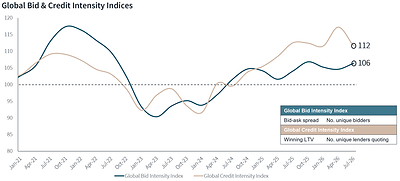
"Liquidity is back—and building," said Richard Bloxam, CEO, Capital Markets, JLL. "The exceptional strength we have seen in credit markets over the past year is now directly propelling transaction activity. As lender confidence spreads into the equity market, buyers are stepping up with clear intent, particularly on larger deals. Looking ahead, the compressing gap between credit intensity and asset bidding marks a pivotal transition toward a more normalized transaction environment through the second half of the year."
While capital depth is expanding and the weight of active bidders continues to rise notably, macro headwinds persist. A recent run-up in bond yields, particularly in the
"Credit liquidity has built a remarkably strong foundation for commercial real estate over the past two years, with continued robust lender appetite and improving investment sales activity," said Trey Morsbach, Head of US Debt Advisory, Capital Markets, JLL. "While elevated bond yields keep borrowing costs top of mind, the expanding pool of active lenders is offering optionality. That competitive credit environment, combined with growing bidder depth, is helping the market align on pricing."
FAQs
1) Question: What do the JLL Global Credit Intensity Index (CII) and Global Bid Intensity Index (BII) measure?
Answer: The Global Credit Intensity Index measures debt market intensity through the number of unique lenders quoting on loan opportunities and the average winning loan-to-value (LTV) ratio. The Global Bid Intensity Index measures investment sales competitiveness through the number of unique bidders on a transaction and the spread between winning bids and asking prices. Together, these indices create a comprehensive liquidity monitoring system and provide unmatched early signals ahead of the rest of the market.
2) Question: What is driving the recent surge in global commercial real estate asset bidding?
Answer: Investor demand is rising due to commercial real estate's attractive relative value and strong support from debt markets. June logged the largest monthly bidding gain in a year, followed by July recording near-record buyer participation.
3) Question: How are commercial real estate credit markets performing?
Answer: Credit markets remain highly active, with JLL's Credit Intensity Index registering at 112 in July. Although lender competition eased slightly from April, lenders continue to compete harder for transactions than asset buyers.
4) Question: Why does a closing gap between credit and bidding activity matter?
Answer: The shrinking gap between credit intensity and bidding intensity signals that available loans are successfully turning into sales. This alignment points to a healthier and more predictable transaction environment.
5) Question: What key factors could influence real estate asset transactions in the months ahead?
Answer: Elevated bond yields, particularly in the
For more news, videos and research resources on JLL, please visit JLL's newsroom.
About JLL
JLL (NYSE:JLL) is a leading global commercial real estate services and investment management company with annual revenue of
Contact: Jesse Tron
Phone: +1 212 376 1216
Email: Jesse.Tron@jll.com
 View original content to download multimedia:https://www.prnewswire.com/news-releases/robust-credit-market-liquidity-powers-increasingly-competitive-transactions-market-302859462.html
SOURCE JLL
FAQ
AI-generated questions and answers. How Rhea-AI works. Not financial advice.