
Joby: U.S. Government’s Advanced Air Mobility Plan is Pivotal Step Toward Commercial Launch
Joby (NYSE:JOBY) endorsed the U.S. Department of Transportation’s Advanced Air Mobility (AAM) National Strategy and said it will engage immediately on workforce, infrastructure, safety and data sharing recommendations.




National roadmap aligns federal policy with real-world air taxi operations beginning in 2026
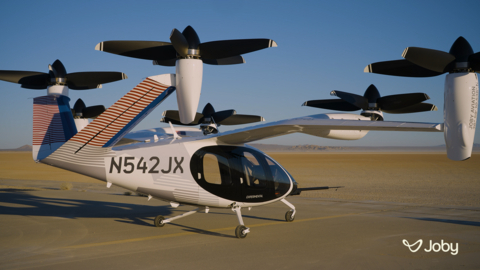
Joby’s electric air taxi at Edwards Air Force Base Credit: Joby Aviation
“This strategy is tangible proof that the
Congress passed the “Advanced Air Mobility and Coordination Act” in 2022 to ensure federal agencies work in coordination on investments necessary for the maturation of the AAM ecosystem in
It also comes as the Federal Aviation Administration (FAA) and DOT look to execute the Electric Vertical Take Off and Landing (eVTOL) Integration Pilot Program (eIPP) starting in 2026. eIPP supports eVTOL use cases across the country ahead of FAA Type Certification, such as proving routes for operations. The eIPP’s near-term operations and the Strategy’s policy recommendations empower regulators, communities and industry alike to move forward in lockstep.
Joby’s advanced progress towards certification and operational maturity uniquely positions the company to immediately engage on the Strategy’s core recommendations:
- Leverage Existing or Repurposed Infrastructure: Joby’s operational strategy has always focused on using a blend of existing and new infrastructure to deploy its air taxi services. The Strategy’s emphasis on facilitating the use of “existing or repurposed infrastructure for near- and medium-term AAM operations” directly aligns with Joby’s plan to initiate commercial services without requiring significant upfront investment in infrastructure.
- Data Sharing with Respective Government Agencies: Joby has led the industry’s regulatory path, becoming the first eVTOL company to finalize its certification blueprint (G-1) with the FAA, and is now entering the final stages of validating all necessary design, flight and manufacturing data. Combined with flying over 50,000 miles - including 850 flights in 2025 and operating test flights within the National Airspace System - means Joby has a significant amount of data needed for the Strategy.
-
Building the Workforce: Careers in aviation unlock opportunities for economic mobility and Joby has been actively engaged in building a skilled AAM workforce here in
the United States . The company employs more than 2,000 people globally, including through Joby’s apprenticeship program. Joby’s manufacturing workforce continues to grow at the company’s scaled production site inDayton, Ohio and its pilot production line inMarina, California . Through its aviation academy, the company is also building a talent pipeline of pilots and aircraft mechanics. The Strategy’s focus on developing workforce pipelines, including leveraging military experience, supports Joby’s integrated manufacturing and operating strategy, as well as its development of dual-use technologies forU.S. defense. -
Autonomy & Safety: The commitment to developing an aviation autonomy roadmap aligns with work already underway at Joby. Joby’s Superpilot™ autonomous flight technology, validated over thousands of flight miles, provides critical operational data to advance the Strategy’s goals for increasingly autonomous and scaled operations. In addition, Joby has participated in two simulations with the FAA and NASA to validate integration of eVTOL operations using existing air traffic control procedures into the National Airspace System around
Los Angeles International Airport, Dallas Love Field and DFW airports.
The Administration’s roadmap comes at a moment of unprecedented validation for Joby. In 2025, Joby’s flight test program spanned three countries, including operations at the World Expo in
About Joby
Joby Aviation, Inc. (NYSE:JOBY) is a
Forward-Looking Statements
This release contains “forward-looking statements” within the meaning of the “safe harbor” provisions of the Private Securities Litigation Reform Act of 1995, including but not limited to, statements regarding the development and performance of our aircraft; the growth of our manufacturing capabilities; our regulatory outlook, progress and timing, including potential operations in 2026 ahead of FAA certification; our business plan, objectives, goals and market opportunity; plans for, and potential benefits of, our strategic partnerships; and our current expectations relating to our business, financial condition, results of operations, prospects, capital needs and growth of our operations. You can identify forward-looking statements by the fact that they do not relate strictly to historical or current facts. These statements may include words such as “anticipate”, “estimate”, “expect”, “project”, “plan”, “intend”, “believe”, “may”, “will”, “should”, “can have”, “likely” and other words and terms of similar meaning in connection with any discussion of the timing or nature of future operating or financial performance or other events. All forward looking statements are subject to risks and uncertainties that may cause actual results to differ materially, including: our ability to launch our air taxi service and the growth of the urban air mobility market generally; our ability to produce aircraft that meet our performance expectations in the volumes and on the timelines that we project; the competitive environment in which we operate; our future capital needs; our ability to adequately protect and enforce our intellectual property rights; our ability to effectively respond to evolving regulations and standards relating to our aircraft; our reliance on third-party suppliers and service partners; uncertainties related to our estimates of the size of the market for our service and future revenue opportunities; and other important factors discussed in the section titled “Risk Factors” in our Annual Report on Form 10-K, filed with the Securities and Exchange Commission (the “SEC”) on February 27, 2025, our Quarterly Reports on Form 10-Q filed with the SEC on May 8, 2025 and August 7, 2025, and in future filings and other reports we file with or furnish to the SEC. Any such forward-looking statements represent management’s estimates and beliefs as of the date of this release. While we may elect to update such forward-looking statements at some point in the future, we disclaim any obligation to do so, even if subsequent events cause our views to change.
View source version on businesswire.com: https://www.businesswire.com/news/home/20251217622364/en/
Media:
Charles Stewart
press@jobyaviation.com
Investors:
investors@jobyaviation.com
Source: Joby Aviation, Inc.