
Kura Oncology Reports Durable Clinical Activity of Darlifarnib Plus Cabozantinib in Cabozantinib-Naïve Clear Cell Renal Cell Carcinoma Patients at KCRS 2026
Kura Oncology (Nasdaq: KURA) reported updated Phase 1a data from the FIT-001 trial of darlifarnib plus cabozantinib in cabozantinib-naïve, pretreated patients with locally advanced or metastatic clear cell renal cell carcinoma (ccRCC).
Rhea-AI Summary
Kura Oncology (Nasdaq: KURA) reported updated Phase 1a data from the FIT-001 trial of darlifarnib plus cabozantinib in cabozantinib-naïve, pretreated patients with locally advanced or metastatic clear cell renal cell carcinoma (ccRCC). Among 34 evaluable patients, objective response rates ranged from 33% to 50% across darlifarnib dose levels, with a median progression-free survival of 13 months across pooled doses and median duration of response not yet estimable at most levels due to ongoing responses.
The combination showed durable clinical benefit, with more than half of patients on treatment at data cutoff, and a manageable safety profile in 72 RCC patients, generally consistent with the individual drugs. According to Kura Oncology, these results support further development of darlifarnib plus cabozantinib, and a global, randomized Phase 1b portion comparing the combination versus cabozantinib alone is underway to define a recommended Phase 3 dose ahead of a planned registrational study in 2028.
Positive
- Objective response rate 33%–50% in 34 cabozantinib-naïve advanced ccRCC patients
- Median progression-free survival 13 months across pooled darlifarnib dose levels
- More than 50% of patients remained on treatment at data cutoff, indicating durable benefit
- Manageable safety profile in 72 RCC patients, generally consistent with individual agents
- Randomized Phase 1b trial underway comparing combination versus cabozantinib alone to select Phase 3 dose
Negative
- Evidence based on early-stage Phase 1a/1b data, with no Phase 3 efficacy results yet available
- Neutropenia required dose interruption/reduction and later supportive care, indicating meaningful hematologic toxicity management needs
Details
News Market Reaction – KURA
In the Jul 27 session, KURA declined 2.31%, reflecting a moderate negative market reaction. Argus tracked a trough of -14.6% from its starting point during tracking. Our momentum scanner triggered 45 alerts that day, indicating elevated trading interest and price volatility.
Data tracked by StockTitan Argus on the day of publication.
Key Figures
- Objective response rate
- 33%-50%
- Cabozantinib-naive ccRCC patients across evaluated darlifarnib dose levels
- Median PFS
- 13 months
- Pooled darlifarnib dose levels in cabozantinib-naive ccRCC patients
- ccRCC sample size
- 34 patients
- Cabozantinib-naive patients evaluated for clinical activity
- Safety population
- 72 patients
- RCC patients evaluated for safety and tolerability
- Patients remaining on treatment
- More than half of patients
- At data cut-off across evaluated combination dose levels
- Planned registrational study
- 2028
- Target timing informed by the randomized Phase 1b portion
Historical Context
-
Long-term darlifarnib and cabozantinib data scheduled for KCRS presentation
-
Long-term ziftomenib combination results supported ongoing Phase 3 development
-
Inducement stock options granted to four new employees
-
Preliminary darlifarnib combination responses and future platform plans disclosed
-
Updated ziftomenib triplet response and survival data reported
24h Move is the share-price change in the day after each event; other market factors may also have contributed.
Key Terms
ccrcc medical
pfs medical
tki medical
hif-2α medical
vegfr medical
farnesyl transferase inhibitor medical
AI-generated analysis. How Rhea-AI works. Not financial advice.




– Response rates up to
– Activity compares favorably with historical outcomes for TKI and HIF-2α monotherapies -–
– Combination was well tolerated and safety profile consistent with reported profiles of the individual agents –
– Findings support potential for darlifarnib to enhance activity of VEGFR-targeted therapies in second- and third-line RCC settings –
– Global, randomized Phase 1b study underway to establish recommended Phase 3 dose –
– Investor call scheduled for today, July 27, 2026, at 5:00 a.m. PT / 8:00 a.m. ET –
SAN DIEGO, July 27, 2026 (GLOBE NEWSWIRE) -- Kura Oncology, Inc. (Nasdaq: KURA), a biopharmaceutical company focused on precision medicines for the treatment of cancer, announced updated Phase 1a results from the ongoing FIT-001 clinical trial (NCT06026410) demonstrating encouraging and durable clinical activity of darlifarnib plus cabozantinib in cabozantinib-naïve patients with advanced clear cell renal cell carcinoma (ccRCC). The results were presented at the 2026 Kidney Cancer Research Summit (KCRS) in Boston and support continued development of the combination, including dose selection for the randomized Phase 1b portion of the study.
The long-term data compare favorably with benchmarks for advanced RCC, showing robust antitumor activity with darlifarnib plus cabozantinib, as well as evidence of durable benefit. The combination had a manageable safety profile across all dose levels, including when administered with full-dose cabozantinib.
Clinical Activity in Cabozantinib-naïve ccRCC Patients (N=34):
- Objective response rate ranged from
33% to50% across evaluated darlifarnib dose levels - Median progression free survival was 13 months across pooled dose levels
- Median duration of response was not estimable at most dose levels assessed because multiple responses remain ongoing
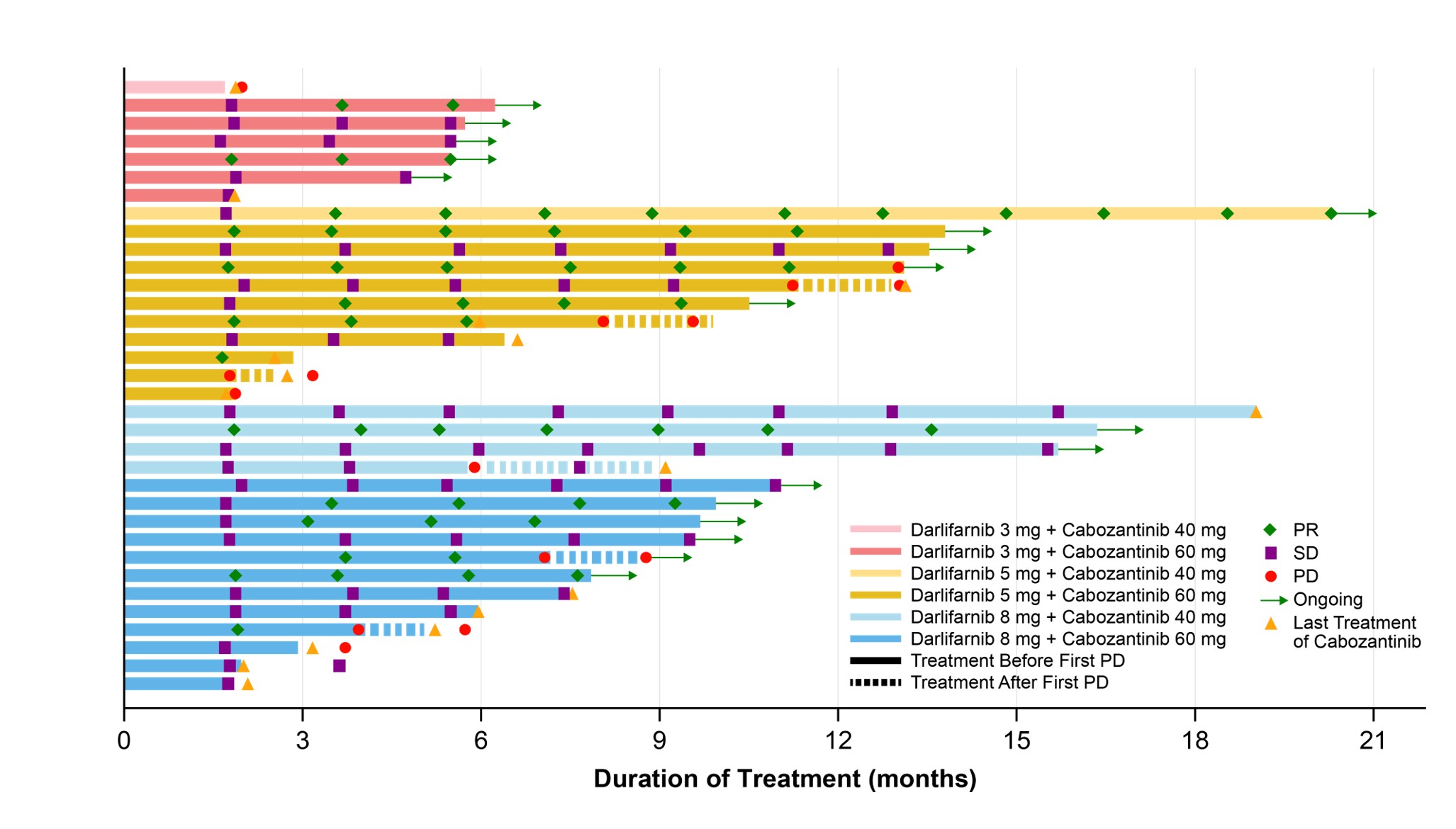
- Durable clinical benefit was observed across all evaluated combination dose levels, with more than half of patients remaining on treatment at data cut-off
Safety and Tolerability in RCC Patients (N=72):
- The safety and tolerability profile was manageable and generally consistent with reported safety profiles of the individual agents
- Supportive care, including for neutropenia, was not allowed during the dose-limiting toxicity study period
- Neutropenia was successfully managed with dose interruption/reduction and supportive care (as allowed after the initial dose-limiting toxicity period)
- Supportive care, including for neutropenia, was not allowed during the dose-limiting toxicity study period
“The response rates and progression-free survival observed with darlifarnib plus cabozantinib are encouraging in this refractory, pretreated, cabozantinib-naïve population, particularly given the limited treatment options after prior immunotherapy, immune check point inhibitors, and VEGFR-targeted therapy,” said Adanma Ayanambakkam, M.D., M.S., Assistant Professor of Hematology Oncology, Assistant Medical Director Clinical Trials Office, Stephenson Cancer Center, University of Oklahoma Health Sciences Center. “Continued follow-up will further define the durability of benefit.”
Duration of Treatment and Clinical Outcomes
Clinical benefit observed across combination dose levels, with multiple patients remaining on treatment.
“These updated Phase 1a data continue to support the potential for darlifarnib to enhance VEGFR-targeted therapy in advanced RCC and have informed the dose combinations advancing into the randomized Phase 1b portion of FIT-001,” said Mollie Leoni, M.D., Chief Medical Officer of Kura Oncology. “Cabozantinib-naïve patients represent an increasingly important treatment population as cabozantinib is often reserved for later lines of therapy following immunotherapy-based regimens. We look forward to longer follow-up from Phase 1a and randomized data from Phase 1b as we continue development toward a planned registrational study.”
Kura is currently enrolling patients in the U.S. and E.U. in the randomized Phase 1b dose-optimization portion of FIT-001 in cabozantinib-naïve, refractory ccRCC. The Phase 1b portion is evaluating darlifarnib plus cabozantinib versus cabozantinib alone and is designed to inform selection of a recommended Phase 3 dose for a planned registrational study in 2028.
Virtual Investor Event
Kura will host a webcast and conference call today, July 27, 2026, at 5:00 a.m. PT / 8:00 a.m. ET featuring management and Adanma Ayanambakkam, M.D., M.S., Assistant Professor of Hematology Oncology and Assistant Medical Director, Clinical Trials Office, Stephenson Cancer Center, University of Oklahoma Health Sciences Center. The live webcast and replay will be available on the Company’s website at www.kuraoncology.com under the Investors tab in the Events and Presentations section.
Abbreviations
HIF-2α, hypoxia-inducible factor 2 alpha; PD, progressive disease; PFS, progression-free survival; PR, partial response; RCC, renal cell carcinoma; SD, stable disease; TKI, tyrosine kinase inhibitor; VEGFR, vascular endothelial growth factor receptor
About Darlifarnib
Darlifarnib is a next-generation farnesyl transferase inhibitor (FTI) under development that inhibits farnesylation of RHEB, resulting in selective mTORC1 inhibition while sparing mTORC2. This mechanism has potential to enhance the activity of multiple targeted therapies where complementary inhibition of oncogenic pathways may improve clinical outcomes, including VEGFR-targeted therapies such as cabozantinib.
About Kura Oncology
Kura Oncology is a biopharmaceutical company committed to realizing the promise of precision medicines for the treatment of cancer. Kura’s pipeline of small molecule drug candidates is designed to target cancer signaling pathways and address high-need hematologic malignancies and solid tumors. Kura developed and is commercializing KOMZIFTI® (ziftomenib), the FDA-approved once-daily, oral menin inhibitor for the treatment of adults with relapsed or refractory NPM1-mutated acute myeloid leukemia, and continues to pioneer advancements in menin inhibition and farnesyl transferase inhibition. For additional information, please visit the Kura website at https://kuraoncology.com/ and follow us on X and LinkedIn.
Forward-Looking Statements
This news release contains certain forward-looking statements that involve risks and uncertainties that could cause actual results to be materially different from historical results or from any future results expressed or implied by such forward-looking statements. Such forward-looking statements include, among other things, statements regarding the potential of darlifarnib to enhance the activity of cabozantinib and other VEGFR-targeted therapies in RCC and to improve clinical outcomes, the potential of darlifarnib in combination with cabozantinib to offer durable benefit to patients with RCC, and ongoing and planned clinical trials of darlifarnib in combination with cabozantinib. Factors that may cause actual results to differ materially include the risk that compounds that appeared promising in early research or clinical trials do not demonstrate safety and/or efficacy in later preclinical studies or clinical trials, the risk that Kura may not obtain approval to market its product candidates, uncertainties associated with performing clinical trials, regulatory filings, and other interactions with regulatory bodies, and other risks associated with the process of discovering, developing and commercializing drugs that are safe and effective for use as human therapeutics, and in the endeavor of building a business around such drugs. You are urged to consider statements that include the words “may,” “will,” “would,” “could,” “should,” “believes,” “estimates,” “projects,” “potential,” “expects,” “plans,” “anticipates,” “intends,” “continues,” “designed,” “goal,” or the negative of those words or other comparable words to be uncertain and forward-looking. For a further list and description of the risks and uncertainties Kura faces, please refer to Kura’s periodic and other filings with the Securities and Exchange Commission, which are available at www.sec.gov. Such forward-looking statements are current only as of the date they are made, and Kura assumes no obligation to update any forward-looking statements, whether as a result of new information, future events or otherwise.
Conflict of Interest Disclosure
Dr. Ayanambakkam's disclosures include consulting or advisory roles with AVEO, Pfizer/Astellas; Johnson & Johnson; Kura Oncology: Travel, Accommodations, Expenses, and Research Funding; and Regeneron.
Kura Contact
Investors and Media:
Greg Mann
858-987-4046
gmann@kuraoncology.com
A photo accompanying this announcement is available at https://www.globenewswire.com/NewsRoom/AttachmentNg/b3ffef56-a27c-4f7a-a629-51d913a2d1a3

FAQ
AI-generated questions and answers. How Rhea-AI works. Not financial advice.