
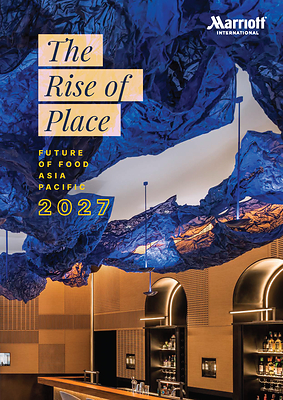
The Rise of Place: Marriott International Reveals Asia Pacific's Future of Food
42% of surveyed Marriott restaurants and bars in Asia Pacific excluding China reported increased sales of non-alcoholic beverages.
Sentiment and the balance of points
Rhea-AI Sentiment reads the wording of the document, how positive or negative its language is on a 1 to 5 scale. The balance of points shown with the takes weighs what the document actually discloses, so the two can disagree, for example when a trial that missed its main goal is described in upbeat language.
Rhea-AI Summary
Marriott International (MAR) unveiled Future of Food 2027, a report examining dining trends across Asia Pacific excluding China.
Drawing on expert conversations and property insights, the report identifies growing interest in locally rooted dining and flexible social spaces. 95% of surveyed properties identified demand for authentic local signature dishes as their market's biggest trend, while nearly half reported growing demand for casual venues. Across the region, 58% of properties reported average fine-dining experiences lasting 1.5 to 2 hours. Marriott also plans to introduce its APEC Plant-Forward Program in 2027, integrating plant-forward dining into its operations across the region.
AI-generated analysis. How Rhea-AI works. Not financial advice.




Local cuisine emerges as the region's strongest dining force, as traditional restaurant settings give way to fluid, social spaces.
Across Asia Pacific excluding
"Across Asia Pacific, we're witnessing a shift toward intimate, locally-rooted experiences, where smaller, intentional spaces replace traditional formal dining models," said Petr Raba, Vice President of Food & Beverage, Marriott International,
Key Trends Shaping the Future of Food
- The Spatial Shift
Dining is moving beyond the traditional restaurant model as guests increasingly lean toward more flexible, social and experience-led spaces. AcrossAsia Pacific excludingChina , nearly half of the surveyed properties report a growing demand for casual venues such as lounges, bars and outdoor settings, while emerging concepts are embracing intimate 40 to 60-seat footprints with distinct identities. InVietnam ,71% of surveyed properties report growth in bar and lounge dining, reflecting the growing appeal of more fluid dining experiences. An invisible layer of technology is supporting this shift, with AI enhancing everything from menu development and marketing to staffing and guest insights, allowing teams to focus on delivering more personalized hospitality.100% of restaurants and bars surveyed inThailand are already using AI in their operations. - The Local Advantage
Local cuisine has become the defining force shaping dining decisions across the region. Demand for authentic local signature dishes is now the strongest trend identified by95% of the surveyed properties and outweighing value for money when guests choose where to dine. Hotels are responding by building menus around ingredients and stories rooted in their destinations. At Hearth at The Ritz-Carlton,Perth , for example, a signature dish featuring local Wagin duck showcasesWestern Australia's produce while reflecting the restaurant's seasonal, locally driven philosophy. Over the past year, four in five properties have introduced new local ingredients fromKyoto vegetables inJapan to Kampot sea salt inCambodia -inspired menus and indigenous spices acrossSoutheast Asia , while nearly three-quarters report local ingredients appearing more frequently in beverage menus. This trend is particularly pronounced inIndia andIndonesia , where demand for local signature cuisine reaches71% and67% respectively, highlighting a growing desire for dining experiences that tell the story of a destination. - 99-Minute Fine Dining
Fine dining is undergoing a temporal revolution with up to five memorable courses delivered in under two hours, replacing four-hour tasting menus with ten-plus courses. Across the region,58% of properties report that the average fine dining experiences last between 1.5 and 2 hours.Singapore has emerged as one of the region's fastest-paced fine dining markets with85% of restaurants reporting an average time of 1.5 hours. Restaurants are adapting by simplifying menus, introducing more a la carte options and focusing on standout moments over the number of courses. InSouth Korea , one in five establishments have already reduced the number of courses served, while30% of fine-dining restaurants inthe Philippines have introduced a la carte menus.Australia sees both fewer courses and shorter service times, with the conversation shifting toward "wow moments" rather than course quantity.
Additional Report Highlights:
- Eat Well, Eating Your Age: Wellness has become a core dining consideration, with ingredients rooted in
Asia Pacific's rich food traditions finding renewed relevance among modern travelers. Today,97% of surveyed Marriott International properties inAsia Pacific excludingChina serve dishes associated with health and longevity, while wellness increasingly extends beyond the plate to healthier mini-bars and wellness-focused turndown experiences. - The Modern Menu: Across
Asia Pacific , menus are becoming more expressive and multi-sensory, with texture rising alongside flavor as a defining element of the dining experience. At the same time, plant-forward dining is accelerating, prompting Marriott International to introduce its APEC Plant-Forward Program across the region in 2027, making it one of the first major global hotel groups to integrate plant-forward dining into its operational foundation permanently. - Alcohol Alternatives: The low- and no-alcohol movement has evolved from niche trend to hospitality mainstay, with
42% of Marriott International restaurants and bars surveyed inAsia Pacific excludingChina reporting increased sales of non-alcoholic beverages. From premium spirits to alcohol-free pairings, guests are increasingly seeking sophisticated alternatives without compromise.
Looking Ahead
Download the full Future of Food 2027 report here to explore the complete trends shaping
Access high-resolution images and media assets here.
ABOUT MARRIOTT INTERNATIONAL
Marriott International, Inc. (Nasdaq: MAR) is based in Bethesda, Maryland, USA, and encompasses a portfolio of compelling brands across luxury, premium, select, midscale, extended stay, and all-inclusive, with over 10,000 properties in 148 countries and territories, as of June 30, 2026. Marriott franchises, operates, and licenses hotel, residential, timeshare, yacht, outdoor, and other lodging products all around the world. The company offers Marriott Bonvoy®, its highly awarded travel platform. For more information, please visit our website at www.marriott.com, and for the latest company news, visit www.marriottnewscenter.com. In addition, connect with us on Facebook and @MarriottIntl on X and Instagram.

 View original content to download multimedia:https://www.prnewswire.com/news-releases/the-rise-of-place-marriott-international-reveals-asia-pacifics-future-of-food-302898760.html
SOURCE Marriott International, Inc.