
CARFAX Investigation: More than 1 in 4 Taxis and Rideshares in Major U.S. Cities Have Unfixed Recall
CARFAX, part of Mobility Global, found elevated unfixed recall rates in taxis and rideshares and promotes free tools to check and fix them.
Rhea-AI Summary
Mobility Global (MBGL), through its CARFAX unit, reported on Sept. 14, 2026 that more than 1 in 4 taxis and rideshares checked in 16 major U.S. cities had at least one unfixed safety recall.
CARFAX analyzed nearly 438,000 VINs from registered taxi and rideshare vehicles and found about 27% had an open recall, compared with roughly 20% of vehicles nationwide. Rates were highest in New York City at 38.6% and Seattle at 37.5%, while Los Angeles and Boston were much lower at 11% and 9% respectively. CARFAX highlights that consumers can check any vehicle for open recalls for free at carfax.com/recall and complete repairs at no cost through dealers, and drivers can use the free CARFAX Car Care app for maintenance and recall alerts.
Positive
- None.
Negative
- None.
Details
News Market Reaction – MBGL
In the Sep 14 session, MBGL gained 0.45%, reflecting a mild positive market reaction.
Data tracked by StockTitan Argus on the day of publication.
Key Figures
- Vehicles analyzed
- Nearly 438,000 VINs
- Registered taxi and rideshare vehicles across 16 major U.S. cities
- Cities analyzed
- 16 major U.S. cities
- CARFAX taxi and rideshare investigation
- Vehicles with open recalls
- About 27%
- Taxi and rideshare vehicles analyzed
- New York City rate
- 38.6%
- Medallion cabs with an unfixed recall
- Seattle rate
- 37.5%
- Taxi and rideshare vehicles with an unfixed recall
- Los Angeles rate
- 11%
- Vehicles with an unfixed recall
- Boston rate
- 9%
- Vehicles with an unfixed recall
Historical Context
-
Reported drivers behind on recommended maintenance and promoted free CARFAX Car Care reminders.
24h Move is the share-price change in the day after each event; other market factors may also have contributed.
Key Terms
vin technical
AI-generated analysis. How Rhea-AI works. Not financial advice.




New CARFAX Investigation Checks Nearly Half a Million Vehicles Across 16 Major Cities
"If you're paying for a ride, you should be able to count on the vehicle being safe, too, but our data shows that isn't always the case," said Paul Nadjarian, Chief Product Officer at CARFAX. The good news is checking for an open recall is free at carfax.com/recall and getting it fixed is free. It's a simple but important step toward creating a safer ride."
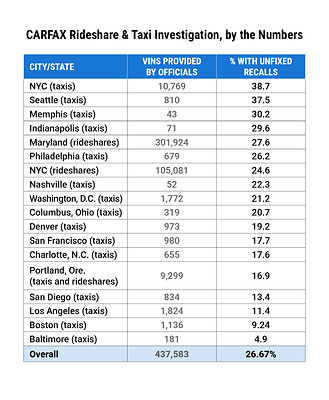
Meanwhile, some cities were doing far better than the roughly
There are conditions that can keep taxi and rideshare drivers from getting recall repairs done, said Elena Sierra, Executive Director of the Transportation Alliance, a trade group for taxi fleets. "It's important to recognize that not all recalls present the same level of safety risk," Sierra said. "They range from software updates and labeling corrections to more significant mechanical issues."
Consumers can check any vehicle for an unfixed recall for free at carfax.com/recall. The tool provides instant recall information and can help consumers find a dealer to complete the repair at no cost. Drivers can also download the free CARFAX Car Care app for reminders about routine maintenance and newly issued safety recalls.
Editor's note: Interviews are available upon request. Please contact Em Nguyen at emnguyen@carfax.com.
About CARFAX
CARFAX, part of Mobility Global Inc. (NYSE: MBGL), helps millions of people every day confidently shop, buy, service, and sell cars with innovative solutions powered by CARFAX® vehicle history information. The expert in vehicle history since 1984, CARFAX provides CARFAX Car Listings, CARFAX Car Care, CARFAX History-Based Value, and the flagship CARFAX Report to consumers and the automotive industry. CARFAX owns the largest vehicle history database and is nationally recognized as a top workplace by The Washington Post and USA Today. Shop, Buy, Service, Sell – Show me the CARFAX®.
Mobility Global is the world's standard for automotive information, providing critical data and analytics across the full vehicle lifecycle. Mobility Global supports the world's major automotive manufacturers, suppliers, dealer groups, media, financial institutions, and consumers with data, forecasts, insights, technology, and innovation. For more information, visit mobilityglobal.com.

 View original content to download multimedia:https://www.prnewswire.com/news-releases/carfax-investigation-more-than-1-in-4-taxis-and-rideshares-in-major-us-cities-have-unfixed-recall-302877156.html
SOURCE CARFAX
FAQ
AI-generated questions and answers. How Rhea-AI works. Not financial advice.
Which cities had the highest and lowest rates of unfixed recalls?
The highest reported unfixed recall rates were in New York City medallion cabs at 38.6% and Seattle at 37.5%. Cities with much lower rates than the roughly 20% national average included Los Angeles at 11% and Boston at 9%.
How can consumers and drivers check for and address open recalls?
Consumers can check any vehicle for an unfixed recall for free at carfax.com/recall, where they receive instant recall information and help finding a dealer to complete repairs at no cost. Drivers can also download the free CARFAX Car Care app for reminders about routine maintenance and notifications of newly issued safety recalls.
Do all vehicle recalls indicate the same level of safety risk?
The Transportation Alliance notes that recalls vary in severity. In the group’s description, issues can range from software updates and labeling corrections to more significant mechanical problems, so not every recall represents the same safety risk.