
CHINA'S AUTOMOTIVE PLAYBOOK IS REWRITING GLOBAL COMPETITION, MOBILITY GLOBAL FINDS
Mobility Global cautions that tariffs can only buy time unless paired with sustained investment in industrial capacity and supply chains.
Sentiment and the balance of points
Rhea-AI Sentiment reads the wording of the document, how positive or negative its language is on a 1 to 5 scale. The balance of points shown with the takes weighs what the document actually discloses, so the two can disagree, for example when a trial that missed its main goal is described in upbeat language.
Rhea-AI Summary
Mobility Global (MBGL) published a report examining how China's automotive industrial ecosystem is reshaping competition across Europe and North America.
The company's analysis projects Chinese-origin brands could reach nearly 20% of Europe's light-vehicle market by 2030. It expects foreign automakers' share of China's market to fall from roughly 60% in 2014 to 20% by 2030, while China's share of global electric-vehicle production is forecast to remain near 50%, down from 60% today.
The report presents two potential paths for Western automakers: a “Western Renaissance”, with operational changes gradually reducing some Chinese competitive advantages by 2030, or a “Managed Retreat”, involving withdrawal from portions of the mass market and further consolidation. Mobility Global considers a more divided global industry the most likely outcome, rather than Western automakers disappearing.
Key Figures
- Chinese-origin brands' European market share
- nearly 20%
- Projected share of Europe's light-vehicle market by 2030
- Foreign automakers' share of China's market
- roughly 60% in 2014 to 20% by 2030
- Mobility Global analysis projection
- China's share of global EV production
- near 50%, down from 60% today
- Forecast to remain near 50%
- Tariffs on Chinese electric vehicles
- 100 percent
- North American policy described as a temporary shield
Key Terms
plug-in hybrid technical
AI-generated analysis. How Rhea-AI works. Not financial advice.




New report finds Chinese-origin brands could reach nearly
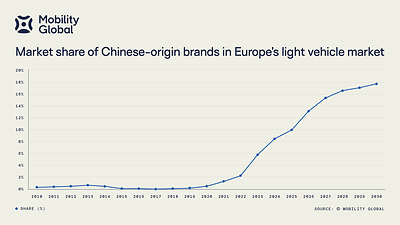
The scale of the shift is already evident, according to the analysis. Mobility Global's analysis projects that Chinese-origin brands could reach nearly
"Much of the conversation around the industry has focused on electrification, but that misses the bigger story," said Michael Robinet, vice president of forecast strategy at Mobility Global. "What we are witnessing is a restructuring of the competitive landscape itself. Companies that succeed over the next decade will be those that reduce complexity, accelerate decision-making and build organizations capable of adapting to continuous change. The challenge is no longer just building better vehicles. It is building a better system."
The report argues that some Western automakers face a uniquely complex challenge. They must simultaneously defend home-market share, offset shrinking profit pools in
Drawing on Mobility Global's proprietary scenario planning, the report explores two potential paths for Western automakers. In a "Western Renaissance" scenario, manufacturers make sustained progress in platform consolidation, parts standardization, software integration and shorter product development cycles, gradually reducing some of
The report contends that future competitiveness will be won through structural reform rather than headline product launches. Manufacturers that simplify operations, consolidate their architectures and standardize non-differentiating parts can free up the capital and invest quickly where it matters most: resilient supply chains and the software-defined capabilities that now shape how a vehicle is judged.
Governments, too, will play an increasingly visible role. With
Nowhere is this tension more visible than in
According to the report, the most likely outcome is not the disappearance of Western automakers but a more divided global industry: one ecosystem centered on
However, the significance of
"It has exposed a widening gap between traditional measures of competitiveness and the capabilities required in a more technology-driven, capital-intensive and supply-chain-dependent industry," said Calum MacRae, executive director for supply chain and technology at Mobility Global. "How manufacturers respond to that gap will play a central role in determining the industry's future structure."
Contacts:
Media
Naz Fathi
External Communications Director
Contact us: Media@mobilityglobal.com
Mobility Global (NYSE: MBGL) is a leading provider of automotive data, providing critical data and analytics across the full vehicle lifecycle. Its portfolio of trusted brands and products includes CARFAX, automotiveMastermind, Polk Automotive Solutions, and Market Scan, supporting the world's major automotive manufacturers, suppliers, dealer groups, media, financial institutions, and consumers with data, forecasts, insights, technology, and innovation. For more, visit mobilityglobal.com.
Forward-Looking Statements
This press release contains "forward-looking statements," as defined in the Private Securities Litigation Reform Act of 1995. These statements, which express management's current views concerning future events, trends, contingencies or results appear at various places in this press release and in the referenced report and use words like "anticipate," "assume," "believe," "continue," "estimate," "expect," "forecast," "future," "warn," "plan," "potential," "predict," "project," "explore," "target," "contend" and similar terms, and future or conditional tense verbs like "could," "may," "might," "should," "will" and "would." For example, management may use forward-looking statements when addressing topics such as: the outcome of contingencies; future actions by regulators; changes in the business strategies within the automotive industry; future actions by suppliers and consumers; the development and performance of the automotive market; and the impact of global and regional economic conditions.
Forward-looking statements are subject to inherent risks and uncertainties. Several factors could cause actual results to differ materially from those expressed or implied in forward-looking statements. Mobility Global and its subsidiaries operate in a dynamic business environment in which new risks emerge frequently. Accordingly, Mobility Global cautions readers not to place undue reliance on any forward-looking statements, which speak only as of the dates on which they are made. Mobility Global undertakes no obligation to update or revise any forward-looking statement to reflect events or circumstances arising after the date on which it is made, except as required by applicable law. Further information about Mobility Global is contained in its filings with the Securities and Exchange Commission (SEC), including in Item 1A, "Risk Factors," in Mobility Global's Registration Statement on Form 10 filed with the SEC on May 27, 2026, as amended.

 View original content to download multimedia:https://www.prnewswire.com/news-releases/chinas-automotive-playbook-is-rewriting-global-competition-mobility-global-finds-302907015.html
SOURCE Mobility Global, Inc.