
Momentus Demonstrates AI-Enabled LiDAR and Imaging Suite During Successful On-Orbit RPO Mission with NASA Satellite
The mission met its primary and extended objectives under a previously awarded $1.86 million SpaceWERX contract.
Sentiment and the balance of points
Rhea-AI Sentiment reads the wording of the document, how positive or negative its language is on a 1 to 5 scale. The balance of points shown with the takes weighs what the document actually discloses, so the two can disagree, for example when a trial that missed its main goal is described in upbeat language.




Successfully validates cost-efficient AI-enabled sensing and communications technologies to enable future advanced space missions
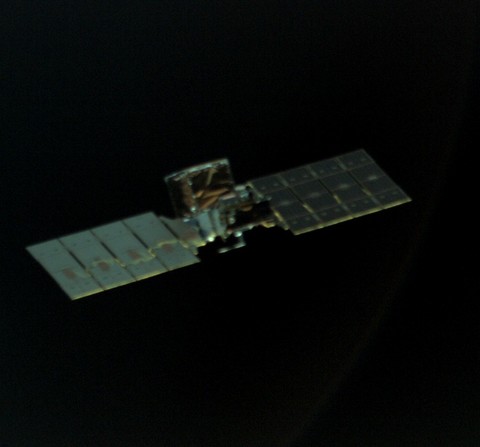
Momentus Vigoride 7 OSV with sensor suite taken by NASA R5-S10 satellite (Image Credit: NASA-JSC)
"This demonstration highlights Momentus' ability to integrate and validate innovative commercial technologies, unlocking new capabilities for in-space transportation, servicing, and logistics," said John Rood, Momentus Chief Executive Officer. "We believe lower cost autonomous operations conducted at greater scale have significant potential to play a key role in supporting in-space operations like manufacturing, servicing, and habitation in the growing space economy."
The demonstration was undertaken under the Company’s contract with SpaceWERX, the innovation arm of the
During the mission, Momentus deployed NASA's R5-S10 6U CubeSat from Vigoride-7. Following deployment and autonomous spacecraft checkout, the NASA satellite performed navigation maneuvers in the vicinity of Vigoride-7, enabling the collection of optical, infrared, and LiDAR data at varying distances and under multiple lighting conditions.
The demonstration successfully achieved both its primary and extended mission objectives. Data collected by the sensor suite tracked and characterized the NASA satellite throughout the operation.
R5-S10 is funded and managed by NASA’s Small Spacecraft and Distributed Systems (SSDS) within the agency’s Research and Technology Mission Directorate (RTMD), along with additional support provided by Johnson Space Center’s Engineering Directorate. SSDS is based at NASA's Ames Research Center in
Through a previously announced collaboration with Solstar Space, this mission successfully demonstrated the use of Solstar's Deke communications terminal. Deke maintained communications between the two spacecraft and supported the transfer and download of imagery collected during the demonstration. The successful performance of the communications system highlights the growing role of commercial space networking capabilities in supporting advanced on-orbit operations.
With the success of this demonstration, Momentus continues to expand its growing portfolio of on-orbit technology and is a further demonstration that the Vigoride platform is an effective vehicle for testing and deploying next-generation space infrastructure technologies. By validating commercially derived autonomous operations technologies on orbit, the Company is positioning itself to pursue future government and commercial opportunities in emerging space infrastructure markets while expanding the long-term revenue potential of the Vigoride platform.
Momentus launched Vigoride-7 aboard the SpaceX Transporter-16 rideshare mission in March 2026 and has now successfully demonstrated critical technologies supporting future in-space logistics and servicing architectures.
The Company's upcoming fully booked Vigoride-8 mission is scheduled to fly in 2027 carrying two NASA payloads. Momentus has also begun work on its Vigoride-9 spacecraft. Capacity remains available on the Vigoride-9 mission, and organizations interested in securing a payload slot can contact the Momentus Commercial team at sales@momentusspace.com.
About Momentus
Momentus is a U.S. commercial space company offering satellites, satellite components, and in-space transportation and infrastructure services. Through its Vigoride orbital service vehicle, the Company delivers hosted payload support, last-mile delivery, and servicing capabilities tailored to scalable mission architectures.
Forward-Looking Statements
This press release contains certain statements which may constitute “forward-looking statements” for purposes of the federal securities laws. Forward-looking statements include, but are not limited to, statements regarding the expected filing of the Company’s Form 10-K and Form 10-Q and its management team’s expectations, hopes, beliefs, intentions or strategies regarding the future, projections, forecasts or other characterizations of future events or circumstances, including any underlying assumptions, and are not guarantees of future performance. Because forward-looking statements relate to the future, they are subject to inherent uncertainties, risks and changes in circumstances that are difficult to predict and many of which are outside of Momentus’ control. Many factors could cause actual future events to differ materially from the forward-looking statements in this press release, including but not limited to risks and uncertainties included under the heading “Risk Factors” in the Annual Report on Form 10-K filed by the Company on March 31, 2026, as such factors may be updated from time to time in our other filings with the Commission, accessible on the Commission’s website at www.sec.gov and the Investor Relations section of our website at investors.momentus.space. Forward-looking statements speak only as of the date they are made. Readers are cautioned not to put undue reliance on forward-looking statements, and, except as required by law, the Company assumes no obligation and does not intend to update or revise these forward-looking statements, whether as a result of new information, future events, or otherwise.
View source version on businesswire.com: https://www.businesswire.com/news/home/20260929557309/en/
Media Contact
press@momentusspace.com
Momentus Investor Relations
investors@momentusspace.com
Source: Momentus Inc.