
Encouraging High-Pressure Slurry Ablation Test Results at Myriad's Copper Mountain Uranium Project
Lab-scale HPSA tests on Copper Mountain material show high uranium recoveries with large mass and radionuclide reductions in the waste fraction.
Rhea-AI Summary
Myriad Uranium (MYRUF) reported initial 2026 test results showing DISA Uranium's high-pressure slurry ablation (HPSA™) technology can substantially concentrate uranium from Copper Mountain samples.
From a composite sample of about 50 kg, HPSA processing recovered 83.9%–90.6% of uranium into a fines concentrate representing 29.3%–37.5% of the total mass, implying roughly a 70% reduction in material requiring further processing. Uranium concentration in the clean coarse fraction was cut by 74.5%–87.9%, while Ra-226 and Th-230 activities in that waste fraction were reduced by 78.8% and 83.5%, respectively. Myriad cites historical Hazen leach tests from 1976 showing >92% uranium recovery with dilute sulphuric acid, which, combined with HPSA preconcentration, could lower overall beneficiation costs. The company notes that further and full-scale testing and optimization are still required.
Positive
- Uranium recovery to fines concentrate 83.9%–90.6% across test intervals
- Mass reduction for further processing fines concentrate only 29.3%–37.5% of total mass
- Uranium reduction in coarse waste 74.5%–87.9% decrease in uranium concentration
- Radionuclide reduction in coarse waste Ra-226 −78.8%, Th-230 −83.5%
- Historical leach tests >92% uranium recovery (most samples >96%) with dilute sulphuric acid
- 100% ownership of Copper Mountain plus interests in Red Basin and Arizona Breccia Pipe projects
Negative
- Tests are lab-scale based on ~50 kg sample; full-scale results still unproven
- Further optimization required company states future testing is needed to improve recoveries
- Historical resource estimates not yet verified as current NI 43-101 mineral resources or reserves
News Explained
The result remains an initial laboratory batch test, not a full-scale operation: Myriad says full-scale results are expected to track the first interval, which put
AI-generated analysis. How Rhea-AI works. Not financial advice.




Vancouver, British Columbia--(Newsfile Corp. - September 22, 2026) - Myriad Uranium Corp. (CSE: M) (OTCQB: MYRUF) (FSE: C3Q) ("Myriad" or the "Company") is pleased to announce the results of an initial testing campaign conducted by DISA Uranium™ Corporation ("DISA Uranium") in 2026 with samples from Myriad Uranium. The primary objective of testing was to determine how efficiently DISA's high-pressure slurry ablation technology ("HPSA™") could concentrate uranium and improve recovery of uranium from the concentrated mass fraction.
Myriad's CEO, Thomas Lamb, commented: "Wyoming's DISA Uranium, in partnership with IsoEnergy and with backing from other uranium industry leaders, has developed a slurry ablation technology, which is potentially tailor-made for Copper Mountain's uraniferous material. Simply put, initial tests confirm that the process can reduce rock mass by about
HPSA™ test results indicate the following:
Effective particle size reduction (setting up the size-based separation that follows).
Meaningful reduction of uranium in the clean coarse material achieved (
74.5% to87.9% ). Most of the uranium was successfully stripped out of the coarse rock, which is typically discarded as waste.78.8% reduction in Ra-226 activity and an83.5% reduction in Th-230 activity, leaving cleaner waste material for handling and disposal.Calculated recoveries of uranium in the fines concentrate were
83.9% (over the first-time interval sample) and90.6% (over the second time interval sample). This is only a marginal increase in recovery over a longer period of ablation.HPSA™ test results indicate that with minimal particle collisions, the process concentrated
83.9% of the uranium into29.3% of the overall mass, i.e. a roughly70% reduction in mass requiring further processing, while keeping most of the uranium.Improved recovery of the concentrated mass fraction, leaving a cleaner coarse (waste) fraction. More uranium ends up in the small concentrate stream, and what's left over (the coarse material) is correspondingly cleaner/lower grade, meaning less material requiring further processing.
Early leach testing by Hazen Research (1976) for Union Pacific found greater than
92% uranium recovery (with most samples >96% ) using a dilute sulphuric acid leach. This, combined with a preconcentration method such as HPSA™, could result in significant overall reduction in beneficiation costs.
DISA Uranium's HPSA™ Methodology and Results
Myriad provided approximately 50 kg of sample material from its 2024 drilling campaign at Canning to DISA Uranium for HPSA™ testing. The HPSA™ process involves the collision of two slurry streams at high pressures to liberate minerals from gangue material for recovery in the fines concentrate. As particles collide at high velocities inside the HPSA™ collision chamber, they fracture at their natural grain boundary lines, which allows minerals to be liberated and recovered. Samples were collected at various time intervals in the unit to show increased liberation and recoveries over time.
The objectives of testing were to:
Provide elemental analysis before and after HPSA™ processing.
Analyse uranium and overall mass shifts at different collision intervals throughout HPSA™ processing.
Determine elemental recoveries in the minus 53-micron size fraction post-HPSA™ processing.
The composite sample was subjected to initial material characterization to determine particle size distribution (PSD), ICP-MS for uranium, and radionuclide activity analysis for Ra-226 and Th-230. This was followed by HPSA™ testing in a batch-style HPSA™ unit (Figure 1) under set parameters and variable testing times. Collected samples were then characterized by a PSD and ICP-MS for uranium. The elemental analysis by ICP-MS for uranium and radionuclide activity analysis for Ra-226 and Th-230, was performed by a third-party laboratory (Energy Labs).
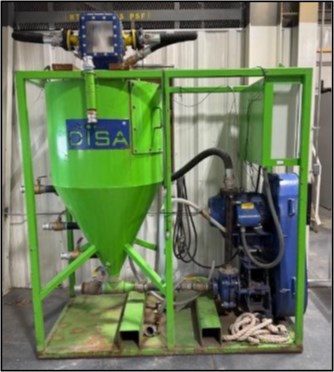
Figure 1 HPSA test unit.
To view an enhanced version of this graphic, please visit:
https://images.newsfilecorp.com/files/6301/315372_e7e262c9c44e3a6b_002full.jpg
ICP-MS results indicated that the total percent reduction of uranium concentration ranged from
Table 1 Results summary of ICP-MS for uranium (bulk feed and HPSA products).
| Parameter | Uranium [ppm] | ||
| Bulk Feed | Time Sample 1 | Time Sample 2 | |
| Calculated Head Grade [ppm] | 306 | 306 | 306 |
| Clean Coarse Material (+53-micron) | 128 | 78 | 37 |
| Fines Concentrate (-53-micron) | 929 | 977 | 593 |
| Total Percent Reduction | |||
| Total Percent Recovery to Fines Concentrate | |||
| Percent Mass to Concentrate Fraction | |||
The radionuclide activity analysis indicated successful reduction in contaminants in the clean coarse material. For time sample 1, the percent reduction of Ra-226 activity was
Conclusion
The results of the testing campaign indicated that HPSA™ processing was successful in uranium liberation and recovery. Meaningful size reduction was also achieved. The percent reduction of uranium in the clean coarse material ranged from
This testing demonstrated that the HPSA™ technology can improve the recovery of uranium for the material provided by Myriad Uranium. Future testing would be beneficial to continue to optimize and improve selective liberation of the uranium particles for increased recovery.
Qualified Person
The scientific and technical information in this news release, including the eU3O8 methodology and historical disclosure, has been reviewed and approved by George van der Walt, MSc., Pr.Sci.Nat., FGSSA, a "Qualified Person" as defined under NI 43-101. Mr. van der Walt is a Principal Consultant with The MSA Group (Pty) Ltd, an independent consultancy, and is independent of the Company for the purposes of NI 43-101. A Qualified Person has not done sufficient work to verify historical exploration results or to classify the historical estimates referred to in this news release as current mineral resources or mineral reserves, and Myriad is not treating such historical estimates as current mineral resources or mineral reserves.
About Myriad Uranium Corp.
Myriad Uranium Corp. holds a
A news release detailing a comprehensive assessment of Copper Mountain's uranium endowment by Bendix Engineering for the US Department of Energy published in 1982 can be viewed here.
Myriad holds a
Myriad's
Note: A qualified person has not done sufficient work to classify the Copper Mountain, Red Basin, and Breccia Pipe Project historical estimates as current mineral resources or reserves and Myriad is not treating historical estimates as current resources or reserves. Myriad intends to conduct further work to determine whether the historical estimates can be verified and, if appropriate, supported by current mineral resource estimates.
For further information, please refer to Myriad's disclosure record on SEDAR+ (www.sedarplus.ca), contact Myriad by telephone at +1.604.418.2877, or refer to Myriad's website at www.myriaduranium.com.
About DISA Uranium
DISA Uranium™ Corporation (DISA Uranium) is redefining American uranium recovery and production. Headquartered in Casper, Wyoming, the veteran-led Company recovers uranium and vanadium from abandoned uranium mine (AUM) waste, remediates legacy sites left across the western United States, and applies its patented high-pressure slurry ablation technology (HPSA™) to make conventional uranium production cleaner, more efficient, and more economic. DISA Uranium holds the only U.S. Nuclear Regulatory Commission (NRC) license to treat and recover AUM waste across multiple sites - and with a growing conventional resource base behind it, the Company is building the domestic capacity to turn American waste and American ore into American fuel. The mission is simple: restore the past while powering the future and rebuild a secure domestic uranium supply chain.
Myriad Contacts:
Thomas Lamb
President and CEO
tlamb@myriaduranium.com
Forward-Looking Statements
This news release contains "forward-looking information" that is based on the Company's current expectations, estimates, forecasts and projections. This forward-looking information includes, among other things, the Company's business, plans, outlook and business strategy. The words "may", "would", "could", "should", "will", "likely", "expect," "anticipate," "intend", "estimate", "plan", "forecast", "project" and "believe" or other similar words and phrases are intended to identify forward-looking information. The reader is cautioned that assumptions used in the preparation of any forward-looking information may prove to be incorrect, including with respect to the Company's business plans respecting the exploration and development of the Company's mineral properties, the proposed work program on the Company's mineral properties and the potential and economic viability of the Company's mineral properties. Forward-looking information is subject to known and unknown risks, uncertainties and other factors that may cause the Company's actual results, level of activity, performance or achievements to be materially different from those expressed or implied by such forward-looking information. Such factors include, but are not limited to: inability to verify historical data, no assurance of defining mineral resources, permitting, drilling delays and changes in economic conditions or financial markets; increases in costs; litigation; legislative, environmental and other judicial, regulatory, political and competitive developments; and technological or operational difficulties. This list is not exhaustive of the factors that may affect our forward-looking information. These and other factors should be considered carefully, and readers should not place undue reliance on such forward-looking information. The Company does not intend, and expressly disclaims any intention or obligation to, update or revise any forward-looking information whether as a result of new information, future events or otherwise, except as required by applicable law. The CSE has not reviewed, approved or disapproved the contents of this news release.
To view the source version of this press release, please visit https://www.newsfilecorp.com/release/315372
FAQ
AI-generated questions and answers. How Rhea-AI works. Not financial advice.
What material was used for the HPSA™ testing and how was it analyzed?
Myriad supplied approximately 50 kg of sample material from its 2024 drilling campaign at Canning. The composite sample underwent initial material characterization for particle size distribution, uranium content by ICP-MS, and radionuclide activity for Ra-226 and Th-230. After HPSA processing, collected products were again analyzed for particle size and uranium by ICP-MS, and radionuclide activity was measured by third-party laboratory Energy Labs.
How did uranium concentration and mass distribution change between the first and second HPSA™ time intervals?
At the first time interval, 83.9% of uranium reported to the fines concentrate, which contained 29.3% of the total mass. At the second time interval, uranium recovery increased by 6.72% to 90.6%, with an additional 8.19% of mass in the fines concentrate, bringing that fraction to 37.5% of total mass.
What does Myriad say about scaling HPSA™ to full operations?
The company states that results of a full-scale operation are expected to align closely with the first laboratory time interval but notes that the system can be engineered and optimized depending on target recoveries and mass pull. It also indicates that future testing would be beneficial to further improve selective liberation of uranium particles.
What ownership interests does Myriad Uranium hold in its key projects?
Myriad holds a 100% interest in the Copper Mountain Uranium Project in Wyoming. It also has a 10% free carried interest in the Red Basin Uranium Project, now owned by Subatomic Industries, and a 100%-owned Breccia Pipe Project in Arizona that includes at least 23 breccia pipes prospective for uranium and rare earth elements.
How does Myriad treat the historical resource estimates mentioned for its projects?
The company explains that a Qualified Person has not done sufficient work to verify the historical exploration results or classify the historical estimates for Copper Mountain, Red Basin, or the Breccia Pipe Project as current mineral resources or reserves. Myriad is not treating these historical estimates as current resources or reserves and intends to conduct further work to determine whether they can be verified and, if appropriate, supported by current mineral resource estimates.