
Myriad Uranium Announces Further Strong Phase II Drill Results from Copper Mountain
Four of five holes intersected mineralisation above the reporting threshold, but the radiation-based grades still require laboratory verification.
Sentiment and the balance of points
Rhea-AI Sentiment reads the wording of the document, how positive or negative its language is on a 1 to 5 scale. The balance of points shown with the takes weighs what the document actually discloses, so the two can disagree, for example when a trial that missed its main goal is described in upbeat language.
Rhea-AI Summary
Myriad Uranium (MYRUF) reported preliminary uranium-equivalent drilling results from five holes at Hesitation and Arrowhead within its Copper Mountain project in Wyoming.
The holes totalled 797.1 metres; four intersected mineralisation above a 100 ppm threshold, with 22 discrete intervals exceeding that level. Hole HES0001BDD returned 34.29 metres at 399 ppm uranium equivalent from 107.15 metres. ARR0003DD recorded the highest peak grade, 1,648 ppm, at 11.6 metres.
Uranium-equivalent grades are estimates from downhole radiation measurements, not chemical assays, and remain subject to laboratory verification. The Phase II program aims to verify mineralisation underlying historical estimates, support a future maiden mineral resource estimate and test exploration targets. Myriad does not treat the historical estimates as current mineral resources or reserves.
How this balance works
Rhea-AI gives every point it takes from this document a weight. Minor counts 1, Moderate 3 and Major 9, so one Major point outweighs several Minor ones. The bar adds up the weights on each side, and when neither side holds more than 65% of the total the balance reads Mixed.
It reads the document as published, with the same rules for every company, and it does not look at what the market expected or at how the stock traded, so a point can be objectively good on a day the stock falls.
Rhea-AI Sentiment measures something else, the tone of the wording.
Hollow bars mark forward-looking points. How the balance works
Positive
- Moderate pointFour of five holes intersected mineralisation above 100 ppm across 797.1 metres of drilling.
- Minor pointHES0001BDD returned 34.29 metres at 399 ppm uranium equivalent from 107.15 metres.
- Minor pointHES0001BDD also returned a separate 7.60-metre interval at 272 ppm uranium equivalent.
- Minor pointHES0002DD returned 2.59 metres at 486 ppm uranium equivalent from 66.86 metres.
- Minor pointHES0002DD returned another 2.59 metres at 414 ppm uranium equivalent from 123.09 metres.
2 minor points
- Minor pointARR0003DD returned 1.22 metres at 786 ppm uranium equivalent, with a 1,648 ppm peak.
- Minor point. Forward-looking: it has not happened yet and may not happen.Phase II drilling aims to support a maiden mineral resource estimate and test exploration targets.
Negative
- Minor point. Forward-looking: it has not happened yet and may not happen.Preliminary radiation-based grades are not chemical assays and remain subject to laboratory verification.
News Explained
Myriad Uranium says it will amend and refile its annual and interim statements; its preliminary, unaudited estimate adds about
AI-generated analysis. How Rhea-AI works. Not financial advice.


Vancouver, British Columbia--(Newsfile Corp. - October 28, 2026) - Myriad Uranium Corp. (CSE: M) (OTCQB: MYRUF) (FSE: C3Q) ("Myriad" or the "Company") is pleased to announce preliminary gamma probe equivalent uranium (eU₃O₈) results from five boreholes recently drilled at Hesitation and Arrowhead, two of six tightly clustered historical uranium deposits at the Company's
Copper Mountain was historically advanced by Union Pacific and Southern California Edison planned to develop Copper Mountain as a large-scale conventional mining operation beginning in 1983 but shelved those plans after the 1979 Three Mile Island accident stalled U.S. nuclear development for decades. These results are not chemical assays and remain subject to laboratory verification.
Myriad's CEO Thomas Lamb commented: "The longest mineralized interval is 34.29 metres (112.5 feet) at 399 ppm eU₃O₈ from 107.15 m with a peak grade of 1,511 ppm in HES0001BDD (using a 100 ppm threshold) and includes 20.27 metres (66.5 feet) at 520 ppm and two intersections above 1,000 ppm eU₃O₈. The exceptional thickness in this single hole, one of the longest intervals recorded in modern drilling at Copper Mountain, is a reminder that the Project's uranium endowment is potentially one of America's largest. Our current Phase II drill program continues to exceed our expectations."
Highlights
Myriad's current Phase II drill program is designed to achieve two primary objectives:
Verify mineralisation that underpins the historical resource estimate1 of 26.63 Mlbs eU₃O₈ and generate modern data to support a future maiden mineral resource estimate.
Unlock the Project's significant exploration upside by drill-testing a deep inventory of targets defined by 1970s drilling and generated by Myriad's own exploration.
Myriad completed 2 holes at Hesitation and 3 holes at Arrowhead for a total of 797.1 metres (2,615 feet) of drilling.
4 of the 5 holes intersected mineralisation above a 100 ppm threshold.
Across the 5 holes, 22 discrete mineralized intervals exceed 100 ppm eU₃O₈.
The longest mineralized interval is 34.29 metres (112.5 feet) grading 399 ppm eU₃O₈ from 107.15 m with a peak grade of 1,511 ppm in HES0001BDD (using a 100 ppm threshold).
The highest peak grade intercepted is 1,648 ppm eU₃O₈ in hole ARR0003DD at 11.6 m (38 feet).
Best Intervals Above 100 ppm eU₃O₈ Threshold
| Hole ID | From (m) | To (m) | Length (m) | eU₃O₈ (ppm) | eU₃O₈ (%) | Peak Grade (eU3O8 ppm) | Depth (m) |
| HES0001BDD | 86.12 | 93.73 | 7.60 | 272 | 0.027 | 796 | 87.6 |
| including | 87.34 | 88.10 | 0.76 | 620 | 0.062 | 796 | 87.6 |
| including | 91.15 | 92.06 | 0.91 | 627 | 0.063 | 722 | 91.8 |
| HES0001BDD | 107.15 | 141.44 | 34.29 | 399 | 0.040 | 1,511 | 136.5 |
| including | 121.17 | 141.44 | 20.27 | 520 | 0.052 | 1,511 | 136.5 |
| including | 131.69 | 132.91 | 1.22 | 1,079 | 0.108 | 1,277 | 132.5 |
| including | 135.96 | 136.72 | 0.76 | 1,360 | 0.136 | 1,511 | 136.5 |
| HES0002DD | 66.86 | 69.45 | 2.59 | 486 | 0.049 | 931 | 68.8 |
| including | 68.08 | 69.30 | 1.22 | 790 | 0.079 | 931 | 68.8 |
| HES0002DD | 123.09 | 125.68 | 2.59 | 414 | 0.041 | 1,292 | 124.1 |
| including | 123.70 | 124.31 | 0.61 | 1,075 | 0.108 | 1,292 | 124.1 |
| ARR0003DD | 11.05 | 12.27 | 1.22 | 786 | 0.079 | 1,648 | 11.6 |
| including | 11.20 | 11.96 | 0.76 | 648 | 0.065 | 1,648 | 11.6 |
- Equivalent uranium (eU₃O₈) grades are radiometric estimates derived from downhole gamma logging and are not chemical assays. They are preliminary, may be affected by disequilibrium, borehole diameter, casing, water, probe calibration and other borehole conditions, and will be verified by laboratory assay results. Verification will include standard QAQC protocols such as the insertion of blanks, standards (Certified Reference Materials) and duplicates as well as the implementation of chain-of-custody procedures.
- The intervals above are selected preliminary radiometric intervals reported above a 100 ppm eU3O8 threshold and are intended to highlight the most material intercepts by length, grade and grade-thickness. They should be read together with Appendix 1, which provides the full interval summaries at the stated reporting thresholds.
- Reported intervals are downhole lengths and do not represent true widths, which have not yet been determined.
The Hesitation Deposit
The Hesitation deposit is located approximately 400 m (1,300 ft) east of the main Canning deposit (Figure 1). In 1969, RMEC intercepted low-grade mineralisation at Hesitation (>
Uranium mineralisation occurs both in the Eocene sediments and within the fractured Precambrian basement. In the younger sediments, mineralisation is preferentially hosted in slightly to moderately oxidized conglomerates and sandstones. Within the basement rocks, uranium occurs predominantly as pitchblende and coffinite coatings of fracture surfaces, commonly associated with pyrite and secondary iron oxides. Mineralisation intensity increases with fracture density, and roughly two-thirds of the mineralisation hosted in the basement occurs within, or associated with, the metamorphic rafts or xenoliths within the granite, which appear to act as structural and chemical traps due to their higher iron and sulphide content (Kendall et al., 1980).
Table 1 Drilled location details at Hesitation
| Borehole ID | X | Y | Inclination | Azimuth | TD (m) | TD (ft) |
| HES0001BDD | 268308 | 4809879 | -90 | 0 | 215.2 | 706 |
| HES0002DD | 268371 | 4809911 | -90 | 0 | 163.7 | 537 |
| Coordinate System: WGS84 UTM13N | ||||||
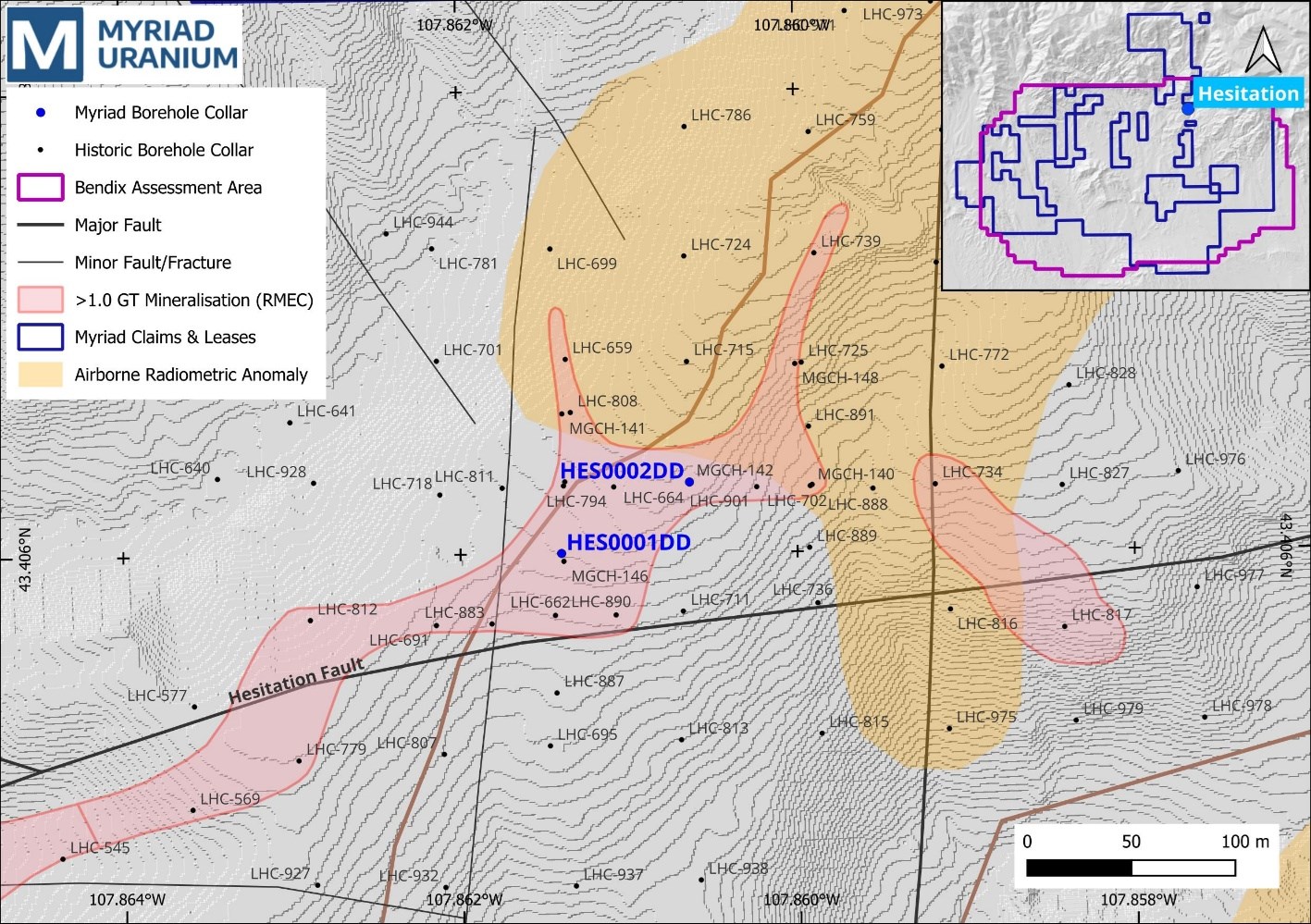
Figure 1: Drilled locations at Hesitation
To view an enhanced version of this graphic, please visit:
https://images.newsfilecorp.com/files/6301/321349_b5f578ae94a07b57_002full.jpg
The Arrowhead Deposit
The Arrowhead deposit is located approximately 500 m (1,600 ft) west of the main Canning deposit (Figure 2). The Arrowhead Mine area (Dry Creek valley) has a history of exploration, development and production activities dating back to the late 1950s. Susquehanna Western Inc. began exploring and developing old underground workings in December 1961. They mined approximately 500,000 pounds at an average grade of
Historically mined uranium mineralisation at Arrowhead occurs primarily within the younger Wagon Bed sediments, where sooty pitchblende, coffinite, and autunite coat clasts and fill pore spaces in the conglomerate and arkosic sandstone units. The clay-rich facies appear to have been too impermeable to host significant mineralisation. Mineralisation also occurs in the underlying Precambrian rocks; however known uranium occurrences were reported to be low-grade, reflecting limited fracture permeability, weak alteration, and minimal oxidation—all factors that restricted fluid flow and prevented substantial uranium enrichment (Kendall et al., 1980).
Table 2 Drilled location details at Arrowhead
| Borehole ID | X | Y | Inclination | Azimuth | TD (m) | TD (ft) |
| ARR0001DD | 266011 | 4809794 | -90 | 0 | 91.4 | 300 |
| ARR0002DD | 265789 | 4809857 | -90 | 0 | 152.4 | 500 |
| ARR0003DD | 265790 | 4810103 | -90 | 0 | 174.3 | 572 |
| Coordinate System: WGS84 UTM13N | ||||||
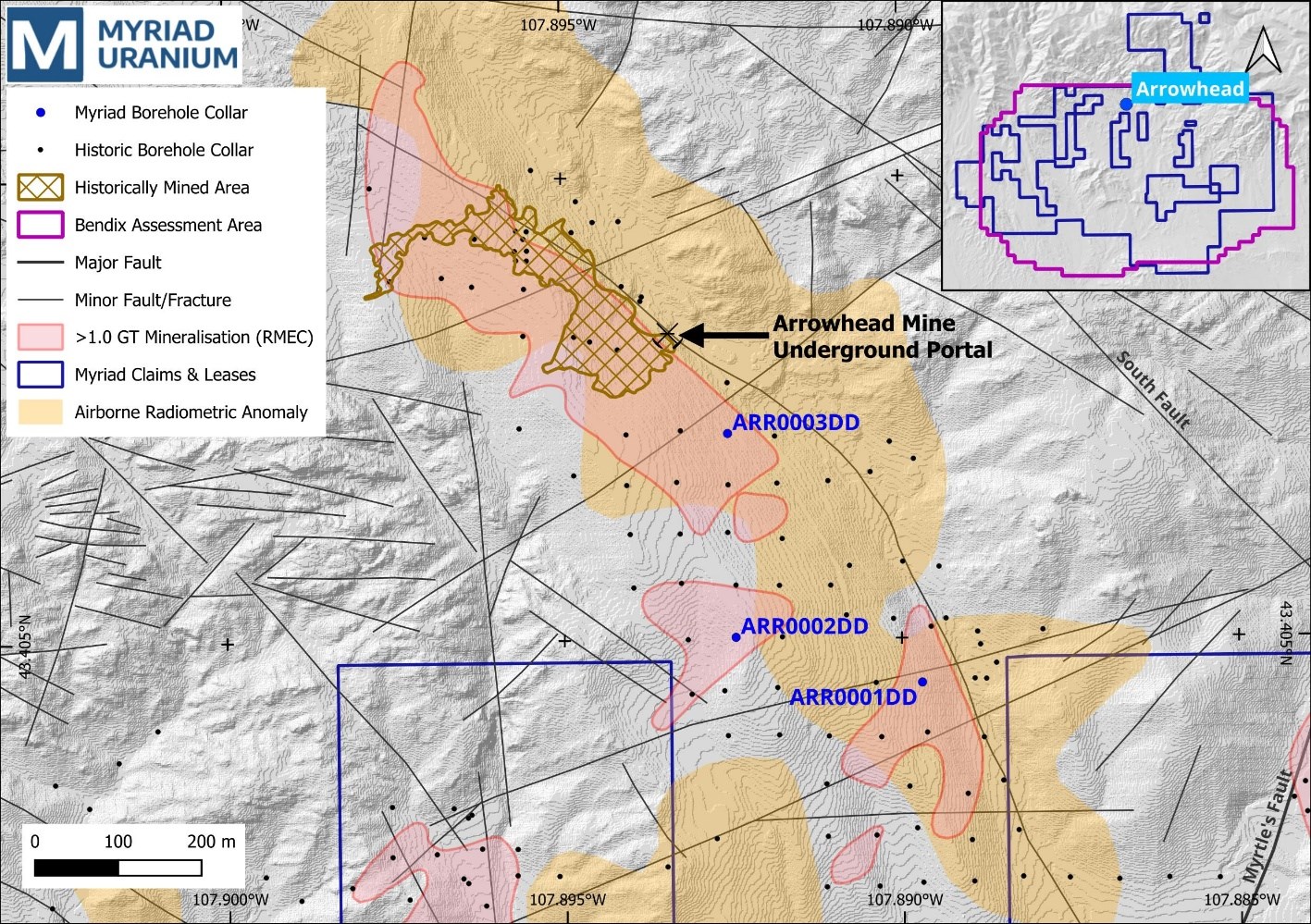
Figure 2: Drilled locations at Arrowhead and the extent of historical mining
To view an enhanced version of this graphic, please visit:
https://images.newsfilecorp.com/files/6301/321349_b5f578ae94a07b57_003full.jpg
Downhole Logging
Downhole logging was undertaken by Century Geophysical (Century), a respected downhole probe manufacturer and logging company based in Tulsa, Oklahoma, that has operated since 1946. Century deployed its "Uranium E-Log Suite", which includes Natural Gamma Ray, Resistivity, Spontaneous Potential (S.P.) and Deviation probes. Borehole deviations were additionally measured using a Gyro Deviation tool, which is unaffected by magnetic interference. Century delivered electronic data for each hole, including log plots and calculated equivalent uranium grades.
Equivalent Uranium Grade Calculations
Century uses its OREGRADE system to convert raw gamma-ray logs into uranium grade estimates expressed as eU3O8. The process relies on a trial-and-error iterative deconvolution algorithm to model the distribution of radioactivity from gamma-ray log data. Raw gamma counts are normalized and corrected for borehole conditions by applying dead time correction, geometric multipliers for area-based K-factors and linear depth, and environmental corrections such as water factor below the water table and casing factor within cased sections. The system uses synthetic log creation and iterative interval calculations to estimate eU3O8 grades over 15 cm (0.5 foot) intervals. The final output is a grade curve and a printed report that identifies distinct zones and calculates cut-off analyses and best intervals based on grade-thickness product. These results remain subject to the limitations of gamma logging and confirmation by laboratory assays.
Historical Resource Estimates
The historical estimates for Hesitation of 4.38 Mt containing 2.20 Mlbs at an average grade of 250 ppm eU3O8, and for Arrowhead of 0.31 Mt containing 0.47 Mlbs at an average grade of 700 ppm eU3O8, using a 100 ppm cut-off, were compiled from internal Rocky Mountain Energy Company reports, which are summarised in a report titled "Copper Mountain Exploration Project Report" by Southard, G.G., et al. (1979). These historical estimates form part of the overall historical estimate for Copper Mountain of 26.63 Mlbs eU₃O₈ contained in 48.95 Mt at 269 ppm eU₃O₈, at a 100 ppm cut-off. A Qualified Person has not done sufficient work to classify the historical estimate as current mineral resources or mineral reserves, and Myriad is not treating the historical estimate as current mineral resources or mineral reserves.
The historical estimates were completed using polygonal methods based on modelled mineralisation geometries. The historical estimates used U.S. Bureau of Mines categories at the time, including terms described as "Inferred" and "Indicated," which are not current CIM terminology and should not be interpreted as current mineral resource categories. Details of the historical resource estimates are available in the current NI 43-101 Technical Report. While the QP has determined that the historical estimates described in this news release are relevant to the Copper Mountain Project Area, are reasonably reliable given the authors and circumstances of their preparation, and are suitable for public disclosure, the estimates are decades old and based on drilling data for which the logs are currently, predominantly not available. Readers are cautioned not to place undue reliance on these historical estimates as an indicator of current mineral resources or mineral reserves at the Project Area. Also, while the Copper Mountain Project Area contains all or most of each deposit referred to, some of the historically estimated mineralization referred to may be located outside the current Copper Mountain Project Area.
Inherent limitations of the historical estimates include that the nature of mineralisation (fracture-hosted) makes estimation from drill data less reliable than other deposit types (e.g. those that are thick and uniform). From Myriad Uranium's viewpoint, limitations include that the Company has not been able to verify the original data itself and that the estimates may be optimistic relative to subsequent work which applied a "delayed fission neutron" (DFN) adjustment factor to calculate grades. On the other hand, DFN is controversial, in that the approach is viewed by some experts as too conservative. Nevertheless, it was applied in later resource estimations by Union Pacific relating to Copper Mountain. To verify the historical estimates and support their classification as current mineral resources, a programme of re-drilling is required to generate new data that can be used to establish the correlation and continuity of geology and grades between boreholes with sufficient confidence to estimate mineral resources.
Exploration Target
The Exploration Target of 1,111 to 2,971 Mt at 100 ppm eU3O8 or 222 to 594 Mt at 500 ppm eU3O8 is based on an assessment completed by the Bendix Field Engineering Corporation ("Bendix") in 1982 on behalf of the U.S. Department of Energy ("DOE"). The methodology and outcomes of the study were detailed in two reports, namely "An Exploration Systems Approach to the Copper Mountain Area Uranium Deposits, Central Wyoming" (Hennesy, September 1982), and "Copper Mountain, Wyoming, Intermediate-Grade Uranium Resource Assessment Project Final Report" (Sayala et al., November 1982). Details of the Exploration Target are available in the current NI 43-101 Technical Report.
Bendix relied on an extensive dataset for their assessment. The information was a combination of data provided by Union Pacific and data collected by Bendix. This included detailed geological studies (general geology, tectono-depositional analysis, structure and metallogeny), surface geochemical studies (lithogeochemical, soil and stream surveys), subsurface geochemical studies (drilling, spectral radiometric probing and core geochemistry), geophysics (radiometric, magnetic and electrical methods) and emanometric (helium and radon) studies. Seven holes (CM-series) were drilled by Bendix in and around the Canning deposit. The data from a further 1,193 holes drilled by RMEC in the Control Area was also supplied to Bendix for their studies.
The data were used to develop a genetic model for uranium mineralisation in the Precambrian and Eocene sedimentary host rock environments, and to develop a structural scoring system in the high-confidence control area to establish the basis for estimations of uranium mineralisation endowment in the total Assessment Area. The model ultimately relied on the relationship between structure and uranium mineralisation, which is the primary style of mineralisation control in granite at Copper Mountain. The scoring system developed for structural favourability (aside from favourable granitic host rock) was based on the following parameters and their potential contribution to structural preparation: 1) the presence of grabens; 2) the presence of a major east-west-trending fault zones; 3) the presence of fault intersections; 4) the presence of variously oriented subsidiary faults; and 5) positioning along a known or inferred favourable structural trend. The scoring system was applied across the Control Area and compared with known deposit locations.
The QP considers the methodology and basis on which the target range has been estimated to be appropriate and relevant for Myriad's own exploration planning. The potential quantity and grade of the Exploration Target are conceptual in nature, there has been insufficient exploration to define a mineral resource, and it is uncertain whether further exploration will result in the Exploration Target being delineated as a mineral resource.
Restatement of Financial Statements
Myriad also announces that it will be adjusting its accounting for non-cash share-based compensation under IFRS 2 for the year ended April 30, 2026 (the "Annual Statements") and its interim financial statements for the three months ended July 31, 2026 (the "Interim Statements"). The adjustment will be entirely non-cash.
Based on its preliminary assessment, the Company expects the restatement to add approximately
The Company will amend and restate the Annual Statements and the Interim Statements, together with the related Management's Discussion and Analysis (collectively, the "Restated Documents"), and will file the Restated Documents on SEDAR+ with re-filed CEO and CFO certifications. Until the Restated Documents are filed, investors should not rely on the previously filed financial statements, Management's Discussion and Analysis or other financial information for these periods. The re-filed financial statements will include note disclosure that contains details of the effect of the restatement for the periods indicated. The adjustment amount provided above is a preliminary unaudited estimate based on currently available information and is subject to change during the course of the Company's restatement process.
Qualified Person
The scientific and technical information in this news release, including the eU3O8 methodology and historical disclosure, has been reviewed and approved by George van der Walt, MSc., Pr.Sci.Nat., FGSSA, a "Qualified Person" as defined under NI 43-101. Mr. van der Walt is a Principal Consultant with The MSA Group (Pty) Ltd, an independent consultancy, and is independent of the Company for the purposes of NI 43-101. A Qualified Person has not done sufficient work to verify historical exploration results or to classify the historical estimates referred to in this news release as current mineral resources or mineral reserves, and Myriad is not treating such historical estimates as current mineral resources or mineral reserves.
About Myriad Uranium Corp.
Myriad Uranium Corp. holds a
A news release detailing a comprehensive assessment of Copper Mountain's uranium endowment by Bendix Engineering for the US Department of Energy published in 1982 can be viewed here.
Myriad holds a
Myriad's
Myriad recently agreed to acquire the 55,000 hectare Los Altares Uranium Project in Argentina. Transaction closing procedures are underway. Announcement can be viewed here.
Note: A qualified person has not done sufficient work to classify the Copper Mountain, Red Basin, and Breccia Pipe Project historical estimates as current mineral resources or reserves and Myriad is not treating historical estimates as current resources or reserves. Myriad intends to conduct further work to determine whether the historical estimates can be verified and, if appropriate, supported by current mineral resource estimates.
For further information, please refer to Myriad's disclosure record on SEDAR+ (www.sedarplus.ca), contact Myriad by telephone at +1.604.418.2877, or refer to Myriad's website at www.myriaduranium.com.
Myriad Contacts:
Thomas Lamb
President and CEO
tlamb@myriaduranium.com
Forward-Looking Statements
This news release contains "forward-looking information" that is based on the Company's current expectations, estimates, forecasts and projections. This forward-looking information includes, among other things, the Company's business, plans, outlook and business strategy, and the amount and timing of the restatement of the Company's financial statements. The words "may", "would", "could", "should", "will", "likely", "expect," "anticipate," "intend", "estimate", "plan", "forecast", "project" and "believe" or other similar words and phrases are intended to identify forward-looking information. The reader is cautioned that assumptions used in the preparation of any forward-looking information may prove to be incorrect, including with respect to the Company's business plans respecting the exploration and development of the Company's mineral properties, the proposed work programme on the Company's mineral properties and the potential and economic viability of the Company's mineral properties. Forward-looking information is subject to known and unknown risks, uncertainties and other factors that may cause the Company's actual results, level of activity, performance or achievements to be materially different from those expressed or implied by such forward-looking information. Such factors include, but are not limited to: inability to verify historical data, changes to the preliminary restatement adjustments or delays in re-filing the Restated Documents, no assurance of defining mineral resources, permitting, drilling delays and changes in economic conditions or financial markets; increases in costs; litigation; legislative, environmental and other judicial, regulatory, political and competitive developments; and technological or operational difficulties. This list is not exhaustive of the factors that may affect our forward-looking information. These and other factors should be considered carefully, and readers should not place undue reliance on such forward-looking information. The Company does not intend, and expressly disclaims any intention or obligation to, update or revise any forward-looking information whether as a result of new information, future events or otherwise, except as required by applicable law. The CSE has not reviewed, approved or disapproved the contents of this news release.
APPENDIX 1: Preliminary eU3O8 Grade Interval Summaries at 100, 200 and 500 ppm thresholds
Reported intervals are downhole lengths; true widths have not yet been determined.
| 100 ppm Threshold | Peak Grade | Depth | |||||
| Hole ID | From (m) | To (m) | Length (m) | eU3O8 (ppm) | eU3O8 (%) | (eU3O8 ppm) | (m) |
| HES0001BDD | 54.88 | 55.79 | 0.91 | 123 | 0.012 | 148 | 55.1 |
| HES0001BDD | 86.12 | 93.73 | 7.60 | 272 | 0.027 | 796 | 87.6 |
| HES0001BDD | 101.06 | 102.12 | 1.07 | 127 | 0.013 | 164 | 101.3 |
| HES0001BDD | 107.15 | 141.44 | 34.29 | 399 | 0.040 | 1511 | 136.5 |
| HES0002DD | 56.04 | 58.78 | 2.74 | 247 | 0.025 | 430 | 57.5 |
| HES0002DD | 59.70 | 62.74 | 3.05 | 171 | 0.017 | 343 | 60.8 |
| HES0002DD | 63.51 | 66.10 | 2.59 | 189 | 0.019 | 317 | 65.6 |
| HES0002DD | 66.86 | 69.45 | 2.59 | 486 | 0.049 | 931 | 68.8 |
| HES0002DD | 75.09 | 76.92 | 1.83 | 152 | 0.015 | 191 | 75.8 |
| HES0002DD | 86.52 | 88.50 | 1.98 | 140 | 0.014 | 184 | 87.5 |
| HES0002DD | 111.51 | 114.25 | 2.74 | 119 | 0.012 | 160 | 113.4 |
| HES0002DD | 117.61 | 118.37 | 0.76 | 263 | 0.026 | 368 | 118.0 |
| HES0002DD | 119.13 | 121.11 | 1.98 | 117 | 0.012 | 131 | 119.8 |
| HES0002DD | 123.09 | 125.68 | 2.59 | 414 | 0.041 | 1292 | 124.1 |
| ARR0001DD | No intervals above 100 ppm | ||||||
| ARR0002DD | 84.05 | 85.12 | 1.07 | 126 | 0.013 | 163 | 84.7 |
| ARR0002DD | 108.13 | 108.89 | 0.76 | 182 | 0.018 | 240 | 108.5 |
| ARR0002DD | 150.04 | 150.65 | 0.61 | 195 | 0.019 | 266 | 150.4 |
| ARR0003DD | 9.07 | 10.13 | 1.07 | 135 | 0.014 | 161 | 9.6 |
| ARR0003DD | 11.05 | 12.27 | 1.22 | 786 | 0.079 | 1648 | 11.6 |
| ARR0003DD | 93.95 | 95.63 | 1.68 | 153 | 0.015 | 193 | 95.3 |
| ARR0003DD | 117.73 | 119.10 | 1.37 | 112 | 0.011 | 135 | 118.9 |
| ARR0003DD | 163.91 | 167.11 | 3.20 | 128 | 0.013 | 183 | 166.9 |
| 200 ppm Threshold | Peak Grade | Depth | |||||
| Hole ID | From (m) | To (m) | Length (m) | eU3O8 (ppm) | eU3O8 (%) | (eU3O8 ppm) | (m) |
| HES0001BDD | 87.19 | 88.41 | 1.22 | 531 | 0.053 | 796 | 87.6 |
| HES0001BDD | 90.85 | 92.37 | 1.52 | 494 | 0.049 | 722 | 91.8 |
| HES0001BDD | 111.72 | 117.06 | 5.33 | 391 | 0.039 | 656 | 116.2 |
| HES0001BDD | 121.78 | 133.37 | 11.58 | 560 | 0.056 | 1277 | 132.5 |
| HES0001BDD | 134.28 | 140.99 | 6.71 | 564 | 0.056 | 1511 | 136.5 |
| HES0002DD | 56.65 | 58.32 | 1.68 | 310 | 0.031 | 430 | 57.5 |
| HES0002DD | 60.46 | 61.07 | 0.61 | 289 | 0.029 | 343 | 60.8 |
| HES0002DD | 65.03 | 65.79 | 0.76 | 280 | 0.028 | 317 | 65.6 |
| HES0002DD | 67.32 | 69.45 | 2.13 | 563 | 0.056 | 931 | 68.8 |
| HES0002DD | 117.76 | 118.37 | 0.61 | 296 | 0.030 | 368 | 118.0 |
| HES0002DD | 123.25 | 124.62 | 1.37 | 662 | 0.066 | 1292 | 124.1 |
| ARR0001DD | No intervals above 200 ppm | ||||||
| ARR0002DD | No intervals above 200 ppm | ||||||
| ARR0003DD | 11.05 | 12.12 | 1.07 | 878 | 0.088 | 1648 | 11.6 |
| 500 ppm Threshold | Peak Grade | Depth | |||||
| Hole ID | From (m) | To (m) | Length (m) | eU3O8 (ppm) | eU3O8 (%) | (eU3O8 ppm) | (m) |
| HES0001BDD | 87.34 | 88.10 | 0.76 | 620 | 0.062 | 796 | 87.6 |
| HES0001BDD | 91.15 | 92.06 | 0.91 | 627 | 0.063 | 722 | 91.8 |
| HES0001BDD | 115.99 | 116.75 | 0.76 | 609 | 0.061 | 656 | 116.2 |
| HES0001BDD | 122.09 | 123.31 | 1.22 | 614 | 0.061 | 762 | 123.1 |
| HES0001BDD | 123.92 | 124.37 | 0.46 | 747 | 0.075 | 891 | 124.1 |
| HES0001BDD | 128.34 | 128.95 | 0.61 | 599 | 0.060 | 654 | 128.4 |
| HES0001BDD | 130.16 | 133.21 | 3.05 | 897 | 0.090 | 1277 | 132.5 |
| HES0001BDD | 135.19 | 136.87 | 1.68 | 1056 | 0.106 | 1511 | 136.5 |
| HES0001BDD | 138.85 | 140.38 | 1.52 | 625 | 0.063 | 896 | 139.2 |
| HES0002DD | 68.08 | 69.30 | 1.22 | 790 | 0.079 | 931 | 68.8 |
| HES0002DD | 123.70 | 124.31 | 0.61 | 1075 | 0.108 | 1292 | 124.1 |
| ARR0001DD | No intervals above 500 ppm | ||||||
| ARR0002DD | No intervals above 500 ppm | ||||||
| ARR0003DD | 11.20 | 11.96 | 0.76 | 648 | 0.065 | 1648 | 11.6 |
| 1,000 ppm Threshold | Peak Grade | Depth | |||||
| Hole ID | From (ft) | To (ft) | Length (ft) | eU3O8 (ppm) | eU3O8 (%) | eU3O8 (ppm) | (m) |
| HES0001BDD | 131.69 | 132.91 | 1.22 | 1079 | 0.108 | 1277 | 132.5 |
| HES0001BDD | 135.96 | 136.72 | 0.76 | 1360 | 0.136 | 1511 | 136.5 |
1 A Qualified Person has not done sufficient work to classify the historical estimate as current mineral resources or mineral reserves, and Myriad is not treating the historical estimate as current mineral resources or mineral reserves. See note about historical estimates.

To view the source version of this press release, please visit https://www.newsfilecorp.com/release/321349
FAQ
AI-generated questions and answers. How Rhea-AI works. Not financial advice.
What was Myriad Uranium's longest reported Copper Mountain drill interval?
HES0001BDD returned 34.29 metres at 399 ppm uranium equivalent from 107.15 metres, using a 100 ppm reporting threshold. The interval included 20.27 metres at 520 ppm. These are preliminary radiation-based estimates, not chemical assays.
How will Myriad Uranium verify the Copper Mountain uranium-equivalent results?
Myriad will verify the radiation-based estimates through laboratory assays, with blanks, certified reference standards, duplicates and chain-of-custody procedures. The estimates may be affected by disequilibrium, meaning an imbalance in the radioactive decay chain, as well as borehole conditions and probe calibration.