
New Found Gold Confirms High-Grade Gold Mineralization Over Broad Widths from Keats Zone Initial Grade Control Drilling, Queensway Gold Project: 219 g/t Au over 9.35 m from 19.00 m and 160 g/t Au over 10.30 m from 15.80 m
New Found Gold (NYSE American: NFGC) released initial grade control drilling results from the Keats excavation at the Queensway Gold Project on December 1, 2025.
Rhea-AI Summary
New Found Gold (NYSE American: NFGC) released initial grade control drilling results from the Keats excavation at the Queensway Gold Project on December 1, 2025.
Results from the first 16 of 84 grade-control diamond holes (≈638 m) highlight multiple near-surface high-grade intercepts, including 219 g/t Au over 9.35 m and 160 g/t Au over 10.30 m. The KEGCDP tests a ~65 m by 30 m by 40 m volume at 5 m spacing; the full program totals 84 DDH, 2,772 m. Company says results conform with the MRE block model and will support an MRE update and PEA Phase 1 mine planning.
Positive
- Keats intercept of 219 g/t Au over 9.35 m
- Keats intercept of 160 g/t Au over 10.30 m
- Initial 16 DDH (~638 m) confirm near-surface continuity
- KEGCDP full scope: 84 DDH totaling 2,772 m
Negative
- Only 16 of 84 DDH (~20%) reported to date
- Uncertainty in true width due to crosscutting infill veining
Details
News Market Reaction – NFGC
In the Dec 1 session, NFGC gained 18.26%, reflecting a significant positive market reaction.
Data tracked by StockTitan Argus on the day of publication.
Key Figures
- Keats intercept
- 219 g/t Au over 9.35 m
- Hole NFGC-25-GC-005 from 19.00 m
- Keats intercept
- 160 g/t Au over 10.30 m
- Hole NFGC-25-GC-009 from 5.10 m
- Keats intercept
- 105 g/t Au over 10.20 m
- Hole NFGC-25-GC-007 from 15.80 m
- Broad Keats interval
- 24.7 g/t Au over 26.25 m
- Hole NFGC-25-GC-007 from 34.25 m
- High-grade sub-interval
- 1,885.50 g/t Au over 1.00 m
- Within NFGC-25-GC-005
- Program scope (reported)
- 638 m across 16 DDH
- Initial Keats grade-control drilling in H2/25
- Full KEGCDP size
- 2,772 m across 84 DDH
- Keats excavation grade control drill program
- Tested volume
- 65 m x 30 m x 40 m
- Keats near-surface high-grade region with 5 m x 5 m spacing
Historical Context
-
Queensway land package expanded by up to 31% via claim acquisition.
-
Initial Keats grade control drilling confirms near-surface high-grade gold.
-
Engagement of project finance advisor referencing PEA and capex needs.
-
Infill and expansion drilling at K2/Jackpot with multiple high-grade hits.
-
Eric Sprott increases NFGC stake via Maritime Resources arrangement.
24h Move is the share-price change in the day after each event; other market factors may also have contributed.
Key Terms
grade control drilling technical
diamond drill holes technical
Preliminary Economic Assessment technical
mineral resource estimate technical
PhotonAssay technical
hydrogeological drilling technical
AI-generated analysis. How Rhea-AI works. Not financial advice.




Vancouver, British Columbia--(Newsfile Corp. - December 1, 2025) - New Found Gold Corp. (TSXV: NFG) (NYSE American: NFGC) ("New Found Gold" or the "Company") is pleased to announce initial results from grade control drilling at the Keats zone ("Keats") excavation in the AFZ Core ("AFZC"), completed as part of the Company's ongoing 2025 drill program on its
Highlights include:
- Keats excavation grade control program:
- 219 g/t Au1 over 9.35 m2 from 19.00 m (NFGC-25-GC-005)
- 160 g/t Au over 10.30 m from 5.10 m (NFGC-25-GC-009)
- 105 g/t Au over 10.20 m from 15.80 m (NFGC-25-GC-007)
- 24.7 g/t Au over 26.25 m from 34.25 m (NFGC-25-GC-007)
- 35.3 g/t Au over 12.85 m from 36.25 m (NFGC-25-GC-006)
- 27.1 g/t Au over 12.85 m from 14.65 m (NFGC-25-GC-012)
- 142 g/t Au over 2.25 m from 4.15 m (NFGC-25-GC-004)
- 50.8 g/t Au over 4.10 m from 0.00 m (NFGC-25-GC-003)
- 17.1 g/t Au over 11.85 m from 21.45 m (NFGC-25-GC-009)
- 9.61 g/t Au over 18.05 m from 25.25 m (NFGC-25-GC-003)
- 9.29 g/t Au over 15.40 m from 1.10 m (NFGC-25-GC-008)
- 38.3 g/t Au over 3.40 m from 4.10 m (NFGC-25-GC-011)
Melissa Render, President of New Found Gold stated: "We are excited to share these first results from grade control drilling at the Keats excavation, which continue to define the high-grade tenor of the near-surface portion of this zone. These results provide detailed data to further validate our resource models, specifically with respect to grade top cutting and influence limiting of high-grade intersections in advance of a MRE update and further mine planning. We look forward to updating the market with further results from grade control drilling at both Keats and Iceberg."
"The program was executed safely and successfully over challenging topography. I would like to take this opportunity to acknowledge our hard-working employees and contractors for their efforts," continued Ms. Render.
Work Summary
The results presented in this release include the first 16 of 84 diamond drill holes ("DDH"), or approximately
This press release reports results from an initial 638 m of drilling across 16 DDH completed in H2/25 (Figures 1 to 3). The full KEGCDP comprises 84 DDH totalling 2,772 m; remaining results will be reported as they become available. Drill highlights, along with detailed results for these 16 DDH, are provided in Tables 1 to 3 below.
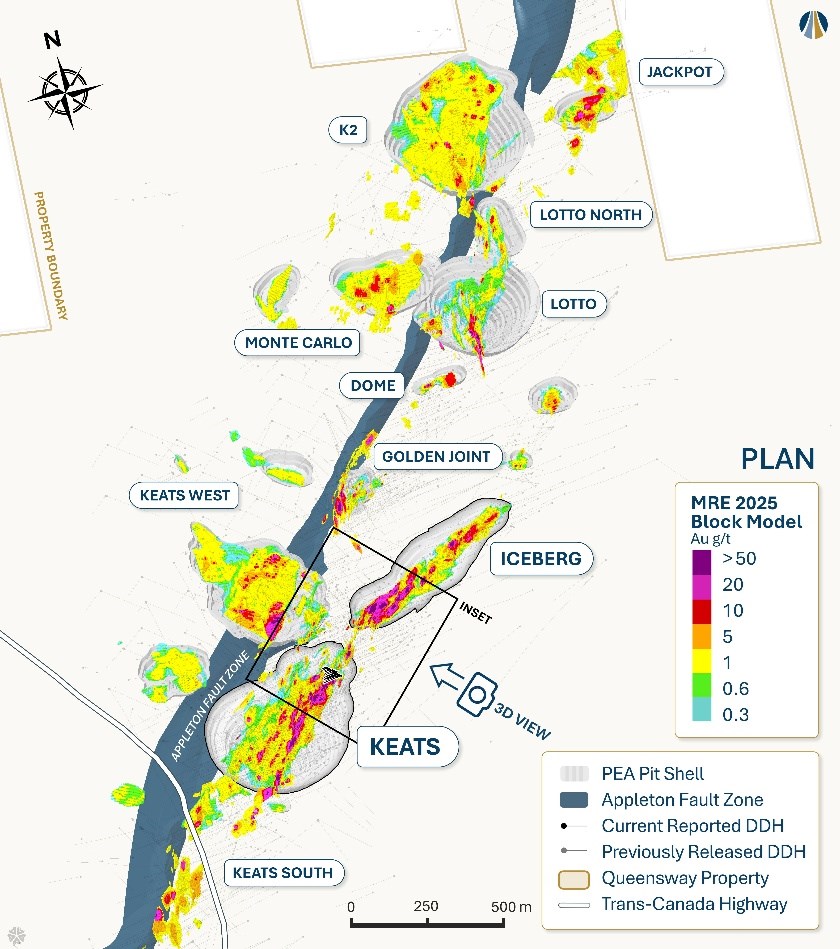
Figure 1: Plan view map of the AFZ Core with location of Keats and Iceberg excavation grade control drill programs.
To view an enhanced version of this graphic, please visit:
https://images.newsfilecorp.com/files/7337/276380_abb1554ed4f48b09_001full.jpg
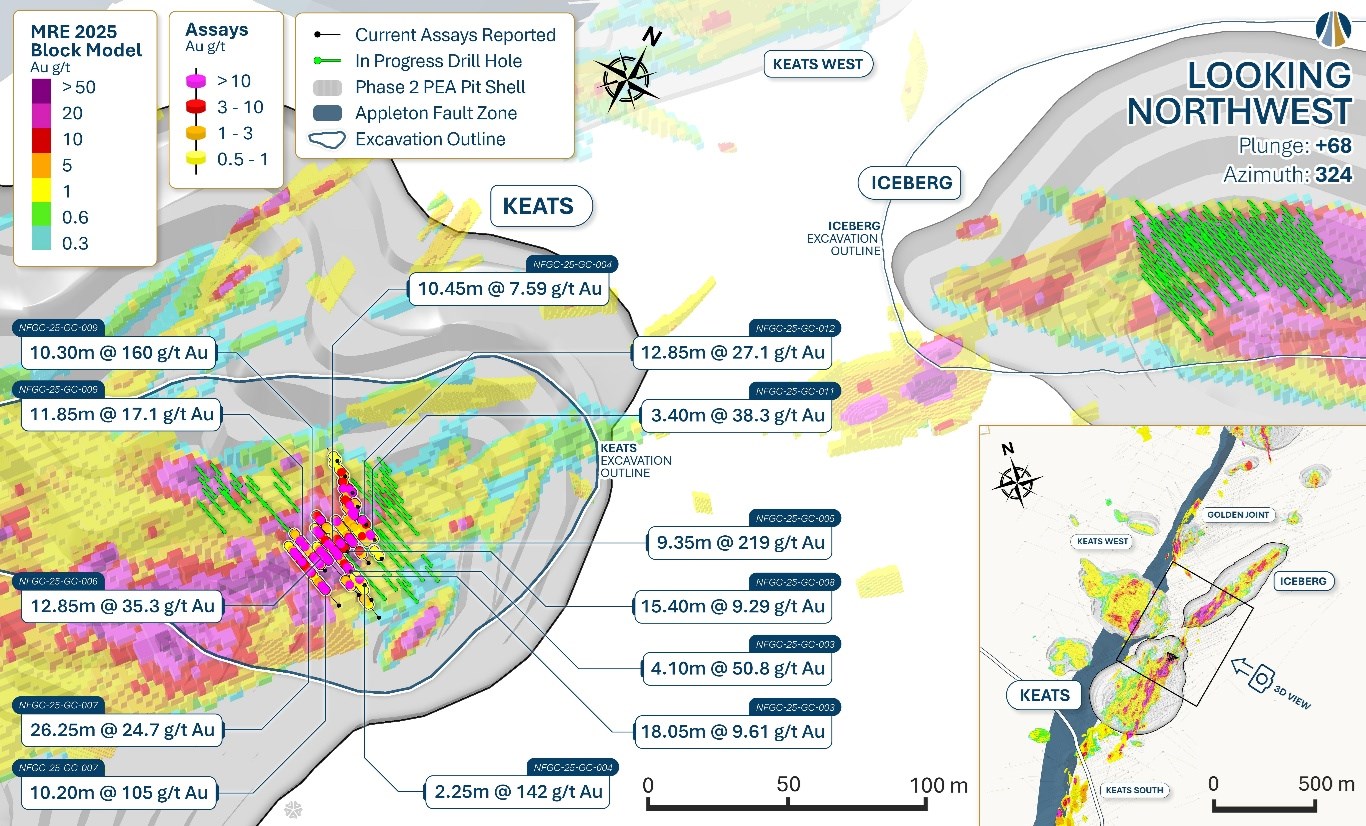
Figure 2: Keats and Iceberg excavations with proposed grade control drill holes and location of results received.
To view an enhanced version of this graphic, please visit:
https://images.newsfilecorp.com/files/7337/276380_abb1554ed4f48b09_002full.jpg
The KEGCDP tests a volume that is approximately 65 m long by 30 m deep by 40 m wide with a drill spacing of 5 m by 5 m; a near-surface high-grade region that was uncovered as part of the Company's ongoing excavation program (see the New Found Gold news releases dated September 23, 2024, December 2, 2024 and September 25, 2025).
These initial results conform well with the initial mineral resource estimate ("MRE") block model and appear to confirm the strong continuity of the high-grade mineralization at Keats, with most intervals occurring at or within a few meters of surface.
The Keats and Iceberg zones are hosted within the Keats-Baseline Fault Zone ("KBFZ"), a high-grade gold-bearing structure that has been defined over a current strike length of 1.9 kilometres ("km"). This corridor consists of a broad mineralized fault zone with limited deep drill testing to date. Drilling completed in 2024 confirms that the system extends to vertical depths of up to 1.1 km (see the New Found Gold news releases dated July 11, 2024, October 31, 2024, April 29, 2025.
The Company will expand the KEGCDP in 2026, leveraging results from the 2025 program to optimize drill hole spacing and program scope.
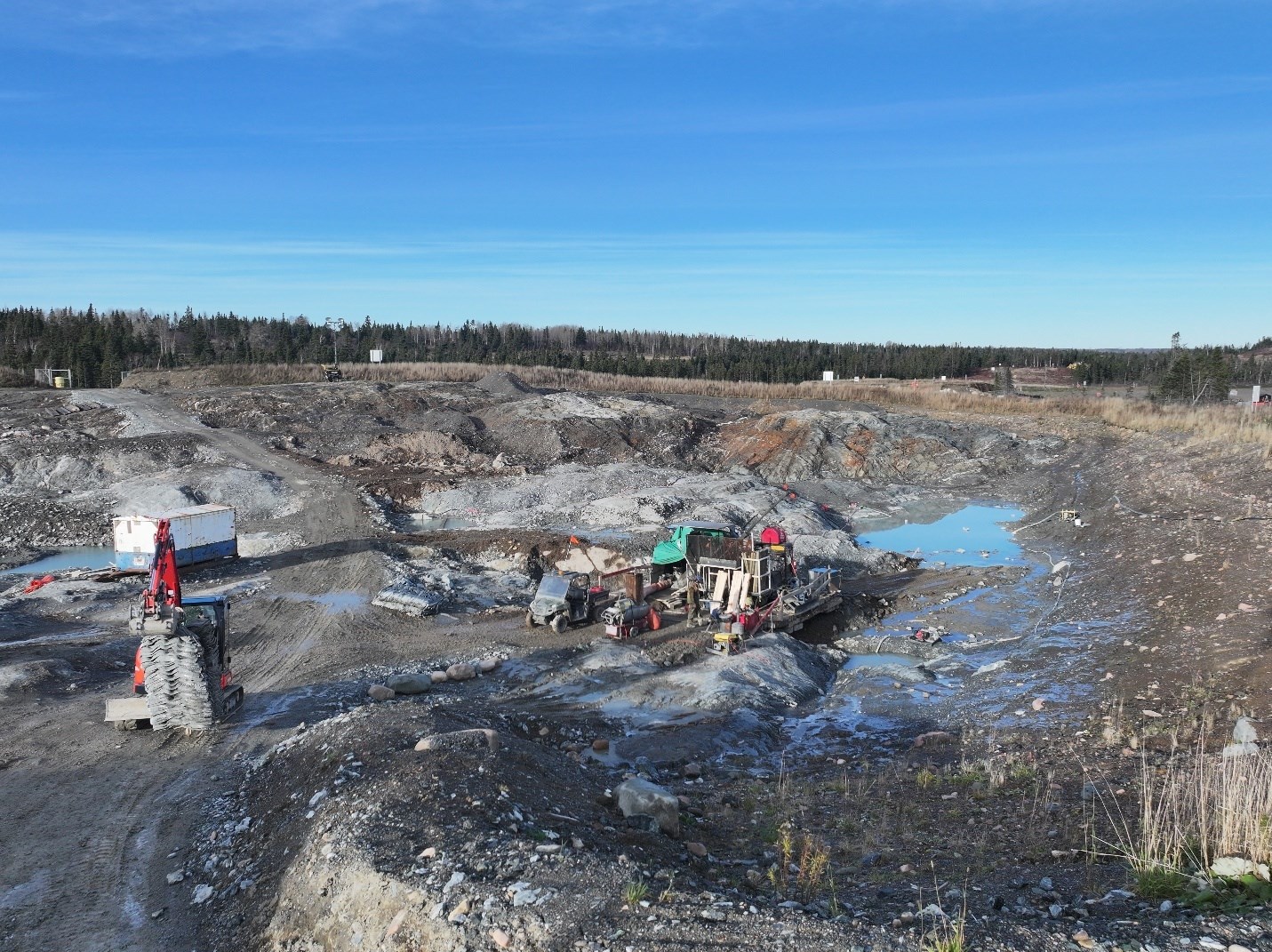
Figure 3: Keats excavation grade control drilling.
To view an enhanced version of this graphic, please visit:
https://images.newsfilecorp.com/files/7337/276380_abb1554ed4f48b09_003full.jpg
Looking Ahead
The 70,000 m 2025 Queensway drill program commenced in May 2025, with approximately
Infill drilling covering the PEA Phase 1 open pits, with the objective of converting resources from inferred to indicated has been completed and results will be released once they are available. Additional ongoing drilling at Queensway includes geotechnical drilling of PEA Phase 1 pits, condemnation drilling for infrastructure and plant siting and hydrogeological drilling, all of which has commenced and is expected to conclude in Q4/25.
Exploration drilling continues in the vicinity of the Dropkick zone in the AFZ Peripheral ("AFZP") area, approximately 11 kilometres north of the AFZC, where the Company has begun to outline a new zone of gold mineralization (see the New Found Gold news releases dated February 11, 2025, May 21, 2025, October 30, 2025).
In addition to the 2025 drill program, an excavation program was undertaken to excavate, map and channel sample near-surface zones of the AFZC, with the objective of validating the geological model and collecting detailed analytical information across key zones that will be part of the PEA Phase 1 mine plan. Excavation, mapping and channel sampling of the Lotto zone ('Lotto") is now complete, and samples have been sent for analysis. The Lotto excavation has uncovered a 210 m long by 70 m area; results from this work will be released once they are available.
With channel sampling at the Keats and Iceberg excavations complete (see the New Found Gold news releases dated September 23, 2024, December 2, 2024 and September 25, 2025), a 5 m by 5 m definition drilling program covering a 65 m by 30 m area has recently been completed at the Keats zone and a 5 m by 5 m definition drilling program covering a 60 m by 45 m area has commenced at the Iceberg zone in late Q4/25.
Table 1: Drill Result Highlights.
| Hole No. | From (m) | To (m) | Interval (m) | Au (g/t) | True Width (%) | Zone |
| NFGC-25-GC-003 | 0.00 | 4.10 | 4.10 | 50.79 | 70-95 | Keats Trench |
| Including | 0.50 | 0.80 | 0.30 | 20.56 | 70-95 | |
| Including | 2.20 | 4.10 | 1.90 | 105.60 | 70-95 | |
| And | 25.25 | 43.30 | 18.05 | 9.61 | 40-70 | |
| Including | 28.10 | 28.75 | 0.65 | 29.58 | 40-70 | |
| Including | 39.25 | 41.65 | 2.40 | 18.37 | 70-95 | |
| Including | 42.95 | 43.30 | 0.35 | 224.15 | 70-95 | |
| NFGC-25-GC-004 | 4.15 | 6.40 | 2.25 | 141.91 | 65-95 | Keats Trench |
| Including | 5.60 | 6.40 | 0.80 | 397.65 | 65-95 | |
| And | 33.70 | 44.15 | 10.45 | 7.59 | 70-95 | |
| Including | 34.25 | 34.65 | 0.40 | 23.61 | 70-95 | |
| Including | 38.05 | 38.65 | 0.60 | 88.32 | 70-95 | |
| Including | 43.85 | 44.15 | 0.30 | 17.00 | 70-95 | |
| NFGC-25-GC-005 | 19.00 | 28.35 | 9.35 | 219.01 | 70-95 | Keats Trench |
| Including | 19.40 | 20.40 | 1.00 | 1885.50 | 70-95 | |
| Including | 22.30 | 23.30 | 1.00 | 70.77 | 70-95 | |
| Including | 24.15 | 24.70 | 0.55 | 153.66 | 70-95 | |
| NFGC-25-GC-006 | 36.25 | 49.10 | 12.85 | 35.31 | 60-90 | Keats Trench |
| Including | 36.25 | 37.85 | 1.60 | 17.40 | 70-95 | |
| Including | 38.85 | 40.60 | 1.75 | 225.98 | 70-95 | |
| And Including | 38.85 | 39.60 | 0.75 | 501.03 | 70-95 | |
| Including | 41.25 | 41.65 | 0.40 | 11.92 | 70-95 | |
| Including | 42.30 | 42.65 | 0.35 | 51.82 | 70-95 | |
| Including | 46.95 | 47.50 | 0.55 | 24.05 | 70-95 | |
| NFGC-25-GC-007 | 15.80 | 26.00 | 10.20 | 104.76 | 50-80 | Keats Trench |
| Including | 16.25 | 16.80 | 0.55 | 589.19 | 50-80 | |
| Including | 17.15 | 19.20 | 2.05 | 385.12 | 50-80 | |
| And Including | 18.05 | 18.75 | 0.70 | 743.20 | 50-80 | |
| Including | 20.60 | 21.55 | 0.95 | 11.60 | 50-80 | |
| And | 34.25 | 60.50 | 26.25 | 24.70 | 70-95 | |
| Including | 35.40 | 36.40 | 1.00 | 23.78 | 70-95 | |
| Including | 46.60 | 47.05 | 0.45 | 42.85 | 70-95 | |
| Including | 52.80 | 54.30 | 1.50 | 135.39 | 70-95 | |
| Including | 56.90 | 58.20 | 1.30 | 291.90 | 70-95 | |
| And Including | 57.50 | 57.90 | 0.40 | 910.95 | 70-95 | |
| NFGC-25-GC-008 | 1.10 | 16.50 | 15.40 | 9.29 | 70-95 | Keats Trench |
| Including | 6.05 | 7.80 | 1.75 | 63.65 | 70-95 | |
| NFGC-25-GC-009 | 5.10 | 15.40 | 10.30 | 159.92 | 50-80 | Keats Trench |
| Including | 6.05 | 9.40 | 3.35 | 355.36 | 50-80 | |
| And Including | 6.05 | 6.85 | 0.80 | 1288.27 | 50-80 | |
| Including | 10.00 | 10.65 | 0.65 | 10.07 | 50-80 | |
| Including | 13.45 | 14.40 | 0.95 | 454.69 | 50-80 | |
| And Including | 13.45 | 13.95 | 0.50 | 850.86 | 50-80 | |
| And | 21.45 | 33.30 | 11.85 | 17.09 | 70-95 | |
| Including | 25.20 | 26.10 | 0.90 | 192.08 | 70-95 | |
| Including | 31.00 | 32.60 | 1.60 | 12.35 | 70-95 | |
| NFGC-25-GC-011 | 4.10 | 7.50 | 3.40 | 38.28 | 70-95 | Keats Trench |
| Including | 4.10 | 6.55 | 2.45 | 52.57 | 70-95 | |
| NFGC-25-GC-012 | 14.65 | 27.50 | 12.85 | 27.07 | 65-95 | Keats Trench |
| Including | 14.65 | 15.30 | 0.65 | 482.12 | 65-95 | |
| Including | 20.75 | 21.25 | 0.50 | 18.29 | 70-95 |
Note that the host structures are interpreted to be moderately to steeply dipping. Infill veining in secondary structures with multiple orientations crosscutting the primary host structures are commonly observed in drill core which could result in additional uncertainty in true width. Composite intervals reported carry a minimum weighted average of 1 g/t Au diluted over a minimum core length of 2 m with a maximum of 4 m consecutive dilution when above 200 m vertical depth and 2 m consecutive dilution when below 200 m vertical depth. Included high-grade intercepts are reported as any consecutive interval with grades greater than 10 g/t Au. Grades have not been capped in the averaging and intervals are reported as drill thickness. Details of all 16 drill holes are included in Table 2 and Table 3 below.
Table 2: Summary of composite drill hole results reported in this news release for Keats
| Hole No. | From (m) | To (m) | Interval (m) | Au (g/t) | True Width (%) | Zone |
| NFGC-25-GC-001 | 15.65 | 20.30 | 4.65 | 1.23 | 70-95 | Keats Trench |
| NFGC-25-GC-002 | 36.60 | 47.75 | 11.15 | 1.56 | 50-80 | Keats Trench |
| NFGC-25-GC-003 | 0.00 | 4.10 | 4.10 | 50.79 | 70-95 | Keats Trench |
| Including | 0.50 | 0.80 | 0.30 | 20.56 | 70-95 | |
| Including | 2.20 | 4.10 | 1.90 | 105.60 | 70-95 | |
| And | 13.25 | 15.80 | 2.55 | 4.42 | 70-95 | |
| Including | 15.25 | 15.80 | 0.55 | 18.78 | 70-95 | |
| And | 25.25 | 43.30 | 18.05 | 9.61 | 40-70 | |
| Including | 28.10 | 28.75 | 0.65 | 29.58 | 40-70 | |
| Including | 39.25 | 41.65 | 2.40 | 18.37 | 70-95 | |
| Including | 42.95 | 43.30 | 0.35 | 224.15 | 70-95 | |
| NFGC-25-GC-004 | 4.15 | 6.40 | 2.25 | 141.91 | 65-95 | Keats Trench |
| Including | 5.60 | 6.40 | 0.80 | 397.65 | 65-95 | |
| And | 33.70 | 44.15 | 10.45 | 7.59 | 70-95 | |
| Including | 34.25 | 34.65 | 0.40 | 23.61 | 70-95 | |
| Including | 38.05 | 38.65 | 0.60 | 88.32 | 70-95 | |
| Including | 43.85 | 44.15 | 0.30 | 17.00 | 70-95 | |
| NFGC-25-GC-005 | 7.65 | 11.30 | 3.65 | 2.93 | 25-55 | Keats Trench |
| And | 19.00 | 28.35 | 9.35 | 219.01 | 70-95 | |
| Including | 19.40 | 20.40 | 1.00 | 1885.50 | 70-95 | |
| Including | 22.30 | 23.30 | 1.00 | 70.77 | 70-95 | |
| Including | 24.15 | 24.70 | 0.55 | 153.66 | 70-95 | |
| And | 35.40 | 43.40 | 8.00 | 4.22 | 70-95 | |
| Including | 41.15 | 41.90 | 0.75 | 26.68 | 70-95 | |
| NFGC-25-GC-006 | 9.55 | 15.80 | 6.25 | 7.38 | 55-85 | Keats Trench |
| Including | 9.55 | 10.45 | 0.90 | 48.00 | 55-85 | |
| And | 36.25 | 49.10 | 12.85 | 35.31 | 60-90 | |
| Including | 36.25 | 37.85 | 1.60 | 17.40 | 70-95 | |
| Including | 38.85 | 40.60 | 1.75 | 225.98 | 70-95 | |
| And Including | 38.85 | 39.60 | 0.75 | 501.03 | 70-95 | |
| Including | 41.25 | 41.65 | 0.40 | 11.92 | 70-95 | |
| Including | 42.30 | 42.65 | 0.35 | 51.82 | 70-95 | |
| Including | 46.95 | 47.50 | 0.55 | 24.05 | 70-95 | |
| NFGC-25-GC-007 | 15.80 | 26.00 | 10.20 | 104.76 | 50-80 | Keats Trench |
| Including | 16.25 | 16.80 | 0.55 | 589.19 | 50-80 | |
| Including | 17.15 | 19.20 | 2.05 | 385.12 | 50-80 | |
| And Including | 18.05 | 18.75 | 0.70 | 743.20 | 50-80 | |
| Including | 20.60 | 21.55 | 0.95 | 11.60 | 50-80 | |
| And | 34.25 | 60.50 | 26.25 | 24.70 | 70-95 | |
| Including | 35.40 | 36.40 | 1.00 | 23.78 | 70-95 | |
| Including | 46.60 | 47.05 | 0.45 | 42.85 | 70-95 | |
| Including | 52.80 | 54.30 | 1.50 | 135.39 | 70-95 | |
| Including | 56.90 | 58.20 | 1.30 | 291.90 | 70-95 | |
| And Including | 57.50 | 57.90 | 0.40 | 910.95 | 70-95 | |
| NFGC-25-GC-008 | 1.10 | 16.50 | 15.40 | 9.29 | 70-95 | Keats Trench |
| Including | 6.05 | 7.80 | 1.75 | 63.65 | 70-95 | |
| And | 24.10 | 26.25 | 2.15 | 1.50 | 70-95 | |
| And | 32.60 | 39.50 | 6.90 | 7.08 | 70-95 | |
| Including | 33.15 | 34.25 | 1.10 | 33.84 | 70-95 | |
| NFGC-25-GC-009 | 5.10 | 15.40 | 10.30 | 159.92 | 50-80 | Keats Trench |
| Including | 6.05 | 9.40 | 3.35 | 355.36 | 50-80 | |
| And Including | 6.05 | 6.85 | 0.80 | 1288.27 | 50-80 | |
| Including | 10.00 | 10.65 | 0.65 | 10.07 | 50-80 | |
| Including | 13.45 | 14.40 | 0.95 | 454.69 | 50-80 | |
| And Including | 13.45 | 13.95 | 0.50 | 850.86 | 50-80 | |
| And | 21.45 | 33.30 | 11.85 | 17.09 | 70-95 | |
| Including | 25.20 | 26.10 | 0.90 | 192.08 | 70-95 | |
| Including | 31.00 | 32.60 | 1.60 | 12.35 | 70-95 | |
| And | 37.45 | 40.25 | 2.80 | 1.61 | 70-95 | |
| NFGC-25-GC-010 | 22.70 | 25.15 | 2.45 | 1.30 | 40-70 | Keats Trench |
| And | 34.50 | 43.15 | 8.65 | 1.33 | 70-95 | |
| NFGC-25-GC-011 | 4.10 | 7.50 | 3.40 | 38.28 | 70-95 | Keats Trench |
| Including | 4.10 | 6.55 | 2.45 | 52.57 | 70-95 | |
| And | 26.00 | 35.40 | 9.40 | 2.06 | 70-95 | |
| Including | 26.00 | 26.35 | 0.35 | 16.63 | 70-95 | |
| Including | 29.25 | 29.65 | 0.40 | 18.18 | 70-95 | |
| NFGC-25-GC-012 | 0.00 | 5.75 | 5.75 | 7.09 | 70-95 | Keats Trench |
| Including | 4.50 | 5.20 | 0.70 | 44.75 | 70-95 | |
| And | 14.65 | 27.50 | 12.85 | 27.07 | 65-95 | |
| Including | 14.65 | 15.30 | 0.65 | 482.12 | 65-95 | |
| Including | 20.75 | 21.25 | 0.50 | 18.29 | 70-95 | |
| NFGC-25-GC-013 | 1.40 | 4.05 | 2.65 | 1.25 | 70-95 | Keats Trench |
| And | 17.00 | 19.10 | 2.10 | 5.82 | 70-95 | |
| Including | 17.95 | 18.40 | 0.45 | 20.86 | 70-95 | |
| NFGC-25-GC-014 | No Significant Values | Keats Trench | ||||
| NFGC-25-GC-015 | 0.70 | 5.15 | 4.45 | 1.33 | 70-95 | Keats Trench |
| NFGC-25-GC-016 | 0.00 | 5.20 | 5.20 | 6.10 | 70-95 | Keats Trench |
| Including | 0.00 | 0.40 | 0.40 | 25.72 | 70-95 | |
| Including | 3.20 | 4.00 | 0.80 | 11.48 | 70-95 | |
| And | 10.20 | 12.25 | 2.05 | 1.78 | 70-95 | |
Note that the host structures are interpreted to be moderately to steeply dipping. Infill veining in secondary structures with multiple orientations crosscutting the primary host structures are commonly observed in drill core which could result in additional uncertainty in true width. Composite intervals reported carry a minimum weighted average of 1 g/t Au diluted over a minimum core length of 2 m with a maximum of 4 m consecutive dilution when above 200 m vertical depth and 2 m consecutive dilution when below 200 m vertical depth. Included high-grade intercepts are reported as any consecutive interval with grades greater than 10 g/t Au. Grades have not been capped in the averaging and intervals are reported as drill thickness.
Table 3: Details of drill holes reported in this news release.
| Hole No. | Azimuth (°) | Dip (°) | Length (m) | UTM E | UTM N | Prospect |
| NFGC-25-GC-001 | 300 | -45 | 24 | 658245 | 5427513 | Keats |
| NFGC-25-GC-002 | 300 | -45 | 53 | 658238 | 5427517 | Keats |
| NFGC-25-GC-003 | 300 | -45 | 47 | 658226 | 5427521 | Keats |
| NFGC-25-GC-004 | 300 | -45 | 49 | 658233 | 5427520 | Keats |
| NFGC-25-GC-005 | 300 | -45 | 47 | 658229 | 5427528 | Keats |
| NFGC-25-GC-006 | 300 | -45 | 54 | 658234 | 5427516 | Keats |
| NFGC-25-GC-007 | 299 | -45 | 65 | 658231 | 5427509 | Keats |
| NFGC-25-GC-008 | 299 | -45 | 44 | 658221 | 5427527 | Keats |
| NFGC-25-GC-009 | 300 | -45 | 47 | 658219 | 5427517 | Keats |
| NFGC-25-GC-010 | 300 | -45 | 48 | 658232 | 5427532 | Keats |
| NFGC-25-GC-011 | 300 | -45 | 42 | 658226 | 5427536 | Keats |
| NFGC-25-GC-012 | 300 | -45 | 34 | 658220 | 5427539 | Keats |
| NFGC-25-GC-013 | 300 | -45 | 27 | 658214 | 5427543 | Keats |
| NFGC-25-GC-014 | 300 | -45 | 13 | 658198 | 5427552 | Keats |
| NFGC-25-GC-015 | 300 | -45 | 23 | 658204 | 5427548 | Keats |
| NFGC-25-GC-016 | 300 | -45 | 21 | 658209 | 5427545 | Keats |
Sampling, Sub-sampling, and Laboratory
All drilling recovers HQ core. For deep holes, the core size may be reduced to NQ at depth. The drill core is split in half using a diamond saw or a hydraulic splitter for rare intersections with incompetent core.
A geologist examines the drill core and marks out the intervals to be sampled and the cutting line. Sample lengths are mostly 1.0 meter and adjusted to respect lithological and/or mineralogical contacts and isolate narrow (<1.0m) veins or other structures that may yield higher grades.
Technicians saw the core along the defined cutting line. One-half of the core is kept as a witness sample and the other half is submitted for analysis. Individual sample bags are sealed and placed into totes, which are then sealed and marked with the contents.
New Found Gold has submitted samples for gold determination by PhotonAssay™ to ALS Canada Ltd. ("ALS") since February 2024. ALS operates under a commercial contract with New Found Gold.
Drill core samples are shipped to ALS for sample preparation in Thunder Bay, Ontario. ALS does not currently have accreditation for the PhotonAssay™ method at their Thunder Bay, ON laboratory. They do however have ISO/IEC 17025 (2017) accreditation for gamma ray analysis of samples for gold at their Australian labs with this method, including the Canning Vale lab in Perth, WA.
Samples submitted to ALS beginning in February 2024, received gold analysis by photon assay whereby the entire sample is crushed to approximately
For samples that have VG identified, the entire crushed sample is riffle split and weighed into multiple jars that are submitted for photon assay. The assays from all jars are combined on a weight-averaged basis.
Select samples prepared at ALS are also analyzed for a multi-element ICP package (ALS method code ME-ICP61) at ALS Vancouver.
Drill program design, Quality Assurance/Quality Control, and interpretation of results are performed by qualified persons employing a rigorous Quality Assurance/Quality Control program consistent with industry best practices. Standards and blanks account for a minimum of
Quality Control data are evaluated on receipt from the laboratories for failures. Appropriate action is taken if assay results for standards and blanks fall outside allowed tolerances. All results stated have passed New Found Gold's quality control protocols.
New Found Gold's quality control program also includes submission of the second half of the core for approximately
The Company does not recognize any factors of drilling, sampling, or recovery that could materially affect the accuracy or reliability of the assay data disclosed.
The assay data disclosed in this press release have been verified by the Company's Qualified Person against the original assay certificates.
Qualified Person
The scientific and technical information disclosed in this press release was reviewed and approved by Melissa Render, P. Geo., President, and a Qualified Person as defined under National Instrument 43-101. Ms. Render consents to the publication of this press release, by New Found Gold. Ms. Render certifies that this press release fairly and accurately represents the scientific and technical information that forms the basis for this press release.
About New Found Gold Corp.
New Found Gold is an emerging Canadian gold producer with projects in Newfoundland and Labrador, Canada. The Company holds a
In 2025, the Company completed a PEA at Queensway (see New Found Gold news release dated July 21, 2025). Recent drilling continues to yield new discoveries along strike and down dip of known gold zones, pointing to the district-scale potential of the Project that covers a +110 km strike extent along two prospective fault zones. On September 8, 2025, the Company announced it had entered into a property purchase agreement with Exploits Discovery Corp. ("Exploits") that would provide New Found Gold with a
Keith Boyle, P.Eng.
Chief Executive Officer
New Found Gold Corp.
Contact
For further information on New Found Gold, please visit the Company's website at www.newfoundgold.ca, contact us through our investor inquiry form at https://newfoundgold.ca/contact/ or contact:
Fiona Childe, Ph.D., P.Geo.
Vice President, Communications and Corporate Development
Phone: +1 (416) 910-4653
Email: contact@newfoundgold.ca
Follow us on social media at https://www.linkedin.com/company/newfound-gold-corp https://x.com/newfoundgold.
Neither the TSXV nor its Regulation Services Provider (as that term is defined in the policies of the TSXV) accepts responsibility for the adequacy or accuracy of this release.
Forward-Looking Statement Cautions
This press release contains certain "forward-looking statements" within the meaning of Canadian securities legislation, including relating to the current drill program on its Queensway Gold Project in Newfoundland and Labrador, Canada, and the timing, results and interpretation and use of the drill results; future drill programs and the timing and focus thereof; the excavation program and the timing and results thereof; future exploration and the objectives and timing thereof, including future drilling and excavation; exploration, drilling and mineralization at Queensway; the extent of mineralization and the discovery of zones of high-grade gold mineralization; the potential conversion of mineral resources; potential resource expansion; a mineral resource update and the timing thereof; focus on growth and value creation; and the merits of Queensway. Although the Company believes that such statements are reasonable, it can give no assurance that such expectations will prove to be correct. Forward-looking statements are statements that are not historical facts; they are generally, but not always, identified by the words "expects", "plans", "anticipates", "believes", "interpreted", "intends", "estimates", "projects", "aims", "suggests", "indicate", "often", "target", "future", "likely", "pending", "potential", "encouraging", "goal", "objective", "prospective", "possibly", "preliminary", and similar expressions, or that events or conditions "will", "would", "may", "can", "could" or "should" occur, or are those statements, which, by their nature, refer to future events. The Company cautions that forward-looking statements are based on the beliefs, estimates and opinions of the Company's management on the date the statements are made, and they involve a number of risks and uncertainties. Consequently, there can be no assurances that such statements will prove to be accurate and actual results and future events could differ materially from those anticipated in such statements. Except to the extent required by applicable securities laws and the policies of the TSXV, the Company undertakes no obligation to update these forward-looking statements if management's beliefs, estimates or opinions, or other factors, should change. Factors that could cause future results to differ materially from those anticipated in these forward-looking statements include risks associated with the Company's ability to complete exploration and drilling programs as expected, possible accidents and other risks associated with mineral exploration operations, the risk that the Company will encounter unanticipated geological factors, risks associated with the interpretation of exploration results and the results of the metallurgical testing program, the possibility that the Company may not be able to secure permitting and other governmental clearances necessary to carry out the Company's exploration plans, the risk that the Company will not be able to raise sufficient funds to carry out its business plans, and the risk of political uncertainties and regulatory or legal changes that might interfere with the Company's business and prospects. The reader is urged to refer to the Company's Annual Information Form and Management's Discussion and Analysis, publicly available through the Canadian Securities Administrators' System for Electronic Document Analysis and Retrieval (SEDAR+) at www.sedarplus.ca for a more complete discussion of such risk factors and their potential effects.
1 g/t Au= grams of gold per tonne
2 m = metres

To view the source version of this press release, please visit https://www.newsfilecorp.com/release/276380
FAQ
AI-generated questions and answers. How Rhea-AI works. Not financial advice.