
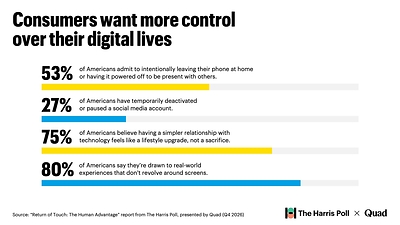
75% of Americans think a simpler relationship with technology is a lifestyle upgrade
Among Americans surveyed, 84% said owning physical items feels more satisfying than owning digital items.
Sentiment and the balance of points
Rhea-AI Sentiment reads the wording of the document, how positive or negative its language is on a 1 to 5 scale. The balance of points shown with the takes weighs what the document actually discloses, so the two can disagree, for example when a trial that missed its main goal is described in upbeat language.
Rhea-AI Summary
Quad/Graphics (NYSE: QUAD) and The Harris Poll released a study examining how digital fatigue shapes Americans’ preferences for brand experiences. “Return of Touch: The Human Advantage” surveyed 2,004 U.S. adults and found that 75% view a simpler relationship with technology as a lifestyle upgrade rather than a sacrifice.
Among Gen Z respondents, 49% said social scrolling leaves them drained, while 82% reported improved mental health from social media breaks, up six percentage points from last year. Across Americans surveyed, 64% would pay a premium for products guaranteed to be human-designed or handcrafted. Print can influence website purchases for 68%, while 72% said mail, print materials or catalogs make them likely to visit a physical store. Among Gen Z and Millennials, 78% prefer retailers that encourage them to stay and explore. These findings describe consumer preferences, not Quad’s financial results.
Key Figures
- Survey sample
- 2,004 U.S. adults
- Study conducted on behalf of Quad
- Lifestyle upgrade
- 75% of Americans
- Say a simpler relationship with technology feels like a lifestyle upgrade
- Improved mental health
- 82% of Gen Z
- Report improvement from social media breaks
- Year-over-year increase
- 6 percentage points
- Increase in Gen Z reporting improved mental health from social media breaks
- Premium for human-designed or handcrafted products
- 64% of Americans
- Say they would pay a premium
- Print influences online purchase
- 68% of Americans
- Say print can influence a purchase from a brand's website
- Print materials prompt store visits
- 72% of Americans
- Say mail, print materials or catalogs make them likely to visit a physical store
- Print influences brand choice
- 66% of Americans
- Say print could lead them to choose one brand over competitors
AI-generated analysis. How Rhea-AI works. Not financial advice.




Research from The Harris Poll and Quad reveals how brands should interact with digitally fatigued audiences
Building on the initial 2025 "Return of Touch" report, which found that
Digital detoxes become lifestyle upgrades
Gen Z feels the burden of digital life most acutely: nearly half of Gen Z (
Seventy-five percent of Americans believe a simpler relationship with technology feels like a lifestyle upgrade rather than a sacrifice. That intention to disconnect is especially visible among Gen Z: seven in 10 plan to pick up more hands-on hobbies this year to reduce screen time, and they're more likely than Americans overall to have tried analog alternatives such as paper planners or physical cameras (
"This generation didn't grow up without technology. They grew up inside it. And now they're doing something the industry didn't predict: they're choosing constraints. Film cameras with 27 shots. Paper planners. Phones that don't scroll. These aren't anti-tech choices: they're pro-human ones," said Libby Rodney, Chief Strategy Officer, The Harris Poll. "For marketers, the opportunity isn't to pull back from digital. It's to show up differently. Give people something to hold, something to touch, something worth the trip. Because what the data keeps telling us is that people don't want less from brands. They want more of the stuff that feels real."
The cultural cachet of collectibles
Collecting has emerged as an important hobby as Americans strive for balance. Seventy-nine percent of Gen Z say collecting physical objects helps them feel more connected to the real world, while
Collecting is far from niche:
The need for human craft
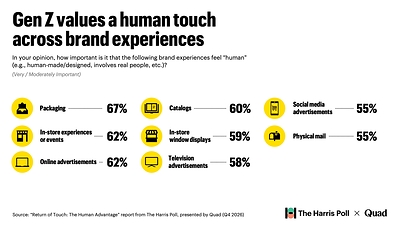
The appeal of collectibles reflects a broader consumer desire to see evidence of human care and craft within the brands they encounter. Roughly six in 10 Gen Z respondents say they seek a human touch in product packaging (
For marketers, this points to an opportunity to make the human touch tangible through thoughtful design, quality materials and finishes. The survey findings suggest these details drive consumer actions:
If you build it, they will stay and hang out
As
Stores are important third spaces for younger generations—
"People notice when brands put thought and care into how they show up—from the substance of a package to the way a store welcomes people and invites them to stay. Those details make brands feel more human, build confidence and create experiences worth remembering," said Heidi Waldusky, VP of Brand, Content & Creative, Quad. "In a world where more interactions are becoming efficient and predictable, human attention to detail is a real advantage for building brand loyalty."
From the self-expression of collectibles to thoughtful ads and welcoming stores, the "Return of Touch: The Human Advantage" demonstrates that consumers want more control over how technology fits into their lives and more opportunities to connect with brands through human, tangible experiences.
This study was conducted by The Harris Poll on behalf of Quad from July 23 to August 12, 2026, among 2,004
Find additional data from the survey here and the full press kit here.
About Quad
Quad (NYSE: QUAD) is a marketing experience, or MX, company that helps brands make direct consumer connections, from household to in-store to online. The company does this through its MX Solutions Suite, a comprehensive range of marketing and print services that seamlessly integrate creative, production and media solutions across online and offline channels. Supported by state-of-the-art technology and data-driven intelligence, Quad simplifies the complexities of marketing by removing friction wherever it occurs along the marketing journey. The company tailors its uniquely flexible, scalable and connected solutions to each client's objectives, driving cost efficiencies, improving speed-to-market, strengthening marketing effectiveness and delivering value on client investments.
Quad employs approximately 10,000 people in 10 countries and serves approximately 2,100 clients including industry leading blue-chip companies that serve both businesses and consumers in multiple industry verticals, with a particular focus on commerce, including retail, consumer packaged goods, and direct-to-consumer; financial services; and health. Quad is ranked among the largest agency companies in the
For more information about Quad, including its commitment to operating responsibly, intentional innovation and values-driven culture, visit quad.com.
About The Harris Poll
The Harris Poll is one of the longest-running surveys in the U.S., tracking public opinion, motivations, and social sentiment since 1963. Now part of Harris Insights & Analytics, we provide market intelligence that helps businesses and policymakers make informed decisions. To learn more, visit https://theharrispoll.com.
Media Contact
Sarah Mikhailova
Media Relations Manager
212-672-1319
sumikhailova@quad.com

 View original content to download multimedia:https://www.prnewswire.com/news-releases/75-of-americans-think-a-simpler-relationship-with-technology-is-a-lifestyle-upgrade-302907652.html
SOURCE Quad
FAQ
AI-generated questions and answers. How Rhea-AI works. Not financial advice.
What did Quad’s Return of Touch study find about Americans’ relationship with technology?
75% of Americans surveyed believe a simpler relationship with technology feels like a lifestyle upgrade rather than a sacrifice. In addition, 53% said they intentionally leave their phones at home or turn them off to be more present with others.
How was Quad’s 2026 Return of Touch survey conducted?
The Harris Poll conducted the study on behalf of Quad from July 23 to August 12, 2026, among 2,004 U.S. adults ages 18 and older. It was the second wave of a multi-year study. Data were weighted where necessary to align demographic and other characteristics with their proportions in the population.