
Rain Enhancement Technologies Reports WETA Delivers New Water at $10 Per Acre-Foot, a Fraction of the Cost of Conventional Supply Alternatives
Rhea-AI Summary
Rain Enhancement Technologies (NASDAQ:RAIN) reported validated winter results from its WETA ionization system in Utah’s La Sal Mountains, indicating new water at $10 per acre-foot, which the company says is over 95% cheaper than desalination, recycled water, demand management, and groundwater recharge.
The 2025-2026 deployment ran mid-November through March, covering 100 square miles and producing an estimated 8,750 acre-feet (about 2.85 billion gallons), with 20%+ Snow Water Equivalent enhancement versus control sites. Three independent statistical methods and external scientific review validated the results, which occurred during the region’s driest winter on record.
Positive
- Validated WETA cost of $10 per acre-foot on 10-year plan
- Estimated 8,750 acre-feet of incremental water from one installation
- More than 20% Snow Water Equivalent enhancement in 2025-2026 winter
- Coverage of 100 square miles from a single ground-based WETA site
- Results reviewed and validated by independent scientific experts
- Conventional alternatives cited from $180 to over $3,000 per acre-foot
Negative
- None.
Details
News Market Reaction – RAIN
In the Jun 9 session, RAIN declined 4.57%, reflecting a moderate negative market reaction.
Data tracked by StockTitan Argus on the day of publication.
Key Figures
- WETA water cost
- $10 per acre-foot
- Validated La Sal Mountains winter 2025–2026 deployment
- Incremental water
- 8,750 acre-feet
- Estimated new water from La Sal deployment in one winter season
- Service area
- 100 square miles
- Coverage from a single ground-based WETA installation at La Sal
- Water volume
- 2.85 billion gallons
- Equivalent volume for 8,750 acre-feet of water
- Household supply
- 26,000 households
- Households potentially supplied for one year by La Sal deployment
- SWE enhancement
- More than 20%
- Snow Water Equivalent increase across full La Sal winter season
- 5-year plan cost
- $17 per acre-foot
- Validated WETA cost on 5-year payment plan including warm-season ops
- Recycled water cost
- $180 per acre-foot
- Starting cost for recycled water as competing supply option
Historical Context
-
Texas A&M analysis showed large agricultural benefits versus WETA system investment.
-
Announced industry-first guaranteed 10% precipitation enhancement backed by prior trials.
-
Reported consistent Utah snowpack gains over three winter months versus control site.
-
January Utah operations showed >3.5 inches extra snow and >20% enhancement.
-
Launched study on using ionization for air quality and smog mitigation via dry deposition.
24h Move is the share-price change in the day after each event; other market factors may also have contributed.
Key Terms
snow water equivalent medical
ground-based ionization technical
bayesian structural time series technical
cloud seeding technical
desalination technical
AI-generated analysis. How Rhea-AI works. Not financial advice.




Validated Winter Results from La Sal Mountains Establish Ground-Based Ionization as the Most Cost-Effective Incremental Water Supply Option Available to Western Water Managers
NAPLES, FL / ACCESS Newswire / June 9, 2026 / Rain Enhancement Technologies Holdco, Inc. (NASDAQ:RAIN), a leading provider of ionization rainfall generation technology, today reported validated winter results showing that its Weather Enhancement Technology Array (WETA) delivers new water at
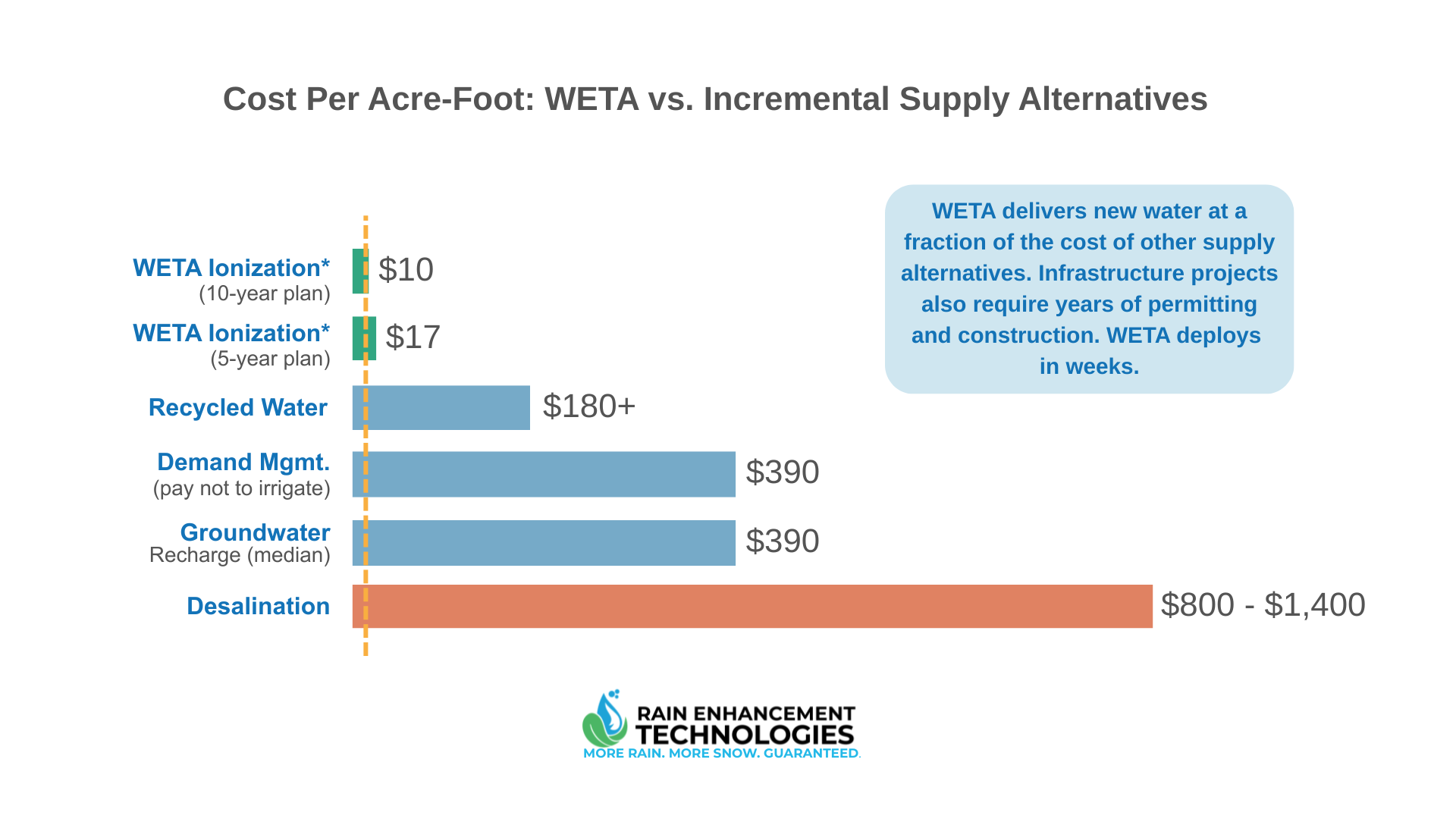
The comparison arrives at a critical moment for water managers across the American West. A record-dry winter in 2025-2026 has left regional reservoirs significantly below normal, accelerating pressure on agencies to identify new incremental supply. The conventional alternative supply options share a common profile: high capital costs, long permitting timelines measured in years, and significant ongoing operational expense. WETA deploys in weeks from a single ground-based installation, requires no chemicals and no on-site personnel, and operates continuously and autonomously.
"Water managers across the West are being asked to find new supply with budgets that won't cover pipelines, desalination plants, or decade-long permitting battles," said Randy Seidl, Chief Executive Officer of Rain Enhancement Technologies. "The La Sal results give us something the industry has never had: a validated cost per acre-foot for ground-based ionization, independently reviewed. At
The La Sal Mountains deployment produced more than 20 percent Snow Water Equivalent (SWE) enhancement across the full winter season, as measured against paired control sites in the nearby Abajo Mountains. Three independent statistical methods -- analog year comparison, ridge regression counterfactual modeling, and Bayesian Structural Time Series (BSTS) analysis -- all converged on the same finding. SWE enhancement of more than one inch was sustained throughout the season at La Sal Upper, persisting even through a period of record-warm temperatures and active snowmelt in February 2026.
Across the winter season, WETA produced a calculated 8,750 acre-feet of incremental water from a single ground-based installation covering 100 square miles. That figure represents approximately 2.85 billion gallons, enough to supply roughly 26,000 households for a full year. The results are particularly notable given that the 2025-2026 winter was the driest on record, with below-average snowpack at all regional sites. These conditions would have significantly curtailed traditional cloud seeding operations. Results were reviewed and validated by Dr. Binod Pokharel, Utah State University.
"The La Sal analysis applied three statistically independent methods, each with different assumptions and different potential failure modes, and all three reached the same conclusion," said Dr. Pokharel. "The results from this season are consistent with precipitation enhancement due to ionization. These results reflect actual observed performance under challenging conditions, not modeled projections. I am encouraged by this outcome and look forward to continued operation and scientific testing in future seasons."
"What makes the La Sal economics compelling is that the cost figure is derived directly from measured performance, not assumptions," said Dr. Jeffrey Chagnon, Senior Meteorologist at Rain Enhancement Technologies. "The 8,750-acre-foot figure reflects what the analysis actually shows happened on the ground during the driest winter on record, and that is what makes the cost comparison to conventional alternatives meaningful."
Water agencies evaluating new supply face four conventional options, all requiring significant capital investment and multi-year permitting. Recycled water starts at
Desalination is the most expensive option, running
Against this backdrop, WETA's validated cost of
RET has been clear that WETA is not intended to replace existing cloud seeding programs, which operate within specific temperature and cloud-type windows using silver iodide. WETA fills the gap that those programs cannot cover, operating across a wider range of atmospheric conditions, temperatures, and seasons. The competitive context for WETA is the infrastructure budget -- the capital allocation decisions water agencies face when evaluating pipelines, desalination facilities, demand management contracts, and recycled water systems.
Additional instrumentation at the La Sal Range is planned for 2026, and year-round WETA operations targeting warm-season precipitation are ongoing. Final seasonal reporting incorporating completed model runs is available on request. The La Sal deployment represents the first complete winter operational period for a WETA installation in the United States.
About Rain Enhancement Technologies, Inc.
Rain Enhancement Technologies was founded to provide the world with reliable access to water, one of life's most important resources. To achieve this mission, RET develops, manufactures, and commercializes ionization precipitation generation technology that enhances rainfall and snowpack to address water scarcity challenges. The Company is also developing applications for fog mitigation to expand its weather modification capabilities. RET's chemical-free, solar-powered technology seeks to transform water resource management for businesses, society, and the planet. To learn more, go to www.investor.rainenhancement.com.
Forward-Looking Statements
The disclosure herein includes certain statements that are not historical facts but are forward-looking statements for purposes of the safe harbor provisions under the United States Private Securities Litigation Reform Act of 1995. Forward-looking statements generally are accompanied by words such as "believe," "may," "will," "estimate," "continue," "anticipate," "intend," "expect," "should," "would," "plan," "project," "forecast," "predict," "potential," "seem," "seek," "future," "outlook," and similar expressions that predict or indicate future events or trends or that are not statements of historical matters, but the absence of these words does not mean that a statement is not forward looking. These forward-looking statements include, but are not limited to, (1) statements regarding expected installation of the Company's technology; (2) references with respect to the anticipated benefits of the Company's WETA platform and technology; (3) references to the market opportunity for rain enhancement technologies and products; (4) the projected technological developments of RET; and (5) current and future potential commercial and customer relationships. These statements are based on various assumptions, whether or not identified in this press release, and on the current expectations of RET's management, and are not predictions of actual performance. These forward-looking statements are provided for illustrative purposes only and are not intended to serve as, and must not be relied on by any investor as, a guarantee, an assurance, a prediction, or a definitive statement of fact or probability. Actual events and circumstances are difficult or impossible to predict and will differ from assumptions. Many actual events and circumstances are beyond the control of RET. These forward-looking statements are subject to a number of risks and uncertainties, as set forth in the section entitled "Risk Factors" in the Company's annual report on Form 10-K for the year ended December 31, 2024, filed with the SEC on April 16, 2025, as amended from time to time. If any of these risks materialize or our assumptions prove incorrect, actual results could differ materially from the results implied by these forward-looking statements. The risks and uncertainties above are not exhaustive, and there may be additional risks that Rain Enhancement Technologies, Inc. ("RETI") and RET do not presently know or that RETI and RET currently believe are immaterial that could also cause actual results to differ from those contained in the forward-looking statements. In addition, forward-looking statements reflect RETI and RET's expectations, plans or forecasts of future events and views as of the date of this press release. RETI and RET anticipate that subsequent events and developments will cause RETI and RET's assessments to change. However, while RETI and RET Holdco may elect to update these forward-looking statements at some point in the future, RETI and RET specifically disclaim any obligation to do so. These forward-looking statements should not be relied upon as representing RETI and RET's assessments as of any date subsequent to the date of this press release. Accordingly, undue reliance should not be placed upon the forward-looking statements.
Media Contacts
Neal Stein
Technology PR Solutions
321-473-7407
nealjstein@techprsolutions.com
Linda Maynard
Rain Enhancement Technologies
(617) 869-4832
linda@rainenhancement.com
SOURCE: Rain Enhancement Technologies
View the original press release on ACCESS Newswire
FAQ
AI-generated questions and answers. How Rhea-AI works. Not financial advice.