
Supermicro Reveals DCBBS® with New NVIDIA Vera Rubin NVL72, HGX Rubin NVL8, and Vera CPU Systems, Designed to Accelerate Customer Time-to-Market
Supermicro (NASDAQ: SMCI) unveiled systems built for the NVIDIA Vera Rubin platform on March 16, 2026, using its DCBBS liquid-cooling stack to accelerate AI factory deployments.
Rhea-AI Summary
Supermicro (NASDAQ: SMCI) unveiled systems built for the NVIDIA Vera Rubin platform on March 16, 2026, using its DCBBS liquid-cooling stack to accelerate AI factory deployments.
Key specs include the Vera Rubin NVL72 rack (up to 3.6 Exaflops inference, 75TB fast memory, 1.6 PB/s HBM4 bandwidth), claims of up to 10x throughput per watt and one-tenth token cost vs Blackwell, a 2U HGX Rubin NVL8 supporting up to 72 Rubin GPUs per rack, and a 2U Vera CPU node with dual Vera CPUs and up to 6 RTX PRO 4500 GPUs. Supermicro also previewed a BlueField-4 powered context memory storage platform and announced continued availability of Blackwell-based systems for immediate deployment.
Positive
- Vera Rubin NVL72: 3.6 Exaflops inference capacity
- Vera Rubin NVL72: 75TB fast memory capacity
- 1.6 PB/s HBM4 bandwidth for NVL72
- HGX Rubin NVL8: up to 72 Rubin GPUs per rack
- Claimed up to 10x throughput per watt vs Blackwell
Negative
- Vera Rubin platforms will be fully liquid-cooled from this generation
- Next-generation Vera systems are in development, not immediately available
Details
News Market Reaction – SMCI
On Mar 17, the first trading day after this news, SMCI closed 1.10% below the previous close.
Data tracked by StockTitan Argus for the Mar 17 session.
Key Figures
- Throughput efficiency
- up to 10x throughput per watt
- Vera Rubin NVL72 vs NVIDIA Blackwell solutions
- Token cost
- one-tenth the token cost
- Vera Rubin NVL72 vs NVIDIA Blackwell solutions
- Rack GPU density
- 72 Rubin GPUs per rack
- 2U HGX Rubin NVL8 systems per rack
- GPU count per node
- up to 6 RTX PRO 4500 GPUs
- NVIDIA Vera CPU 2U server
- Inference performance
- up to 3.6 Exaflops
- Vera Rubin NVL72 rack-scale accelerator
- Fast memory
- 75TB fast memory
- Vera Rubin NVL72 configuration
- HBM4 bandwidth
- 1.6 PB/s HBM4 bandwidth
- Vera Rubin NVL72 supercomputer
- HGX systems per rack
- 9 HGX Rubin NVL8 systems
- Per rack, supporting 72 Rubin GPUs total
Historical Context
-
Expanded support for AI-RAN and sovereign AI infrastructure with new systems.
-
Introduced high-density AMD EPYC 4005 MicroBlade platform for cloud and edge.
-
Launched CNode-X enterprise AI data platform with NVIDIA and VAST Data.
-
Demonstrated GPU-based AI compute providing fast demand response for power markets.
-
Announced participation in multiple March investor conferences with 1x1 meetings.
24h Move is the share-price change in the day after each event; other market factors may also have contributed.
Key Terms
liquid-cooling technical
coolant distribution units (cdus) technical
mixture-of-experts (moe) technical
dpu technical
pcie technical
lpddr5x technical
kv cache technical
rag technical
AI-generated analysis. How Rhea-AI works. Not financial advice.




- Supermicro's NVIDIA Vera Rubin NVL72 and HGX Rubin NVL8 systems are built on the DCBBS liquid-cooling stack, targeting up to 10x throughput per watt and one-tenth the token cost, compared to NVIDIA Blackwell solutions.
- Supermicro's 2U HGX Rubin NVL8 system is the most flexible platform supporting NVIDIA Vera and next-generation x86 CPUs, scaling to 72 Rubin GPUs per rack, as well as a DCBBS Liquid-to-Air (L2A) Sidecar CDU option for data centers without liquid-cooling.
- Supermicro's new NVIDIA Vera CPU systems include a 2U server supporting up to 6 RTX PRO 4500 Blackwell Server Edition GPUs and a new AI storage system for context memory extension integrated with NVIDIA BlueField-4 DPU.
"We are entering a new era where every organization requires an AI factory to win in the marketplace, as the demand for inference workloads is reshaping what data center infrastructure must deliver," said Charles Liang, president and CEO of Supermicro. "Supermicro's DCBBS technology stack is being engineered to empower upcoming NVIDIA Vera Rubin NVL72, HGX Rubin NVL8, and Vera CPU systems to give our customers a fast, clear path to deploying next-generation AI factories, at scale. We are excited to provide an early look at these solutions as a testament to being first to market with the infrastructure that will power the next frontier of AI."
For more information visit NVIDIA Vera Rubin | Supermicro.
Supermicro DCBBS for NVIDIA Vera Rubin and Rubin Platforms
Delivering AI factory performance at scale requires much more than just compute — It demands power, cooling, and networking infrastructure that performs seamlessly. Supermicro's modular DCBBS approach enables data center operators to deploy validated, pre-engineered rack solutions rather than custom-building infrastructure for each project — reducing time-to-online, minimizing integration risk, and lowering total cost of ownership across AI factory deployments of any scale.
Supermicro's DCBBS are engineered specifically to meet the evolving thermal, power, and networking demands needed to enable rapid and robust deployment of upcoming NVIDIA Vera Rubin NVL72, NVIDIA HGX Rubin, and NVIDIA Vera CPU infrastructure. To meet the needs of Vera Rubin platforms, which will be fully liquid-cooled from this generation forward, DCBBS includes a full suite of validated liquid-cooling infrastructure. This expansion includes in-rack and in-row components such as coolant distribution units (CDUs), manifolds, and liquid-to-air sidecar. Also included are infrastructure solutions such as cooling towers and cabling design and implementation services — designed to integrate seamlessly with Supermicro's next-generation system portfolio.
Supermicro NVIDIA Vera Rubin NVL72 SuperCluster
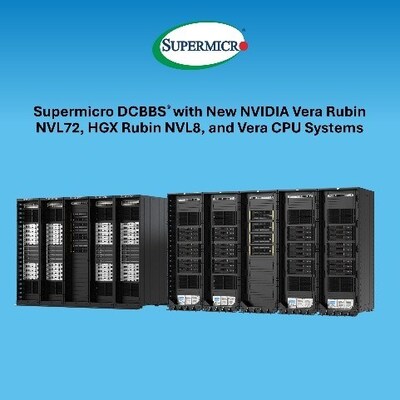
Supermicro is engineering its NVIDIA Vera Rubin NVL72 with new DCBBS liquid-cooling components to fully support the power and thermal envelope at rack and cluster scale. This includes the manufacturing of optimized NVIDIA MGX racks, in-rack or in-row CDU, RDHx and L2A sidecar to streamline production and deployment of the rack-scale AI supercomputer at scale. The Vera Rubin NVL72 operates as a single rack-scale accelerator, unifying six co-designed chips — Rubin GPU, Vera CPU, NVIDIA NVLink 6, NVIDIA ConnectX-9 SuperNIC, NVIDIA BlueField-4 DPU, and NVIDIA Spectrum-X Ethernet — to deliver up to 3.6 Exaflops of inference, 75TB of fast memory, and 1.6 PB/s of HBM4 bandwidth, targeting up to 10x the throughput per watt and one-tenth the token cost compared to NVIDIA Blackwell.
NVIDIA HGX Rubin NVL8 System
The 2U HGX Rubin NVL8 system provides the densest and most flexible HGX platform — and the first HGX platform to offer greater flexibility in CPU selections including NVIDIA Vera CPUs alongside next-generation AMD and Intel x86 processors. Built on the NVIDIA MGX rack architecture with Supermicro's blind mate busbar and manifold for tool-free rack integration, it gives customers the freedom to pair eight Rubin GPUs with the CPU platform that best fits their workload and software stack.
The design supports 9 HGX Rubin NVL8 systems per rack — up to 72 Rubin GPUs total — for large-scale AI training, inference, and accelerated HPC. DCBBS provides in-rack CDU, in-row CDU, RDHx and an optional Liquid-to-air (L2A) sidecar for customers deploying in liquid-cooled or air-cooled data center environments.
NVIDIA Vera CPU System with RTX PRO
Supermicro's Vera CPU next-generation agentic AI system is being engineered as a versatile AI compute node for organizations targeting next-generation agentic AI deployments. The system features dual NVIDIA Vera CPUs supporting up to 6 RTX PRO 4500 Blackwell Server Edition GPUs in a compact 2U chassis — delivering the compute density and energy efficiency that enterprise AI inference, agentic workloads, visualization, and adding accelerated computing to all enterprise workloads. It is a high-bandwidth LPDDR5X memory subsystem and PCIe GPU acceleration in a space-efficient footprint.
NVIDIA BlueField-4 STX Context Memory Storage Platform
Supermicro's upcoming Context Memory Storage Platform (CMX) introduces a new class of AI-native storage for context memory — architected as an intelligent pod-level context memory storage tier that extends GPU KV cache capacity and serves long-context inference data at the throughput that Vera Rubin NVL72 super pod clusters demand. Powered by NVIDIA BlueField-4 processor, NVIDIA Vera CPUs, NVIDIA ConnectX-9 SuperNICs, Spectrum-X Ethernet NVIDIA DOCA, and NVIDIA Dynamo, the system provides the high-bandwidth, low-latency fabric and intelligent data path offload that large-scale AI inference pipelines and RAG workloads require.
Supermicro NVIDIA Blackwell Solutions — Available Now
With next-generation systems in rapid development, Supermicro's current portfolio of NVIDIA Blackwell-based systems is in full production and available for immediate deployment through Supermicro's US and global manufacturing capacity, enabling customers to build and scale production AI infrastructure today. Supermicro is investing across both its current Blackwell lineup and its next-generation systems to ensure customers have the right platform at every stage of this transformation.
Visit Supermicro at GTC San Jose 2026
Supermicro will be unveiling early previews of its Vera Rubin platform systems alongside its current production Blackwell portfolio. Supermicro experts will be available to discuss current procurement options, roadmap planning, and deployment timelines for both near-term and next-generation AI infrastructure in Supermicro booth #1113.
About Super Micro Computer, Inc.
Supermicro (NASDAQ: SMCI) is a global leader in Application-Optimized Total IT Solutions. Founded and operating in
Supermicro, Server Building Block Solutions, and We Keep IT Green are trademarks and/or registered trademarks of Super Micro Computer, Inc.
All other brands, names, and trademarks are the property of their respective owners.
 View original content to download multimedia:https://www.prnewswire.com/news-releases/supermicro-reveals-dcbbs-with-new-nvidia-vera-rubin-nvl72-hgx-rubin-nvl8-and-vera-cpu-systems-designed-to-accelerate-customer-time-to-market-302714873.html
SOURCE Super Micro Computer, Inc.
FAQ
AI-generated questions and answers. How Rhea-AI works. Not financial advice.