
2025 Year in Rear View: CARFAX Canada Unveils Used Vehicle History Insights for the Year
Key Terms
vehicle history report technical
lien financial
vin fraud technical
cloned vins technical
vin technical




With Millions of Issues Uncovered, Canadians Urged to Get a CARFAX Canada History Report Before Buying a Used Car
CARFAX Canada Year in Rear View 2025. Based on data from CARFAX Canada reports run from September 30, 2024, to October 1, 2025.
"Our data reveals critical issues buyers should be aware of when shopping in the used car market—from accidents and weather damage to money owing and fraud. One of the first things buyers should do is check a vehicle’s history and lien status before purchasing or they could risk ending up with a major headache," said Shawn Vording, President at CARFAX Canada.
Accidents or Damage: 1 in 4 Vehicles
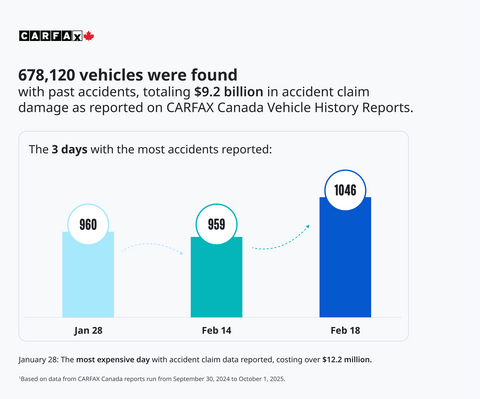
In 2025, the total amount of accident claim damage found on CARFAX Canada Vehicle History Reports was more than
-
Fun fact: February 18 was the day with the most accident records in 2025, with over a thousand incidents reported. The most expensive day for accident claims was January 28, costing more than
$12.2 million
Beyond collisions, CARFAX Canada uncovered more than 50,000 vehicles with severe weather-related damage, leaving behind expensive repairs.
The top 3 provinces with the most expensive hail-related claims:
-
Alberta :$414.8 million -
Ontario :$37.4 million -
Quebec :$1.56 million
Wind damage claims also impacted Canadians this year with
-
Alberta :$39.9 million -
Ontario :$11.8 million -
Nova Scotia :$1.16 million
Money Owing:
Liens (money owing on vehicles) persist as a top concern for used car buyers, with
CARFAX Canada’s 2025 Year in Rear View serves as a stark reminder that investigating a vehicle's history isn't just recommended—it's absolutely critical before making any used vehicle purchase. Without this essential due diligence, buyers risk inheriting costly mechanical problems, hidden accident damage, or even safety hazards that could put lives at risk and drain thousands from their wallets.
Other fun facts:
- White, black and gray are the most popular vehicle colours for Canadians
- The highest odometer reading found this year was on a 2015 GMC Savana with an impressive 995,761 kilometres logged
Vording adds “Canadians should remain vigilant against VIN fraud as this continues to be an issue in the country affecting the entire auto industry from used car buyers to vehicle owners, dealerships, and insurance providers. We estimate that over 372,000 vehicles are in the country with potentially cloned VINs.”
From accident records to money owning and potential VIN fraud, CARFAX Canada searches billions of data records to help Canadians make the right choice when buying used vehicles.
Visit carfax.ca to learn more about CARFAX Canada Vehicle History Report and VIN Fraud Check.
Based on data from CARFAX Canada reports run from September 30, 2024, to October 1, 2025.
About CARFAX Canada
CARFAX Canada, a part of S&P Global (NYSE: SPGI), is Canada’s definitive source of automotive information, delivering vehicle history, valuation and service solutions. Drawing on billions of data records from thousands of sources, its products enable used vehicle buyers, sellers and vehicle service providers to make informed decisions. CARFAX Canada is dedicated to transparency and is trusted to provide vehicle history, valuation and service information to dealerships, vehicle manufacturers, consumers, service shops, major auctions, governments, insurance providers and police agencies.
Connect with CARFAX Canada on Instagram, Facebook and LinkedIn.
1Based on data from CARFAX Canada reports run from September 30th, 2024, to October 1st, 2025.
View source version on businesswire.com: https://www.businesswire.com/news/home/20251125632667/en/
Claudia Jaimes
Manager, Public Relations and Social Media
CARFAX Canada
cjaimes@carfax.ca
+1.519.709.4941
Source: CARFAX Canada