
Toyota and Rivian Adopt Stratasys' New F870™ to Accelerate Factory-Floor Manufacturing Applications at Scale
Stratasys unveils its F870 large-format FDM system, targeting factory-floor tooling and production support, with early use at Toyota and Rivian.
Sentiment and the balance of points
Rhea-AI Sentiment reads the wording of the document, how positive or negative its language is on a 1 to 5 scale. The balance of points shown with the takes weighs what the document actually discloses, so the two can disagree, for example when a trial that missed its main goal is described in upbeat language.




New industrial FDM® platform expands Stratasys' production-grade portfolio with the longest heated build capacity in its class, enabling cost-effective tooling, fixtures and end-use parts for demanding manufacturing environments
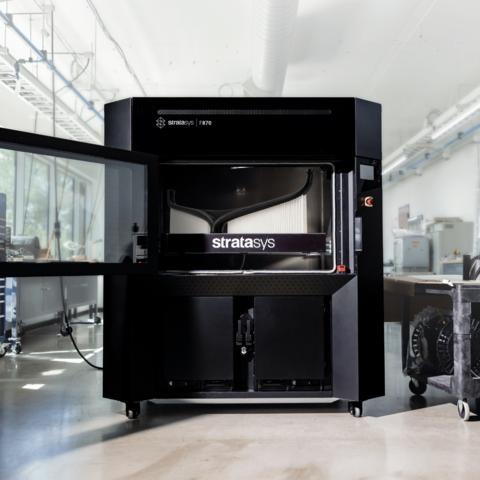
Stratasys F870™ FDM® system, a large-format additive manufacturing platform designed for industrial manufacturers, automotive OEMs, aerospace & defense production lines, looking to scale production on the factory floor.
Extending the Stratasys production-grade FDM portfolio, the F870 combines unrivaled large-format capabilities in a heated chamber backed by a suite of the strongest, most durable materials, all with a lower total cost of ownership so manufacturers can expand additive across manufacturing applications. Manufacturers increasingly demand larger, production-ready systems capable of producing tooling, fixtures, manufacturing aids and end-use parts at the size, throughput, and reliability needed for factory-floor deployment. The F870™ FDM® machine addresses this need.
Systems are currently being adopted by leading manufacturers, including Toyota Production Engineering in
Early deployments address customer needs for automotive tooling, manufacturing aids, and other production-support applications, including large fixtures, assembly tools, and inspection gauges that traditionally require lengthy machining lead times.
"Manufacturers are looking for proven solutions to speed up production, reduce cost, and respond in real-time to ever-changing supply chain and manufacturing requirements," said Rich Garrity, Chief Business Unit Officer, Stratasys. "The F870 is a very unique solution, demonstrating our advanced manufacturing expertise and our deep understanding of customer demand for additive manufacturing solutions that produce larger tooling, fixtures, and manufacturing aids on the factory floor. The new platform is geared towards real manufacturing environments, delivering our leading industrial-scale capabilities with increased build capacity, combined with Stratasys’ proven materials, and production reliability at a competitive price-point."
"We've already seen the value Stratasys additive manufacturing can deliver," said Dallas Martin, Additive Manufacturing Engineer at Toyota North America. "The next challenge is expanding its use across more applications. The F870's combination of build size, material performance and industrial features aligns with the kinds of manufacturing needs we're looking to address."
Designed for production-support applications, the F870 features a build volume of 1000 x 610 x 610 mm (39.4 x 24 x 24 in.) and combines the market's longest build capacity in a fully heated chamber with a portfolio of industrial-grade materials, including Nylon 12CF™, ASA, ABS and the new FDM® ABS Draft (Gray). In particular, Nylon 12CF Carbon Fiber provides the strength, stiffness and durability required for demanding manufacturing-floor tooling and fixture applications. The platform enables manufacturers to produce larger tooling, fixtures, manufacturing aids and end-use parts with the repeatability, durability and throughput required for factory-floor deployment.
Built on Stratasys' industrial FDM® foundation, the F870 expands Stratasys's portfolio of production-focused additive manufacturing solutions, helping manufacturers reduce production costs, improve responsiveness and scale additive manufacturing across manufacturing operations.
Experience the F870 at IMTS 2026
Stratasys will showcase the new F870 platform and other manufacturing-focused innovations at IMTS 2026, Booth 338460, South Hall,
To learn more about the F870, visit https://www.stratasys.com/en/3d-printers/printer-catalog/fdm-printers/f870-printer/ or stop by the booth at IMTS.
To learn more about our large-format 3D Printers click here
About Stratasys
Stratasys is leading the global shift to additive manufacturing with innovative 3D printing solutions for industries including aerospace, automotive, consumer products, and healthcare. Through smart and connected 3D printers, polymer materials, a software ecosystem, and parts on demand, Stratasys solutions deliver competitive advantages at every stage of the product value chain. The world’s leading organizations turn to Stratasys to transform product design, bring agility to manufacturing and supply chains, and improve patient care.
To learn more about Stratasys, visit www.stratasys.com, the Stratasys blog, X/Twitter, LinkedIn, or Facebook. Stratasys reserves the right to utilize any of the foregoing social media platforms, including Stratasys’ websites, to share material, non-public information pursuant to the SEC’s Regulation FD. To the extent necessary and mandated by applicable law, Stratasys will also include such information in its public disclosure filings.
Forward-Looking Statements
This press release contains forward-looking statements within the meaning of the Private Securities Litigation Reform Act of 1995. Those forward-looking statements are based on current information that is, by its nature, subject to potential change, due to risks and uncertainties faced by the Company, including those risks described in Item 3.D “Key Information - Risk Factors” of Stratasys’ annual report on Form 20-F for the year ended December 31, 2025, which Stratasys filed with the SEC on March 6, 2026, and in other reports and documents that Stratasys files with or furnishes to the SEC from time to time, which are designed to advise interested parties of the risks and factors that may affect Stratasys’ business, financial condition, results of operations and prospects. Any forward-looking statements made in this press release are made as of the date hereof, and Stratasys undertakes no obligation to publicly update or revise any forward-looking statements, whether as a result of new information, future events or otherwise, except as required by law.
View source version on businesswire.com: https://www.businesswire.com/news/home/20260909980551/en/
Media and Investor contacts:
Media Relations
Galit Mendelson
Director, Global Communications
+972-74-7454913
Galit.Mendelson@stratasys.com
Investor Relations
Yonah Lloyd
Chief Communications Officer and VP Investor Relations
Yonah.Lloyd@stratasys.com
+972 74 745 4919
Source: Stratasys Ltd.