STOCK TITAN

New Synchrony Study Finds Homeowners Underestimate Lifetime Home Maintenance and Repair Costs by More Than $250,000

Rhea-AI Impact
(Moderate)
Rhea-AI Sentiment
(Neutral)
Tags

Synchrony (NYSE: SYF) released a national Lifetime of Home Care study (September 2025) showing homeowners underestimate maintenance and repair costs by more than $250,000. Homeowners expect ~$70,000 over a lifetime versus actual routine costs >$339,000, and potential lifetime costs exceed $418,000 with emergencies.

The study finds 48% delayed projects due to economic pressure, 75% experienced emergency repairs, and 7 in 10 lack adequate repair reserves, highlighting demand for flexible financing like the Synchrony Project Card.

Loading...
Loading translation...

Positive

  • Large market opportunity: homeowners face >$339,000 lifetime routine costs
  • Financing solution: Synchrony Project Card offers 6–132 month promotional terms
  • Consumer reach: Study surveyed 1,522 homeowners, aged 18–80

Negative

  • Underprepared homeowners: 7 in 10 lack sufficient repair reserves
  • Deferred work risk: 48% delayed or canceled projects due to cost
  • High emergency costs: 40% of emergency repairs exceeded $3,000

Key Figures

Expected lifetime maintenance: $70,000 Actual lifetime upkeep: $339,000+ Annual maintenance cost: $7,000+ per year +5 more
8 metrics
Expected lifetime maintenance $70,000 Homeowners’ estimate of lifetime home maintenance and repair costs
Actual lifetime upkeep $339,000+ Study estimate for routine home maintenance over a lifetime
Annual maintenance cost $7,000+ per year Average home repair and maintenance costs found in the study
Lifetime with emergencies $418,000+ Estimated lifetime cost including major emergency repairs
Projects delayed/canceled 48% Share of homeowners delaying or canceling projects due to economic pressure
Outstanding repair needs 90%+ Homeowners reporting current repair or maintenance needs
Emergency repair incidence 75% Homeowners who have experienced an emergency home repair
High-cost emergencies 40% over $3,000 Emergency incidents costing more than $3,000 among affected homeowners

Market Reality Check

Price: $65.17 Vol: Volume 2,930,158 vs 20-da...
low vol
$65.17 Last Close
Volume Volume 2,930,158 vs 20-day average 4,243,984 suggests muted trading interest before this study release. low
Technical Shares at $65.15, trading below 200-day MA of $72.95 despite a 1.77% gain pre-news.

Peers on Argus

SYF gained 1.77% while key peers were mixed: ALLY +2.19%, OMF +2.35%, PYPL +0.63...

SYF gained 1.77% while key peers were mixed: ALLY +2.19%, OMF +2.35%, PYPL +0.63%, but SOFI -1.98%, indicating company-specific factors rather than a broad credit services move.

Historical Context

5 past events · Latest: Mar 03 (Neutral)
Pattern 5 events
Date Event Sentiment Move Catalyst
Mar 03 Conference participation Neutral +0.0% CFO scheduled for fireside chat at major RBC financial conference.
Mar 02 AI consumer survey Positive -0.7% Survey highlighted rising generative AI use in shopping by U.S. consumers.
Feb 25 Partnership renewal Positive +2.9% Renewed nearly 20-year consumer financing partnership with Polaris dealers.
Feb 19 Partner earnings Positive +1.5% Weave reported FY 2025 growth and guidance, relevant to SYF via ecosystem ties.
Feb 19 CareCredit integration Positive -0.8% Strategic CareCredit integration with Weave to streamline patient financing.
Pattern Detected

Recent SYF news shows mixed price reactions, with strategic partnerships often aligning positively while some product and survey announcements saw modest or negative moves.

Recent Company History

Over the past month, Synchrony has featured in a mix of strategic and informational updates. On Feb 25, 2026, it renewed a long-standing consumer financing partnership with Polaris, which coincided with a price gain. A Feb 19, 2026 CareCredit integration with Weave and a Mar 2, 2026 generative AI shopping survey both had small negative reactions. Participation in a major financial institutions conference on Mar 10, 2026 saw little movement, underscoring that not all visibility events drive the stock.

Market Pulse Summary

This announcement highlights a sizeable home-care spending burden, with lifetime maintenance and rep...
Analysis

This announcement highlights a sizeable home-care spending burden, with lifetime maintenance and repair costs above $339,000 and annual outlays over $7,000. For Synchrony, it reinforces the relevance of financing tools like the Project Card as homeowners manage routine and emergency expenses. In context, investors may track how such research supports product uptake alongside recent credit-quality disclosures and the company’s ongoing partnerships in consumer financing ecosystems.

Key Terms

restricted stock units, rule 10b5-1 trading plan, non-gaap, delinquency rate, +4 more
8 terms
restricted stock units financial
"received a grant of 9,768 restricted stock units at $69.11 per share value"
Restricted stock units are a type of company reward where employees are promised shares of stock, but they only fully own these shares after meeting certain conditions, like staying with the company for a set time. They matter because they can become valuable assets and are often used to motivate employees to help the company succeed.
rule 10b5-1 trading plan regulatory
"open-market sale of 4,338 shares at an average price of $67.71 per share under a pre-established Rule 10b5-1 trading plan"
A Rule 10b5-1 trading plan is a pre-arranged schedule that allows company insiders to buy or sell stock at specific times, even if they have inside information. It helps prevent accusations of unfair trading by making these transactions look planned and transparent, rather than sneaky or illegal.
non-gaap financial
"including a non-GAAP adjusted net charge-off rate that smooths recoveries"
Non-GAAP refers to financial measures that companies use to show their earnings or performance without including certain expenses or income that are often added back to give a different picture. It matters because it can make a company's results look better or more favorable, but it may also hide important costs, so investors need to look at both GAAP (official rules) and non-GAAP numbers to get a full understanding.
delinquency rate financial
"period-end loan receivables were $99.9 billion ... with a 30+ day delinquency rate of 4.7%"
The delinquency rate measures the share of loans or credit accounts with payments past their due date, usually expressed as a percentage of the total loan balance or number of accounts. It matters to investors because rising delinquency rates are an early warning that borrowers are struggling, which can lead to higher losses, tighter lending and weaker profits for banks, lenders and investors in loan-backed securities — like seeing more people miss car payments in a town.
net charge-off rate financial
"and an adjusted net charge-off rate of 5.8%"
Net charge-off rate is the percentage of outstanding loans a lender writes off as uncollectible during a period after subtracting any money later recovered. Think of it like a shop marking damaged items as total loss (then accounting for any partial refunds) — it shows how much credit a lender truly lost. Investors watch it because rising rates signal worsening borrower health, lower future profits and higher risk to a bank’s capital.
open-market sale financial
"executed an open-market sale of 12,980 shares at $67.71 per share"
An open-market sale is when a shareholder sells existing shares directly on a public exchange to any willing buyer, rather than through a private deal. Think of it like putting goods on a busy market stall where price is set by supply and demand; for investors it matters because such sales increase available supply, can put short-term downward pressure on the stock price, and signal changes in liquidity or investor confidence.
tax-withholding disposition financial
"described as a tax-withholding disposition with no investment decision by Juel"
A tax-withholding disposition is an event or transaction—such as selling or transferring securities, exercising options, or receiving compensation—that triggers a requirement to hold back part of the payment and remit it to tax authorities. It matters to investors because it reduces the cash they receive immediately and can change the timing and amount of taxable income, like a cashier taking a portion of your sale proceeds to pay taxes before you get the rest.
loan receivables financial
"period-end loan receivables were $99.9 billion at February 28, 2026"
Loan receivables are amounts a company is owed because it lent money or sold goods or services on credit—think of them as a stack of IOUs the business expects to be paid back. They matter to investors because they are assets that can generate future cash, but their value depends on how likely borrowers are to repay; a large pile of risky IOUs can signal potential losses, weaker cash flow and a need for reserves.

AI-generated analysis. Not financial advice.

Key Highlights:

  • Homeowners expect to spend about $70,000 on lifetime home maintenance costs, while actual costs exceed $339,000 (or more than $7,000 per year).
  • Nearly half of homeowners have delayed or canceled repairs due to economic pressure, driving higher long-term costs.
  • 7 in 10 homeowners lack adequate repair reserves for inevitable emergency repairs.

STAMFORD, Conn., March 18, 2026 /PRNewswire/ -- Synchrony (NYSE: SYF), a leading consumer financing company, today released findings from its new national study, Lifetime of Home Care. The study reveals a significant gap between what homeowners expect to spend on home maintenance and repairs and what they are likely to pay over a lifetime, leaving most homeowners unprepared for the financial reality.

Experience the full interactive Multichannel News Release here: https://www.multivu.com/synchrony/9371151-en-synchrony-study-lifetime-home-maintenance-repair
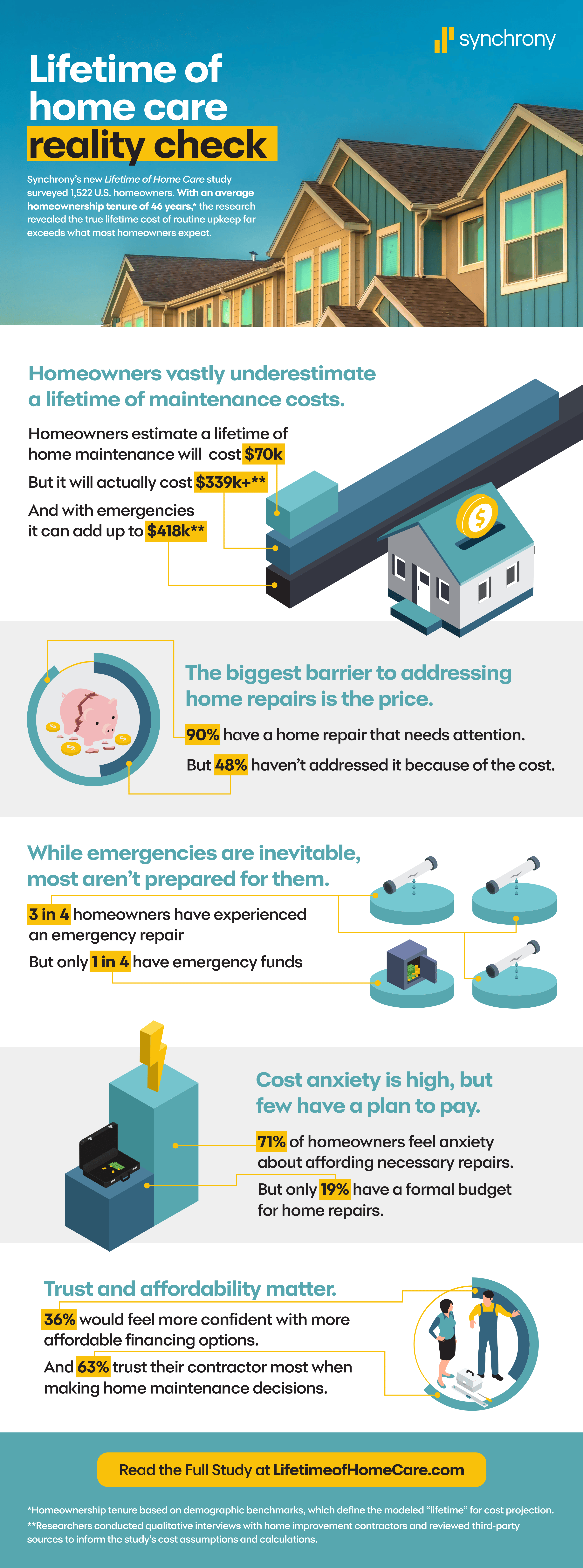
Synchrony's Lifetime of Home Care study reveals a significant gap between what homeowners expect to spend on home maintenance and repairs and what they are likely to pay over a lifetime, leaving most homeowners unprepared for the financial reality.

The study comes amid a shifting housing landscape where U.S. homeowners face mounting pressure from aging homes, rising repair costs, and ongoing economic uncertainty. Despite recent softening, the U.S. repair and remodeling market remains nearly 50% above pre-pandemic levels, topping $600 billion,1 underscoring the growing financial burden of home care.

"At a time when homes are older and more expensive to maintain, many homeowners are unprepared when it comes to understanding and planning for the real cost of maintenance and repair," said Curtis Howse, EVP and CEO, Home & Auto, at Synchrony. "Our Lifetime of Home Care study reveals a critical disconnect between perception and reality and highlights why greater awareness of costs and flexible financing solutions are essential to keeping homes safe, sound and livable over time."

A Growing Stress Point for Homeowners
Home maintenance has become one of the most significant sources of financial stress for American households, surpassing healthcare, childcare and debt.2 These feelings are warranted. According to the Lifetime of Home Care study:

  • Homeowners estimate spending approximately $70,000on maintenance and repairs over a lifetime, yet the actual cost is more than $339,000 for routine upkeep alone.
  • This means that while homeowners estimate spending $1,000 to $5,000 annually, the actual costs exceed $7,000 per year.
  • Homeowners could spend more than $418,000 over the course of ownership when they experience major emergency repairs, such as HVAC failures or water damage.
  • Nearly half of homeowners (48%have delayed or canceled projects due to economic pressures, which can result in more expensive repairs down the road.
  • More than 90% of homeowners currently have outstanding repair or maintenance needs, with paint, flooring and windows topping the list.

Emergency Repairs Are Inevitable, But Few Are Prepared
The Lifetime of Home Care study shows that home emergencies are not a matter of if, but when. Three-quarters (75%) of homeowners have experienced an emergency home repair, and 40% of those incidents cost more than $3,000. Despite this inevitability, 7 in 10 homeowners lack sufficient repair reserves, creating moments when flexible financing becomes essential.

Despite broad awareness of financing options, many homeowners fail to use them when it matters most. While 3 in 4 consumers know contractor financing exists, only 1 in 3 has ever used it, often relying on out-of-pocket payments.

Helping Homeowners Stay Ahead of Costly Repairs
As a leader in consumer financing, Synchrony is committed to helping homeowners better understand and prepare for the lifetime cost of home care. Through flexible financing solutions like the Synchrony Project Card, homeowners can manage routine maintenance, preventative care, and urgent repairs without immediate financial strain. 

The Synchrony Project Card offers access to thousands of contractors nationwide, which can be found on SYFPros.com, promotional financing options from 6 to 132 months, convenient monthly payments, and a fast, hassle-free application process. By helping to enable proactive maintenance and timely repairs, Synchrony helps homeowners avoid deferring work, which often leads to higher long-term costs.

Methodology
The Lifetime of Home Care study was conducted in September 2025. Researchers surveyed 1,522 homeowners between the ages of 18 and 80 who own a home, have financial responsibility for that home, and make decisions on home maintenance and improvement projects. Researchers also conducted qualitative interviews with home improvement contractors and reviewed third-party sources to inform the study's cost assumptions and calculations.

FAQ

How much does a lifetime of home care really cost?
Homeowners estimate lifetime maintenance costs at $70,000, but the Lifetime of Home Care study found actual costs exceed $339,000 and can reach $418,000 or more when emergency repairs are included.

How much should homeowners budget each year for repairs and maintenance?
While many homeowners expect to spend $1,000 to $5,000 annually, the study shows actual home repair and maintenance costs average more than $7,000 per year.

How can homeowners better prepare for the cost of home care?
Prioritizing preventative maintenance and understanding the financing options available can help homeowners stay ahead of unexpected expenses and manage costs more predictably.

How can homeowners pay for home maintenance and repairs?
In addition to savings, homeowners can use flexible financing options to spread the cost of maintenance into manageable monthly payments and avoid financial strain from emergency repairs.

How does Synchrony help homeowners manage repair costs?
Synchrony offers financing solutions, such as the Synchrony Project Card, that help homeowners pay for maintenance and repairs over time, making it easier to stay ahead of home care costs.

About Synchrony
Synchrony (NYSE: SYF) is a leading consumer financing company that has been at the heart of American commerce and opportunity for nearly a century. Synchrony delivers credit and banking products that empower tens of millions of consumers to improve their financial lives and access what matters most. Leveraging innovative solutions that are shaping the future of retail commerce, Synchrony supports the growth and success of some of the nation's most respected brands, alongside hundreds of thousands of small and midsize businesses, including health and wellness providers. Committed to excellence in service and culture, Synchrony is honored to be ranked the #2 Best Company to Work For® in the U.S. by Fortune magazine and Great Place to Work®. For more information, visit www.synchrony.com.

Media Contact:
Lauren Devilbiss
Synchrony
Lauren.Devilbiss@syf.com

1 Harvard Joint Center for Housing Studies "Improving America's Housing 2025 Report"
2 Angi's "2025 State of Home Spending Pulse Report"

 

Synchrony Logo


Through flexible financing solutions like the Synchrony Project Card, homeowners can manage routine maintenance, preventative care, and urgent repairs without immediate financial strain.


Cision View original content:https://www.prnewswire.com/news-releases/new-synchrony-study-finds-homeowners-underestimate-lifetime-home-maintenance-and-repair-costs-by-more-than-250-000--302713672.html

SOURCE Synchrony

FAQ

How much does Synchrony say homeowners actually spend on lifetime home repairs (SYF)?

Homeowners actually spend more than $339,000 on routine maintenance over a lifetime. According to the company, lifetime costs can exceed $418,000 when major emergency repairs like HVAC failures or water damage are included.

What annual repair budget does the Synchrony study recommend compared to homeowner expectations (SYF)?

The study finds actual costs average more than $7,000 per year, not the expected $1,000–$5,000. According to the company, this gap reflects aging homes and higher repair prices, increasing the need for planning and financing.

How many homeowners lack emergency repair savings, per Synchrony (SYF)?

About 7 in 10 homeowners lack sufficient repair reserves for emergencies. According to the company, this shortfall contributes to reliance on out-of-pocket payments and low usage of contractor financing when repairs occur.

What share of homeowners delayed projects because of cost, according to Synchrony (SYF)?

48% of homeowners have delayed or canceled repair projects due to economic pressures. According to the company, deferrals often increase long-term repair bills and drive demand for flexible financing.

How common are emergency home repairs and their costs in Synchrony's study (SYF)?

75% of homeowners have experienced an emergency repair, and 40% of those cost more than $3,000. According to the company, these events make access to financing critical for many households.

How does Synchrony propose homeowners pay for maintenance and repairs (SYF)?

Synchrony recommends flexible financing such as the Synchrony Project Card, with 6–132 month promotional options and contractor access. According to the company, this helps spread costs and avoid deferring necessary work.
Synchrony Financial

NYSE:SYF

View SYF Stock Overview

SYF Rankings

SYF Latest News

SYF Latest SEC Filings

SYF Stock Data

22.25B
346.32M
Credit Services
Finance Services
Link
United States
STAMFORD