
Teradyne Announces Magnum E2 to Address Next-Generation Memory Test Demands Driven by AI and High-Performance Computing
Teradyne (TER) introduced Magnum E2, a memory test system for advanced DRAM and NAND flash devices.
Sentiment and the balance of points
Rhea-AI Sentiment reads the wording of the document, how positive or negative its language is on a 1 to 5 scale. The balance of points shown with the takes weighs what the document actually discloses, so the two can disagree, for example when a trial that missed its main goal is described in upbeat language.




Advanced Near-DUT architecture delivers superior high-speed signal integrity, high parallelism, and a scalable and flexible test foundation for next-generation DRAM and NAND innovations.
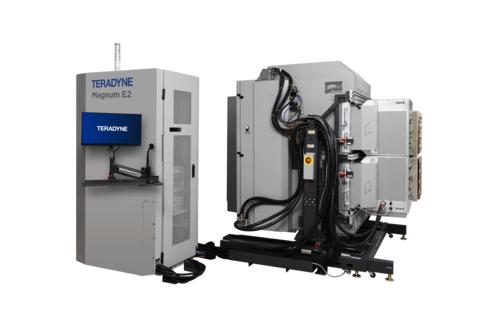
Teradyne Magnum E2 is a high-speed memory test system for advanced DRAM and flash interfaces built for the test demands driven by AI and high-performance computing.
As AI accelerates the pace of technological change in memory devices, Magnum E2 ensures that the high-speed memory at the heart of AI data centers meets the performance and reliability standards required for frontier AI compute. DRAM and flash devices are moving to higher speeds with wide I/O and PAM3 signaling to support faster training and lower latency inference. These transitions demand a tester with greater pin count, higher parallelism, and NRZ and PAM3 support while preserving signal integrity – a challenge Magnum E2 is purpose-built to address.
"The memory inside an AI accelerator is as critical to system performance as the compute die itself, and the test requirements have never been more demanding," said Ben Han, president of the Memory Test division at Teradyne. "As the industry moves to advanced DRAM and high-speed NAND flash for enterprise SSDs, our customers cannot afford a test platform that forces a choice between signal integrity and throughput. Magnum E2 was built to eliminate this trade-off and give leading memory manufacturers a platform they can qualify today and grow with for the future."
Key Features and Benefits
- Higher Yield at Speed: digital instruments are placed close to the device under test to preserve signal integrity, protecting AC margin where conventional architectures lose it.
- Future-Ready Protocol Coverage: Support for high-speed NRZ, PAM3, and PAM4 signaling with flexible, programmable APG architecture on common hardware accommodates current and emerging DRAM and NAND standards without requiring tester replacement.
- Memory and Logic Test on a Single Platform: Built-in logic test capability supports the convergence of memory and logic testing, enabling customers to consolidate test insertions and reduce overall program complexity.
As AI drives successive generations of memory innovation from the AI data center to the edge, the ability to test at higher speeds, with flexible interface signaling at higher parallelism, and across a broader protocol range is a necessity for memory manufacturers. Magnum E2 gives Teradyne's customers the platform to meet that challenge today and evolve with confidence as the industry moves forward.
For more information about Magnum E2, visit Teradyne at SEMICON West, booth #1143, October 13-15 in
About Teradyne
Teradyne (NASDAQ: TER) designs, develops, and manufactures automated test equipment and advanced robotics systems. Its semiconductor and electronics test solutions span the full AI device supply chain, from wafer to data center, enabling customers to meet the quality and reliability standards the AI era demands. Its advanced robotics business deploys intelligent automation across manufacturing, logistics, and data center operations for customers worldwide. For more information, visit teradyne.com. Teradyne is a registered trademark of Teradyne, Inc., in the United States and other countries.
View source version on businesswire.com: https://www.businesswire.com/news/home/20260929262612/en/
For More Information
Amy McAndrews
Investor Relations
Tel: 978.370.3945
investor.relations@teradyne.com
Source: Teradyne, Inc.