Rhea-AI Sentiment reads the wording of the document, how positive or negative its language is on a 1 to 5 scale. The balance of points shown with the takes weighs what the document actually discloses, so the two can disagree, for example when a trial that missed its main goal is described in upbeat language.
LONDON--(BUSINESS WIRE)--
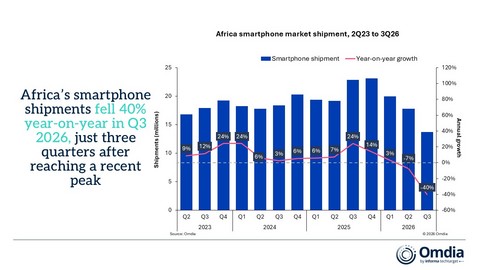
Smartphone shipments in Africa fell 40% year-on-year (YoY) to 13.7 million units, down from 22.8 million a year earlier, according to Omdia’s latest research. This marked the steepest YoY decline in three years following three consecutive years of third-quarter growth. Rising component costs and currency pressures are changing how vendors price their devices and how consumers buy them across Africa's largest markets.
Africa smartphone market shipment, 2Q23 to 3Q26
Rising prices weigh on smartphone shipments and market value
Shipments of smartphones priced below $100 fell nearly 70% YoY in 3Q26, while feature phone shipments grew 27%. Entry-level smartphones are becoming less profitable, prompting vendors to reconsider which models they offer and how they price them. Consumers who pay in cash, particularly those without access to operator subsidies or financing, are delaying upgrades or turning to refurbished smartphones and feature phones. Higher-priced smartphones are increasingly out of reach for these buyers.
“The figures show how affordability is shaping buying decisions in Africa. Some buyers are waiting longer to upgrade or choosing a refurbished smartphone to stay within budget,” notes Manish Pravinkumar, Principal Analyst at Omdia. “In many other regions, higher average selling prices (ASPs) helped sustain market value as shipments fell. In Africa, the ASP reached $222 in 3Q26, its highest third-quarter level in a decade. Even so, market value fell 15%. The increase in average price reflects a widening affordability gap and offers little evidence that buyers are moving to more expensive models.”
Nigeria and Egypt record the steepest shipment declines among Africa’s key markets
The size of the decline varied across Africa's key markets, reflecting differences in economic conditions, access to consumer financing, and exposure to currency and policy changes. Nigeria recorded the steepest decline among these markets, with smartphone shipments down 47% YoY. Fuel price pressures following subsidy removal, limited access to US dollars for import payments and higher handset costs further reduced household purchasing power.
In Egypt, smartphone shipments fell 41%. A weaker Egyptian pound and persistent inflation raised the cost of importing phones and manufacturing them locally, prompting consumers to delay upgrades.
In Kenya, smartphone shipments fell 35%. Shipments in the country’s core price segment, smartphones priced below $150, fell 44% as higher device prices put these devices beyond the reach of more buyers. Credit purchases and instalment plans are playing a growing role in helping consumers manage upfront costs.
South Africa recorded a smaller decline of 20%. Established operator distribution networks, contract upgrades, and a wider range of retail channels helped support shipments. High smartphone penetration, pressure on household budgets and longer replacement cycles continued to weigh on demand.
Samsung gains market share as TRANSSION retains the lead
TRANSSION accounted for 48% of smartphone shipments in Africa in 3Q26. Its shipments fell 43%, reflecting its exposure to the shrinking market for smartphones priced below $100.
Samsung recorded the smallest shipment decline among the five leading vendors, down 8%, and its market share rose to 23%. Its operator relationships and broad Galaxy A-series portfolio supported shipments. The Galaxy A07 4G and A17 4G together accounted for 56% of Samsung’s total smartphone shipments in Africa during the quarter.
Xiaomi’s shipments fell 49% as price increases across its portfolio weakened demand from channel partners and reduced its share of consumer spending.
HONOR’s shipments fell 14% YoY in 3Q26 after recording near triple-digit growth in the previous two years. Its performance in South Africa and expansion into other African markets supported that earlier growth. The decline shows how higher handset prices can slow even fast-growing vendors.
OPPO’s shipments fell 69% as it reorganized its operations as part of its integration with realme.
Tax reforms and device financing offer potential routes to recovery
Omdia expects smartphone shipments in Africa to end 2026 down 23% YoY and forecasts a further 25% decline in 2027.
“The forecast shows how heavily Africa's smartphone market depends on affordable devices and continued growth in shipments,” said Pravinkumar. “With cost pressures expected to persist into 2027, vendors face a difficult pricing challenge. They need to keep entry-level devices profitable, but passing higher component costs on to buyers risks putting smartphones beyond the reach of more households.”
Tax policy and access to financing will also shape the prospects for a recovery. Morocco reduced its smartphone import duty from 17.5% to 2.5%, illustrating how tax reform can ease cost pressures. Vodacom has introduced prepaid handset financing across all its African markets. In Nigeria, vivo is working with Credit Direct on device financing. M-KOPA continues to expand its smartphone financing model.
Pravinkumar added, “Governments, manufacturers and mobile operators all have a role in improving affordability. Closer cooperation will be essential to expand local manufacturing, make distribution more cost-effective, and give more customers access to financing. The next phase of growth depends on making connected devices affordable for a wider range of buyers.”
Africa smartphone shipment and annual growth
Omdia Smartphone Market Pulse: 3Q26
Vendor
3Q26
3Q26
3Q25
3Q25
Annual
shipments
market
shipments
market
growth
(million)
share
(million)
share
TRANSSION
6.6
48%
11.6
51%
-43%
Samsung
3.1
23%
3.4
15%
-8%
Xiaomi
1.5
11%
2.9
13%
-49%
HONOR
0.8
6%
0.9
4%
-14%
OPPO
0.5
3%
1.5
7%
-69%
Others
1.3
9%
2.6
11%
-50%
Total
13.7
100%
22.8
100%
-40%
Note: Xiaomi includes POCO, TRANSSION includes TECNO, Infinix and iTel, OPPO includes realme and OnePlus
Percentages may not add up to 100% due to rounding.
Source: Omdia Smartphone Horizon Service (sell-in shipments), November 2026
What will shape your business in 2027? Explore Omdia’s The Forces Shaping 2027 for research and insights on AI monetization, supply chain disruption, digital sovereignty, and physical AI, and the opportunities and challenges they present for the year ahead.
ABOUT OMDIA
Omdia, part of TechTarget, Inc. d/b/a Informa TechTarget (Nasdaq: TTGT), is a technology research and advisory group. Our deep knowledge of tech markets grounded in real conversations with industry leaders and hundreds of thousands of data points, make our market intelligence our clients’ strategic advantage. From R&D to ROI, we identify the greatest opportunities and move the industry forward.
Average selling price (ASP) is the typical price a company receives for a single unit of a product or service, calculated by dividing total revenue by units sold. Investors watch ASP because it shows whether a company is successfully charging more or less for its offerings — like checking the average price per loaf of bread a bakery sells — which directly affects revenue, profit margins, and the health of future sales.
sell-in shipmentstechnical
Sell-in shipments are the products a manufacturer or supplier sends to distributors, wholesalers or retailers during a reporting period; they count as sales to the channel but not yet as purchases by end customers. Investors watch sell-in because it shows how much stock is moving into the sales pipeline—like a factory delivering boxes to stores—which can signal future revenue growth but may overstate demand if retailers are simply building up inventory rather than selling to consumers.
import dutyregulatory
A charge imposed by a government on goods brought into a country, like a toll collected at a border crossing for imported products. It matters to investors because import duties raise the cost of goods, affect a company’s profit margin, pricing decisions and supply-chain choices, and can change consumer demand and competitive balance—factors that influence revenue, cash flow and the value of an investment.