
Omdia: AI Demand Drives 94.1% Surge in Semiconductor Forecast for 2026
Omdia (NASDAQ:TTGT) has raised its 2026 semiconductor revenue forecast, now expecting a 94.1% year-over-year increase, largely driven by DRAM and NAND as AI demand outstrips global supply.
Sentiment and the balance of points
Rhea-AI Sentiment reads the wording of the document, how positive or negative its language is on a 1 to 5 scale. The balance of points shown with the takes weighs what the document actually discloses, so the two can disagree, for example when a trial that missed its main goal is described in upbeat language.




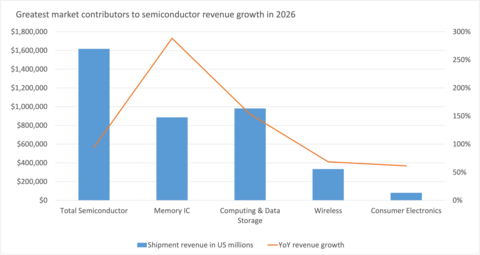
Greatest market contributors to semiconductor revenue growth in 2026
AI demand strains HBM supply and advanced packaging capacity
HBM supply remains fundamentally constrained because production is significantly more complex than standard DRAM and relies on just three suppliers capable of manufacturing at scale: SK Hynix, Samsung, and Micron.
AI accelerators from companies like NVIDIA, AMD, Intel, and Google require HBM stacks, further intensifying demand. Advanced packaging has become another major bottleneck, with dedicated manufacturing lines at TSMC operating at full utilization. Capacity cannot expand quickly enough because of long lead times for specialized equipment while suppliers such as ASML and Tokyo Electron continue to face manufacturing constraints of their own.
Leading node capacity is under similar pressure. TSMC's 2nm and 3nm nodes are largely booked by companies including NVIDIA, AMD, Broadcom, and Apple. At the same time, computing requirements for AI models are growing far faster than foundry capacity can expand.
Memory pricing and component costs impact application segments
As semiconductor revenue growth becomes increasingly concentrated in AI-related applications, other markets are facing significant cost pressure. Smartphones, PCs, and consumer electronics are experiencing higher component costs, while automotive and industrial electronics markets must also compete with AI demand for packaging and memory ICs.
In memory ICs, DRAM suppliers are prioritizing HBM and other high-margin products, making commodity memory pricing and lead times increasingly volatile. In packaging, older and mid-range products are less directly affected, but products requiring 2.5D or 3D packaging must compete for the same capacity as AI GPUs and other high-priority chips. A similar trend is emerging in leading-edge node capacity where AI processors are being prioritized over PC and smartphone chips. As a result, CPUs and SOCs may face delays and higher average selling prices (ASPs) or remain on older process nodes for longer than expected, slowing improvements in performance and power efficiency.
Computing and data storage lead semiconductor revenue growth
Computing & Data Storage will lead all application markets in semiconductor revenue growth, rising by more than
Consumer electronics and wireless applications also present a relatively strong outlook for semiconductor revenue growth in 2026. Smartphone price increases began in the fourth quarter of 2025, and prices are now rising further, particularly in the premium tier, where healthier margins can better absorb inflated memory cost. This strategy is narrowing the price gap between mid-tier and premium models, encouraging consumers to trade up to higher-end devices.
Apple’s iPhone 18 and iPhone Fold, and Google’s Pixel 11 Pro Fold are all expected later this year, increasing semiconductor content through additional features and AI capabilities. Smart watches, fitness and wellness wearables, video game consoles and OLED TVs are also projected to see meaningful semiconductor revenue gains, supported by higher component costs and sustained market demand.
“From mid-2026 through early 2027, the semiconductor market will be defined by relentless AI demand. Capacity will remain constrained, advanced nodes heavily utilized, and memory and advanced packaging costs will continue to rise. Investment tied directly to AI infrastructure will drive record silicon consumption, while non-AI markets continue to face supply constraints.” said Myson Robles-Bruce, Senior Principal Analyst at Omdia.
ABOUT OMDIA
Omdia, part of TechTarget, Inc. d/b/a Informa TechTarget (Nasdaq: TTGT), is a technology research and advisory group. Our deep knowledge of tech markets, grounded in real conversations with industry leaders and hundreds of thousands of data points, make our market intelligence our clients’ strategic advantage. From R&D to ROI, we identify the greatest opportunities and move the industry forward.
View source version on businesswire.com: https://www.businesswire.com/news/home/20260730398107/en/
Fasiha Khan: fasiha.khan@omdia.com
Eric Thoo: eric.thoo@omdia.com
Source: Omdia