
Omdia: Global Smartphone Average Selling Price to Reach $565 in 2026 as Vendors Prioritize Value Over Volume
Omdia forecasts a major shift in the global smartphone market as vendors prioritize value over volume.
Sentiment and the balance of points
Rhea-AI Sentiment reads the wording of the document, how positive or negative its language is on a 1 to 5 scale. The balance of points shown with the takes weighs what the document actually discloses, so the two can disagree, for example when a trial that missed its main goal is described in upbeat language.




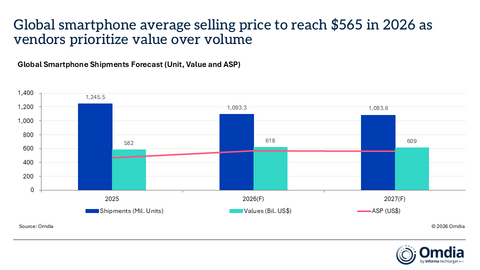
Global Smartphone Shipments Forecast (Unit, Value and ASP)
According to Omdia’s global smartphone forecast, total global smartphone shipments are forecast to contract by
A historic surge in average selling prices
This divergence between shipment volume and market value is being fueled by a sharp rise in retail pricing. The global smartphone average selling price (ASP) is forecast to increase from
This pricing surge reflects severe margin pressures across the supply chain. Average DRAM and NAND flash memory prices rose by more than
“The smartphone industry is currently going through a period of significant disruption, as vendors work to manage short-term component cost pressures as effectively as possible,” said Jusy Hong, Senior Research Manager at Omdia. “Some vendors are gaining early-mover advantages by increasing component inventories to minimize the impact of future price hikes. Once the DRAM and NAND pricing starts to stabilize and plateau at a new level, the market is expected to enter a phase of stabilization, where the focus will shift back to other strategic priorities. This transition is expected towards the second half of 2027.”
“Many industry players will be waiting for the readjustment phase, when component prices start to move downwards. At this stage, vendors with leaner structures will be better positioned to benefit from price declines, and excess inventory could become a major hurdle. The transition to a readjustment phase is currently anticipated in early 2028, driven by expected increases in supply capacity. Short-term ease could arrive earlier, depending on how AI datacenter demand develops,” added Hong.
Strategic Pivot and Regional Impact
To protect margin, global vendors are actively scaling back their low-end product lines and increasing production shares for mid-to-high-end smartphones in their portfolios.
This strategic pivot will impact regions differently:
-
Emerging Markets: Demand is expected to fall heavily in
Africa , theMiddle East , andLatin America . These regions rely heavily on low-end devices and are highly sensitive to price increases. - Developed Markets: Premium-heavy developed markets are expected to be more resilient, with milder shipment declines.
- Vendor Portfolios: Almost every major smartphone brand— apart from Apple—has raised retail prices for new-generation products to offset higher manufacturing costs.
“Vendors are also increasingly relying on wider business models and portfolios to strengthen operational resilience. Vendors and regions with a high dependence on budget smartphones as their primary customer engagement will be particularly exposed. The strongest position will be held by vendors that can capture additional high-value and high-margin streams from each user. This will typically include cross-selling other ecosystem devices, upselling services and subscriptions that increase the lifetime user value, and expanding opportunities to monetize the installed base,” said Runar Bjorhovde, Omdia Principal Analyst for smartphones.
Long-Term Outlook and Delayed Recovery
Omdia forecasts that the global smartphone market contraction will extend into 2027, although the shipment decline is forecast to slow significantly to
Meaningful volume recovery for the industry is therefore expected to begin in 2028. Looking ahead, top global smartphone vendors are expected to remain highly conservative about expanding entry-level lineups. The ultra-low-end smartphone segment is projected to shift away from major global brands and towards smaller, local and regional manufacturers.
ABOUT OMDIA
Omdia, part of TechTarget, Inc. d/b/a Informa TechTarget (Nasdaq: TTGT), is a technology research and advisory group. Our deep knowledge of tech markets, grounded in real conversations with industry leaders and hundreds of thousands of data points, make our market intelligence our clients’ strategic advantage. From R&D to ROI, we identify the greatest opportunities and move the industry forward.
View source version on businesswire.com: https://www.businesswire.com/news/home/20260623523762/en/
Fasiha Khan: fasiha.khan@omdia.com
Eric Thoo: eric.thoo@omdia.com
Source: Omdia