LONDON--(BUSINESS WIRE)--
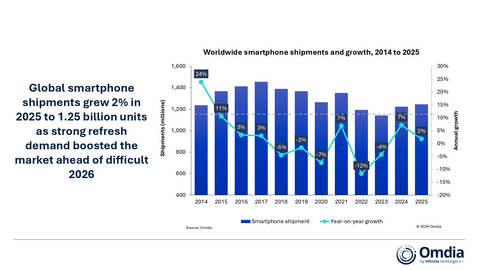
The latest research from Omdia reveals that global smartphone shipments grew by 2% in 2025 to 1.25 billion units, marking the highest annual level since 2021. All regions grew compared to 2024, except for Greater China, which marginally declined amid the fading effect of the national subsidy scheme that boosted its performance in early 2025. Strong demand from both upgraders and replacement-buyers continued to boost the market, as several vendors broke records despite uncertainty reigning in the business environment throughout the year.
Worldwide smartphone shipments and growth, 2014 to 2025.
The global smartphone market ended 4Q25 with 4% year-over-year growth, bolstered by seasonal tailwinds and strong vendor performance. Despite this momentum, rising costs for key components and memory late in the period have started to dampen volume growth expectations for the start of 2026.
Apple delivered its highest annual volume ever in 2025 as iPhone shipments grew 7% to 240.6 million units, helping it maintain the title as the world’s largest vendor for the third consecutive year. An all-time high quarterly iPhone volume in 4Q25 fueled its performance, with Apple notably posting 26% year-on-year growth in Mainland China driven by stronger iPhone 17 series demand. Samsung delivered a meaningful rebound in 2025 after three consecutive years of annual declines, growing 7% year on year and finishing marginally behind Apple. The year culminated in a standout fourth quarter, with shipments up 16% YoY, supported by resilient flagship demand alongside a notable recovery in mass-market volumes. Samsung maintained healthy Galaxy S and Z shipments while regaining share in entry-level and mainstream tiers (A0x and A1x), marking an important reversal after several years of pressure at the lower end of the market.
Xiaomi defended its third-place position in 2025, despite a tougher finish to the year, with shipments declining 2% amid entry-level softness and a sharp 4Q25 contraction in key markets. Expanding value growth through a broader portfolio push from POCO to premium and AIoT across retail remains key. Meanwhile, vivo claimed the fourth spot for the first time, driven by continued success in India alongside a consistent performance in its domestic market, to grow 4% to 105.3 million units. OPPO completed the top 5, with its shipments returning to growth in 4Q25 after a tricky first half of 2025 with newly launched A6x models. OPPO reached 100.7 million units in 2025, down 3% from 2024. With realme going under OPPO’s umbrella from 2026, OPPO will gain key volume and market strengths that can help it challenge for a higher position in the rankings.
Beyond the top 5, several vendors continue to experience positive demand despite challenging market conditions. HONOR and Lenovo grew 11% and 6% respectively, reaching record highs, with growth from rapid geographical expansion amid fierce competition in their core markets. Huawei continued growing as it reclaimed the top spot in Mainland China for the first time in five years. Nothing was the fastest-growing vendor of 2025, with shipments growing 86% to surpass 3 million units.
“Although 2025 overall has been a positive year for most vendors, headwinds are building for the 2026 outlook,” said Runar Bjorhovde, Senior Analyst at Omdia. “According to the recent Omdia report, 'DRAM Eats Smartphones: What Matters for Success in 2026,' escalating supply-side pressures in DRAM, NAND, and other semiconductors are a primary concern for vendors. These constraints threaten to squeeze margins, force pricing adjustments, and ultimately dampen consumer demand. However, vendors are not impacted similarly. Particularly those operating with smaller scale, limited long-term relationships with suppliers, high LPDDR4/4X exposure, and large low-end shares will be particularly exposed. It is also essential that vendors manage pressure points in the supply chain and sales channel effectively with long-term relationships in mind, while attempting to limit the end-buyers’ exposure to the increased costs.”
“With market contraction looking increasingly unavoidable for 2026, vendors will shift toward prioritizing profitability while expanding alternative revenue streams,” added Le Xuan Chiew, Research Manager at Omdia. “Periods of disruption offer a competitive edge to the vendors, suppliers, and partners who navigate challenges with agility. These conditions create a strategic opening to capture upgrade switchers, scale across new channels, and secure the market share vital for long-term resilience. Capitalizing on this momentum not only gains immediate market share but also fortifies long-term viability. Vendors’ core focus must remain on the end-customer, as buying journeys are evolving, it is no longer enough for vendors to understand what consumers want. Equally important is figuring out how and why they buy, to target key influence points where opinions must be swayed. The defining question for 2026 and beyond is which vendors will most effectively acquire customers and optimize partnerships while navigating persistent supply-side pressures.”
Worldwide smartphone shipments (market share and annual growth)
Omdia Smartphone Market Pulse: 4Q25
Vendor
4Q25
shipments
(millions)
4Q25
market
share
4Q24
shipments
(millions)
4Q24
market
share
Annual
growth
Apple
84.3
25%
77.1
23%
9%
Samsung
60.4
18%
51.9
16%
16%
Xiaomi
37.8
11%
42.7
13%
-11%
vivo
27.5
8%
26.4
8%
4%
OPPO
26.8
8%
24.6
7%
9%
Others
102.7
30%
105.3
33%
-3%
Total
339.5
100%
328.1
100%
4%
Note: Xiaomi includes Redmi and POCO, OPPO includes OnePlus, vivo includes iQOO.
Percentages may not add up to 100% due to rounding.
Source: Omdia Smartphone Horizon Service (sell-in shipments), January 2026
Worldwide smartphone shipments (market share and annual growth)
Omdia Smartphone Market Pulse: 2025
Vendor
2025
shipments
(millions)
2025
market
share
2024
shipments
(millions)
2024
market
share
Annual
growth
Apple
240.6
19%
225.9
18%
7%
Samsung
239.1
19%
222.9
18%
7%
Xiaomi
165.4
13%
168.6
14%
-2%
vivo
105.3
8%
100.9
8%
4%
OPPO
100.7
8%
103.6
8%
-3%
Others
394.4
33%
401.4
34%
-2%
Total
1,245.5
100%
1,223.2
100%
2%
Note: Xiaomi includes Redmi and POCO, OPPO includes OnePlus, vivo includes iQOO.
Percentages may not add up to 100% due to rounding.
Source: Omdia Smartphone Horizon Service (sell-in shipments), January 2026
ABOUT OMDIA
Omdia, part of Informa TechTarget, Inc. (Nasdaq: TTGT), is a technology research and advisory group. Our deep knowledge of tech markets grounded in real conversations with industry leaders and hundreds of thousands of data points, make our market intelligence our clients’ strategic advantage. From R&D to ROI, we identify the greatest opportunities and move the industry forward.
A dram is a small, traditional unit used to measure either mass or liquid volume in manufacturing and pharmaceuticals — roughly 1.77 grams for a weight dram or about 3.7 milliliters for a fluid dram, similar to a small teaspoon or a couple of drops. Investors care because dram-based measurements affect drug dosing, packaging sizes, labeling compliance and raw-material usage, which in turn influence production costs, inventory counts and regulatory risk.
nandtechnical
NAND is a type of non-volatile memory used to store data in electronic devices such as phones, SSDs, and tablets; it keeps information even when power is off. Think of it as a digital filing cabinet made of tiny cells where data is written, erased and rewritten. Investors watch NAND because its supply, demand and manufacturing costs drive prices, company revenues and profit margins across the semiconductor and consumer electronics industries.
semiconductorstechnical
Materials and the electronic components made from them that control the flow of electricity inside devices, enabling functions like computing, sensing, and communication; think of them as the traffic controllers that let electrical signals move where they’re needed. They matter to investors because semiconductors are core to virtually all modern technology—changes in demand, production capacity, or supply chains can quickly affect the revenues and stock values of many companies across industries.
lpddr4/4xtechnical
LPDDR4 and LPDDR4X are generations of low-power, high-speed memory used in mobile devices and other battery-powered electronics to hold the data an app or processor is actively using — think of them as a fast, energy-efficient workspace for a device’s brain. They matter to investors because their performance, power use and unit cost influence device battery life, user experience and the sales and profit potential of chip makers and device manufacturers, similar to how a more efficient engine can make a car more desirable.