An operating system is the core software that manages a computer or device’s hardware and runs applications, like a conductor coordinating musicians so each instrument plays at the right time. Investors care because the operating system shapes what apps and services can run, affects performance and security, and often creates a platform ecosystem that drives user adoption, recurring revenue, and competitive advantage.
ostechnical
Overall survival (OS) measures the length of time from a defined starting point, usually treatment or trial enrollment, until death from any cause; it tells how much a therapy extends life. For investors, OS is a hard, widely accepted clinical endpoint that regulators and doctors use to judge a drug’s real-world benefit, and strong OS results can drive approvals, market adoption, and a company’s valuation — like a clear safety rating boosting confidence in a car model.
conversational aitechnical
Conversational AI is technology that allows computers to understand, process, and respond to human language in a way that feels natural and interactive, similar to chatting with a person. It enables machines to hold conversations, answer questions, and assist with tasks automatically. For investors, it matters because this technology can improve customer service, streamline operations, and create new opportunities across many industries.
generative aitechnical
Generative AI is a type of computer technology that can create new content, like text, images, or music, on its own. It’s important because it can produce realistic and useful material quickly, which could change how we create art, write stories, or even develop new products. Think of it as a smart robot that can invent and produce things almost like a human.
qr codetechnical
A QR code is a square, two‑dimensional barcode that stores information such as a website link, payment details, or product data and can be read instantly by a smartphone camera. For investors it matters because companies use QR codes to drive customer engagement, speed payments, track inventory, or provide instant access to reports and disclosures—similar to a digital shortcut that connects physical items or ads directly to online actions that can affect sales, costs, and transparency.
tv ostechnical
An operating system designed for television streaming devices and smart TVs that runs the device’s apps, manages video and audio playback, and connects the screen to online services. Investors care because it shapes what apps and services users can access, influences device and content sales, and affects recurring revenue from subscriptions and app purchases — like the invisible engine that determines how well a streaming platform and its ecosystem perform.
See more from StockTitan in Google Search and AI answers.Adds StockTitan as a preferred source · opens Google
LONDON--(BUSINESS WIRE)--
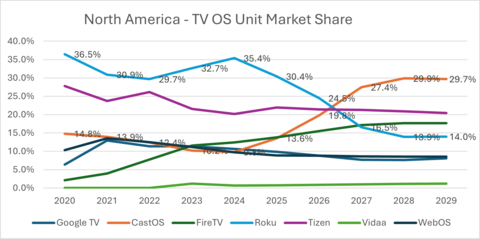
Retailers are forecast to control 47% of the North American TV operating system (OS) market by 2029, up from 27% in 2025, according to Omdia's latest TV Design & Features Tracker. The rapid shift underscores how retailers are prioritizing e-commerce-driven retail media advertising over traditional TV shipment leadership.
North America - TV OS Unit Market Share
This trend was a key theme at CES 2026 in Las Vegas, alongside conversational AI driven features.
Globally, Omdia forecasts that the TV OS opportunity is consolidating into three distinct segments. In China, localized Android forks without Google services continue to dominate holding a stable 96% share a level Omdia expects to persist through the forecast period. In the rest of the world (excluding North America and China), Google TV currently leads with a 40% share but will lose share gradually to three key competitors: VIDAA, Titan and TiVo.
Omdia projects an inflection point in 2027 for North America when Walmart’s CastOS shipments reach 14.0 million units. This is driven by Walmart’s acquisition of Vizio and the expansion of its CastOS platform. After the acquisition of Vizio, Walmart has rapidly increased Vizio unit shipments from 4.8 million units in 2024 to a projected 6.6 million units in 2025, representing a 37.5% increase. Simultaneously, Amazon increased FireTV unit shipments from 6.1 million units in 2024 to a projected 6.8 million units in 2025, an 11.5% increase.
By 2029, Omdia projects Walmart’s CastOS will reach 14.8 million units and Amazon FireTV will reach 8.8 million units. Consequently, these two retailers will ship a combined 23.6 million units into a total market of 50.0 million units.
“At CES 2026, VIDAA OS underwent a major transformation,” said Patrick Horner, Practice Leader, TV Set Research, Omdia. “The operating system is transitioning to a new name, V Home OS, to reflect its broader role beyond just televisions. A significant partnership with Microsoft was announced to integrate Copilot’s generative AI capabilities directly into the platform, enhancing the user experience with advanced AI services. The name change is part of the wider push by the company to be an operating system that encompasses not only AI but also, eventually, acts as a shopping portal.”
Google integrated its Gemini AI into Google TV and, at CES, Google introduced interactive shoppable video. AI-driven "shoppable" prompts are tied to on-screen content and are designed to bridge the gap between watching and buying by using AI to identify items on screen. At CES 2026, Google emphasized "direct paths" from discovery to checkout without leaving the interface. “Users can engage in conversational shopping. For example, a viewer could ask, "Where can I buy those sneakers?" while watching, and the TV can identify the brand and provides a QR code or an option to add the item to a Google Shopping cart. This confirms that across multiple TV OS platforms, enabling shopping is a key market driver,” concluded Horner.
ABOUT OMDIA
Omdia, part of Informa TechTarget, Inc. (Nasdaq: TTGT), is a leading technology research and advisory group. With deep expertise in technology markets, grounded in insightful conversations with industry leaders and supported by hundreds of thousands of data points, Omdia's strategic market intelligence is our clients' competitive advantage. From R&D to ROI, we identify the most promising opportunities to drive the industry forward.