Rhea-AI Sentiment reads the wording of the document, how positive or negative its language is on a 1 to 5 scale. The balance of points shown with the takes weighs what the document actually discloses, so the two can disagree, for example when a trial that missed its main goal is described in upbeat language.
LONDON--(BUSINESS WIRE)--
The latest research from Omdia shows that US PC shipments (excluding tablets) fell 7.0% year-over-year in Q1 2026 to 15.8 million units, the largest annual decline since Q3 2023. The downturn reflects component supply constraints and cost pressures from surging PC memory and storage prices, compounded by a demand hangover following the Windows 11 refresh cycle, which had exhaust much of the near-term commercial pipeline. is the comparison was also affected by a strong Q1 2025, when tariff-related inventory pull-forward inflated shipments, as well as modest channel stocking in Q1 2026 ahead of anticipated memory price increases.
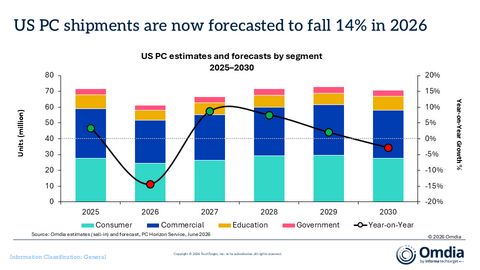
US PC estimates and forecasts by segment, 2025–2030
US PC shipments impacted by component supply constraints
With DRAM and NAND supply increasingly diverted to AI server applications, rising component costs are eroding vendor margins on entry-level devices, making low-priced PCs increasingly unviable. Shipments of PCs priced under $500 declined 18.7% year-on-year in the quarter. Omdia expects industry-wide declines to continue throughout the remainder of 2026 as supply tightness persists, with full-year US PC shipments forecast to decline 14.4% compared to 2025.
Business PC upgrades outpace consumer demand
“The impact of component supply constraints on PC shipments materialized in the US market in the first quarter of 2026,” said Scott Braverman, Senior Analyst at Omdia. “The consumer segment declined 9.5% year-over-year, worse than the overall market, as many consumers delayed purchase decisions amid higher price tags and challenging economic conditions. Business shipments declined by just 5.0% year-over-year, supported by remaining Windows 11 refresh activity and inventory purchases ahead of further price increases.”
According to Omdia’s May forecast, the first half of 2026 is likely to be the stronger period for business PC demand. The component cost environment is expected to keep entry-level prices elevated through 2027, suppressing consumer demand.
“Budget-constrained segments also faced pressure, although the education segment declined just 6.2% in Q1 2026,” said Braverman. “This was a significant improvement from the double-digit declines recorded in each of the previous three quarters. However, this stabilization is unlikely to hold, as rising prices disproportionately affect the entry-level devices that dominate education procurement. Government procurement also declined as price increases strained already tight public sector budgets. Both segments are expected to remain under pressure through 2026, with meaningful recovery unlikely until 2027,” added Braverman.
AI PC adoption and supply pressures drive up average selling prices
“While average selling prices rose just 4% year-on-year in Q1 2026, Omdia expects growth to reach 12% in Q2 and exceed 12% in the second half of 2026 as supply-side headwinds continue to materialize,” said Kieren Jessop, Research Manager at Omdia. “In addition, demand dynamics are also driving average selling prices higher as the share of AI-capable PCs grew to 44% of all shipments. Large enterprises in particular are increasingly procuring higher-cost AI-capable PCs.”
Business PC ASPs are expected to grow 11% in 2026, with 10% ASP increases in the consumer and government segments. Education ASPs are expected to remain flat as this cost-conscious segment delays PC refreshes due to rapid pricing increases.
US desktop and notebook forecast
Omdia PC Forecast: 2025 to 2027
Segment
2025 shipments
2026
shipments
2027
shipments
2025 annual growth
2026 annual growth
2027 annual growth
Consumer
27,695
24,584
26,434
5.2%
-11.2%
7.5%
Commercial
31,222
27,054
28,885
6.0%
-13.3%
6.8%
Government
3,840
3,365
3,638
0.1%
-12.4%
8.1%
Education
8,760
6,234
7,560
-8.7%
-28.8%
21.3%
Total
71,516
61,237
66,517
3.3%
-14.4%
8.6%
Note: Unit shipment in thousands. Totals may not add up due to rounding.
Source: Omdia PC Horizon Service (sell-in shipments), June 2026
Vendor performance varied significantly in Q1 2026, reflecting difference in segment exposure and pricing dynamics. HP’s 21.6% decline in shipments was the steepest drop among major providers and resulted in HP losing its top spot in the US in Q1 2026. Dell captured the lead with a 25.0% share, posting 1.1% growth despite overall market contraction, while Lenovo also achieved growth of 1.2% to reach 20.0% of the market. Both vendors’ growth was driven by significant consumer segment share gains (4 percentage points each year-over-year), narrowing the gap with Apple and HP. Apple’s shipment decline of 1.6% outperformed the overall market, maintaining a 16.9% share as MacBook adoption continued in business segments where Apple’s presence has grown to 15.3%. Smaller vendors also faced severe pressure, with shipments declining 13.1% as these brands lack the same component procurement leverage as larger competitors.
US desktop and notebook shipments (market share and annual growth)
Omdia PC Market Pulse: 1Q26
Vendor
1Q26
shipments
1Q26
market share
1Q25
shipments
1Q25
market share
Annual
growth
Dell
3,936
25.0%
3,895
23.0%
1.1%
HP
3,227
20.5%
4,116
24.3%
-21.6%
Lenovo
3,146
20.0%
3,109
18.4%
1.2%
Apple
2,661
16.9%
2,705
16.0%
-1.6%
Acer
892
5.7%
942
5.6%
-5.4%
Others
1,889
12.0%
2,173
12.8%
-13.1%
Total
15,751
100.0%
16,940
100.0%
-7.0%
Note: Unit shipments in thousands. Percentages may not add up to 100% due to rounding.
Source: Omdia PC Horizon Service (sell-in shipments), June 2026
ABOUT OMDIA
Omdia, part of TechTarget, Inc. d/b/a Informa TechTarget (Nasdaq: TTGT), is a technology research and advisory group. Our deep knowledge of tech markets, grounded in real conversations with industry leaders and hundreds of thousands of data points, make our market intelligence our clients’ strategic advantage. From R&D to ROI, we identify the greatest opportunities and move the industry forward.
A dram is a small, traditional unit used to measure either mass or liquid volume in manufacturing and pharmaceuticals — roughly 1.77 grams for a weight dram or about 3.7 milliliters for a fluid dram, similar to a small teaspoon or a couple of drops. Investors care because dram-based measurements affect drug dosing, packaging sizes, labeling compliance and raw-material usage, which in turn influence production costs, inventory counts and regulatory risk.
nandtechnical
NAND is a type of non-volatile memory used to store data in electronic devices such as phones, SSDs, and tablets; it keeps information even when power is off. Think of it as a digital filing cabinet made of tiny cells where data is written, erased and rewritten. Investors watch NAND because its supply, demand and manufacturing costs drive prices, company revenues and profit margins across the semiconductor and consumer electronics industries.
average selling pricesfinancial
Average selling price (ASP) is the typical revenue a company receives for one unit of a product or service over a given period, calculated by dividing total sales revenue by the number of units sold. Like the average price you pay when buying many similar items, it shows whether a company is getting more or less for what it sells; investors watch ASP to gauge pricing power, product mix shifts, demand trends and how those factors will affect revenue and profit margins.
ai-capable pcstechnical
AI-capable PCs are personal computers built with enough processing power, memory, and often specialized chips to run modern artificial intelligence tools smoothly on the device or to speed up AI tasks handled in the cloud. Think of them as cars with stronger engines designed for heavier loads; for investors they signal potential for higher-priced hardware sales, new software and services, and shifts in supply chains and profit margins as users and businesses upgrade to access AI features.
market sharefinancial
Market share is the percentage of total sales or customers that a company has within a specific industry or market. It shows how big or popular a company is compared to its competitors. Knowing a company's market share helps understand its strength and position in the industry.