
Omdia: US PC Shipments See 1% Annual Drop for a Second Consecutive Quarter
Omdia reports US PC shipments (excluding tablets) fell 1% year‑on‑year in Q3 2025 to 17.7 million units, marking a second consecutive quarterly decline.
Sentiment and the balance of points
Rhea-AI Sentiment reads the wording of the document, how positive or negative its language is on a 1 to 5 scale. The balance of points shown with the takes weighs what the document actually discloses, so the two can disagree, for example when a trial that missed its main goal is described in upbeat language.




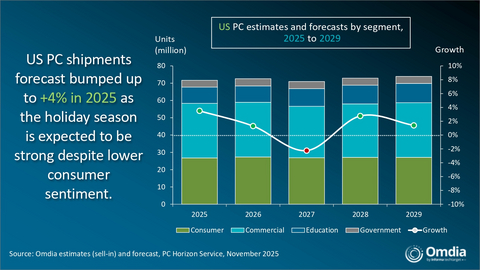
US PC estimates and forecasts by segment, 2025 to 2029
“The education and government segments have both moved into a pattern of continual decline after a strong start to the year in Q1,” said Greg Davis, Analyst at Omdia. “There are a few drivers behind this. First, government funding for both schools and government agencies has been reduced.
Davis continued, “As these excess inventories are cleared, creating room for new shipments, we expect the rate of decline to begin to moderate, especially in the commercial segment where the contraction has been less severe. The ongoing transition from Windows 10 to Windows 11 should provide additional support to commercial demand and help this segment return to growth in Q4.
“The consumer segment has been a bright star for the US PC market in 2025, with growth recorded in each of the first three quarters,” Davis added. “Q3 delivered the strongest performance so far, with consumer shipments rising
“In light of these macroeconomic trends, Omdia forecasts that the consumer PC segment will see an annual decline in Q4 2025. Even so, 2025 as a whole is still projected to be a growth year for the US PC market, and we expect it to finish the year in a stronger position than in the previous two quarters,” Davis concluded.
US desktop and notebook forecast Omdia PC Forecast: 2025 to 2027 |
|
|||||
Segment |
2025
|
2026
|
2027
|
2025
|
2026
|
2027
|
Consumer |
26,809 |
27,350 |
26,879 |
|
|
- |
Commercial |
31,545 |
31,570 |
29,771 |
|
|
- |
Government |
3,946 |
4,145 |
4,103 |
|
|
- |
Education |
9,362 |
9,530 |
10,217 |
- |
|
|
Total |
71,662 |
72,596 |
70,970 |
|
|
- |
|
|
|
|
|||
Note: Unit shipment in thousands. Totals may not add up due to rounding.
Source: Omdia PC Horizon Service (sell-in shipments), November 2025 |
|
|||||
US desktop and notebook shipments (market share and annual growth) Omdia PC Market Pulse: Q3 2025 |
|||||
Vendor |
Q3 2025
|
Q3 2025
|
Q3 2024
|
Q3 2024
|
Annual
|
HP |
4,326 |
|
4,336 |
|
- |
Dell |
3,990 |
|
3,996 |
|
- |
Lenovo |
3,205 |
|
3,089 |
|
|
Apple |
3,175 |
|
2,825 |
|
|
Acer |
820 |
|
782 |
|
|
Others |
2,226 |
|
2,885 |
|
- |
Total |
17,742 |
|
17,913 |
|
- |
|
|
|
|
|
|
Note: Unit shipments in thousands. Percentages may not add up to
Source: Omdia PC Horizon Service (sell-in shipments), November 2025 |
|||||
ABOUT OMDIA
Omdia, part of Informa TechTarget, Inc. (Nasdaq: TTGT), is a technology research and advisory group. Our deep knowledge of tech markets grounded in real conversations with industry leaders and hundreds of thousands of data points, make our market intelligence our clients’ strategic advantage. From R&D to ROI, we identify the greatest opportunities and move the industry forward.
View source version on businesswire.com: https://www.businesswire.com/news/home/20251204173273/en/
Fasiha Khan – fasiha.khan@omdia.com
Eric Thoo – eric.thoo@omdia.com
Source: Omdia