
Omdia: Worldwide PC Market Declined 4% in 2Q26 Amid Mounting Supply Pressure
Omdia reports worldwide PC shipments fell 3.6% year-over-year in 2Q26 to 65.7 million units, as higher memory, storage and component costs drove price increases of about 20%–40% on comparable products.
Sentiment and the balance of points
Rhea-AI Sentiment reads the wording of the document, how positive or negative its language is on a 1 to 5 scale. The balance of points shown with the takes weighs what the document actually discloses, so the two can disagree, for example when a trial that missed its main goal is described in upbeat language.




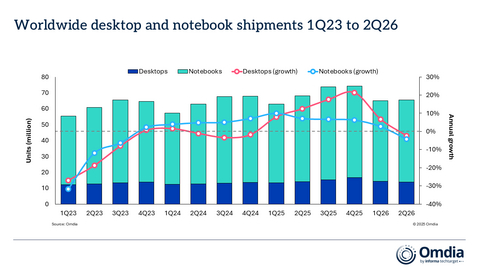
Worldwide desktop and notebook shipments, 1Q23 to 2Q26
“The sharp increase in memory and storage prices during the first quarter of the year had a significant impact on product pricing in the second quarter,” said Ben Yeh, Principal Analyst at Omdia. “It also prompted consumers and IT decision makers to bring forward their PC purchases to mitigate the risk of further price increases. Although sales volumes were maintained at a stable level, the risk of a subsequent downturn remains.”
Apple’s recent decision to raise prices across MacBooks has become one of the key focal points in the market. However, other PC vendors began increasing prices as early as the end of 4Q25 and have continued to adjust them quarter over quarter. Across comparable product lines, prices have risen by about
“After the pull-forward activity seen in the first half of the year, signals are now pointing to a period of delayed demand as the true impact of the supply crunch sinks in,” said Ishan Dutt, Research Director at Omdia. “More than half of the B2B channel partners polled in Omdia’s June survey responded that their customers are putting off hardware refresh plans until the market stabilizes, with a further
Although the pace of memory and storage cost increases is forecast to ease significantly in 2H26, PC selling prices will continue to reflect the upstream component inflation from 2Q26. Omdia’s research indicates that neither memory nor storage prices are projected to reverse within this year. In addition, other components such as multilayer ceramic capacitors (MLCCs) and printed circuit boards (PCBs) are also becoming more expensive. As a result, PC vendors are expected to continue passing the burden of heavy cost pressure on to customers, which will dampen demand in the second half of the year.
Worldwide desktop and notebook shipments (market share and annual growth) Omdia PC Market Pulse: 2Q26 |
|||||
Vendor |
2Q26
|
2Q26
|
2Q25
|
2Q25
|
Annual
|
Lenovo |
16,622 |
|
16,973 |
|
- |
HP |
13,002 |
|
14,291 |
|
- |
Dell |
9,291 |
|
9,772 |
|
- |
Apple |
7,257 |
|
6,264 |
|
|
Asus |
5,019 |
|
4,973 |
|
|
Others |
14,479 |
|
15,825 |
|
- |
Total |
65,670 |
|
68,098 |
|
- |
|
|
|
|
|
|
Note: Unit shipments in thousands. Percentages may not add up to
Source: Omdia PC Horizon Service (sell-in shipments),
|
|
||||
Lenovo retained the top position, shipping 16.6 million units and maintaining a
ABOUT OMDIA
Omdia, part of TechTarget, Inc. d/b/a Informa TechTarget (Nasdaq: TTGT), is a technology research and advisory group. Our deep knowledge of tech markets grounded in real conversations with industry leaders and hundreds of thousands of data points, make our market intelligence our clients’ strategic advantage. From R&D to ROI, we identify the greatest opportunities and move the industry forward.
View source version on businesswire.com: https://www.businesswire.com/news/home/20260708161308/en/
Fasiha Khan: fasiha.khan@omdia.com
Eric Thoo: eric.thoo@omdia.com
Source: Omdia