
Adia Med Reports No Serious Adverse Events in First Cohort of Pediatric Autism Study; Enrollment Continues
Two mild treatment-related rashes resolved after topical glutathione was stopped; enrollment and participant follow-up continue.
Sentiment and the balance of points
Rhea-AI Sentiment reads the wording of the document, how positive or negative its language is on a 1 to 5 scale. The balance of points shown with the takes weighs what the document actually discloses, so the two can disagree, for example when a trial that missed its main goal is described in upbeat language.
Rhea-AI Summary
Adia Med (OTCQB: ADIA) reported no serious adverse events in the first cohort of its randomized pediatric autism study. No events required reporting to the Institutional Review Board. Two children developed mild rashes attributed to topical glutathione spray; both resolved without medical treatment after the spray was stopped.
The Phase 1/2 study compares AdiaVita plus glutathione with glutathione alone in children ages 3 to 12. Enrollment continues on a staggered schedule, with approximately 100 children planned, and first-cohort participants remain in follow-up. The medical director said no efficacy conclusions can be drawn at this time.
Positive
- Minor pointNo serious adverse events occurred in either arm of the first cohort; none required Institutional Review Board reporting.
- Minor point. Forward-looking: it has not happened yet and may not happen.Enrollment continues toward planned enrollment of approximately 100 children in successive cohorts.
Negative
- Minor pointTwo children developed mild rashes attributed to topical glutathione; both resolved without treatment after discontinuation.
- Minor pointNo efficacy conclusions can be drawn at this time, the medical director said.
AI-generated analysis. How Rhea-AI works. Not financial advice.


No serious adverse events reported in either study arm; enrollment and participant follow-up continue
Winter Park, Florida--(Newsfile Corp. - October 26, 2026) - Adia Med Inc. (OTCQB: ADIA) today reported interim safety observations from the first cohort of its randomized Phase 1/2 investigational study in children with autism spectrum disorder (ASD). Investigators reported no serious adverse events in either study arm and no events requiring reporting to the Institutional Review Board (IRB). Enrollment continues under the protocol's staggered schedule, and first-cohort participants remain in follow-up.
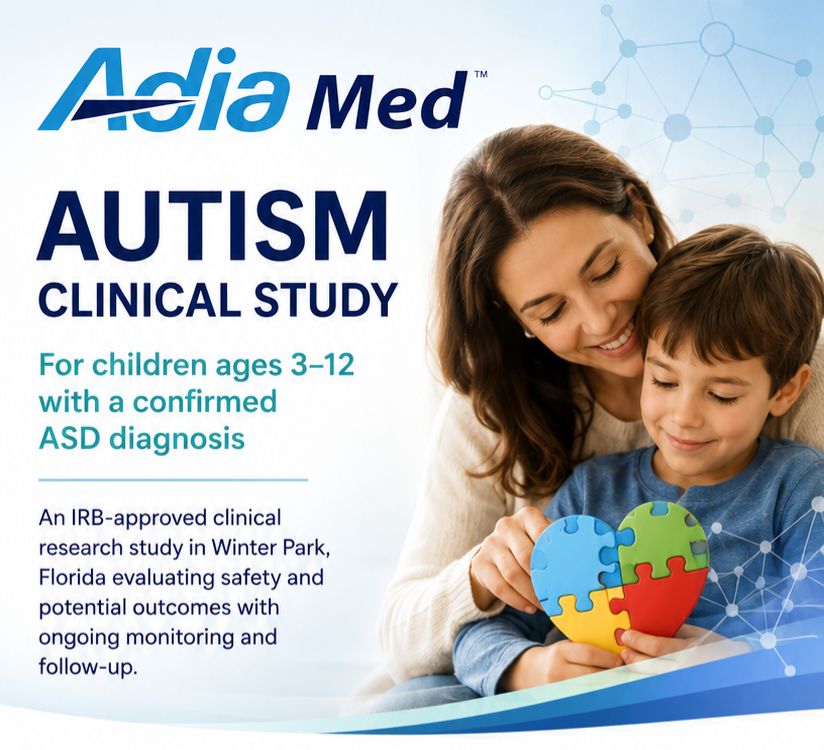
To view an enhanced version of this graphic, please visit:
https://images.newsfilecorp.com/files/10520/320413_screenshot_asd_graphic.jpg
Registered on ClinicalTrials.gov as NCT07304440, the study compares AdiaVita plus glutathione with glutathione alone. AdiaVita is an investigational product consisting of umbilical cord blood-derived stem cells and exosomes. Children in the first cohort were ages 3 to 12, had a confirmed ASD diagnosis, and were randomized to one of the two study arms. All participants received protocol-directed therapy, including intravenous administration and a twice-daily topical glutathione spray used at home.
Two children developed mild rashes attributed to the topical glutathione spray-the only treatment-related findings reported in the first cohort. Both rashes resolved without medical treatment after the spray was discontinued. All participants remained under medical monitoring throughout the protocol.
"No serious adverse events occurred in either arm of the first cohort, and nothing required reporting to the IRB," said Evan Thomas, MD, PhD, medical director of Adia Med. "The two mild rashes were attributed to the topical glutathione spray and cleared after it was stopped, without any medical treatment. I look forward to continued enrollment and to accruing enough patients to evaluate whether adding AdiaVita to glutathione improves parent- and therapist-reported ATEC scores compared with glutathione alone. No efficacy conclusions can be drawn at this time."
The study is designed to enroll approximately 100 children in successive cohorts and remains under ongoing IRB oversight. Continued enrollment and follow-up will support evaluation of symptom-related outcomes, safety, and tolerability.
Investigational Status
AdiaVita has not been approved by the U.S. Food and Drug Administration for any use. Adia Med makes no claims regarding the treatment, cure, or prevention of ASD. The study remains investigational and under IRB oversight. Participation is voluntary, and families may withdraw at any time.
About the Study
The Adia Med of Winter Park LLC Autism Spectrum Disorder Research Study (NCT07304440) is a randomized Phase 1/2 interventional trial evaluating whether adding AdiaVita to glutathione therapy improves ASD symptoms in children ages 3 to 12 compared with glutathione alone. The primary outcome is measured using the Autism Treatment Evaluation Checklist (ATEC), completed by parents and by therapists or teachers. Secondary endpoints include safety, tolerability, quality of life, and overall wellness.
For questions, inquiries, or additional information, please contact Larry Powalisz at ceo@adiamed.com or by phone at 321-231-2843.
About Adia Med Inc.
Adia Med Inc. (OTCQB: ADIA), headquartered in Winter Park, Florida, is a regenerative medicine company built around active, IRB-approved stem cell therapy studies. Through its Adia Med clinics, the company delivers stem cell treatments alongside complementary services like platelet-rich plasma (PRP), therapeutic plasma exchange (TPE), and autologous hematopoietic stem cell transplantation (aHSCT), supported by multiple Institutional Review Board (IRB)-approved clinical studies, The current studies are targeting autism spectrum disorder, chronic kidney disease, and lower back pain, with more planned for 2026. Its Adia Labs division manufactures regenerative products (AdiaVita, AdiaLink) that supply this clinical work.
Adia Labs generates revenue by manufacturing and selling regenerative products (AdiaVita and AdiaLink) to Adia Med clinics and external providers. Adia Med clinics generate revenue through patient treatments (stem cell therapies, PRP, TPE, and aHSCT). Additional revenue comes from the company's
Website: www.adiamed.com
Website: www.adialabs.com
Website: www.cementfactory.co
Twitter (X): @adia_med
Instagram: @adia_med
Facebook: @adia_med
Safe Harbor: This Press Release contains forward-looking statements within the meaning of Section 27A of the Securities Act of 1933 and Section 21E of the Securities Exchange Act of 1934. These forward-looking statements are based on the current plans and expectations of management and are subject to a few uncertainties and risks that could significantly affect the company's current plans and expectations, as well as future results of operations and financial condition. A more extensive listing of risks and factors that may affect the company's business prospects and cause actual results to differ materially from those described in the forward-looking statements can be found in the reports and other documents filed by the company with the Securities and Exchange Commission and OTC Markets, Inc. OTC Disclosure and News Service. The company undertakes no obligation to publicly update or revise any forward-looking statements, because of new information, future events or otherwise.

To view the source version of this press release, please visit https://www.newsfilecorp.com/release/320413
FAQ
AI-generated questions and answers. How Rhea-AI works. Not financial advice.
What safety results did Adia Med report from its first pediatric autism study cohort?
There were no serious adverse events in either study arm and no events requiring Institutional Review Board reporting. Two children developed mild rashes attributed to topical glutathione spray. Both rashes resolved without medical treatment after the spray was discontinued.
How will Adia Med measure whether AdiaVita improves autism symptoms?
The primary outcome uses the Autism Treatment Evaluation Checklist (ATEC), completed by parents and by therapists or teachers. The randomized study compares AdiaVita plus glutathione with glutathione alone. Secondary endpoints include safety, tolerability, quality of life, and overall wellness.