
Arrive AI White Paper Highlights Key Findings of Live Hospital Deployment
Rhea-AI Summary
Arrive AI (NASDAQ:ARAI) published a white paper on March 5, 2026 titled "Autonomous Systems in Active Care Environments: Insights from Arrive AI's Live Hospital Deployment." The report summarizes a live deployment at Hancock Regional Hospital automating biospecimen transfers using Arrive Points™ and an autonomous ground robot.
Key findings stress sensor reliability, clear handoff signals, connectivity stability, multidirectional movement, and fitting automation to existing clinical workflows to reduce staff walking time and enable secure asynchronous handoffs.
Positive
- None.
Negative
- None.
Previous AI Reports
-
Global expansion of AI-powered autonomous logistics ecosystem and deployments.
-
End-to-end ground robot and drone delivery demo at Curiosity Lab.
-
CEO outlined AI-first Plai execution framework and IP strategy.
-
Appointment of Head of Commercialization to drive go-to-market.
-
Indiana UAS test-site designation near Arrive AI’s infrastructure.
24h Move is the share-price change in the day after each event; other market factors may also have contributed.
Key Terms
autonomous logistics technical
biospecimen medical
autonomous ground robot technical
clinical workflows medical
AI-generated analysis. How Rhea-AI works. Not financial advice.




Autonomous logistics deployment at Hancock Health demonstrates how workflow-first design can safely extend staff capacity in active care environments
INDIANAPOLIS, IN / ACCESS Newswire / March 5, 2026 / Arrive AI (NASDAQ:ARAI), an autonomous delivery network company built around patented, AI-powered Arrive Points™, today announced the publication of a new white paper, "Autonomous Systems in Active Care Environments: Insights from Arrive AI's Live Hospital Deployment," sharing critical insights from a demonstration at Hancock Regional Hospital in Indiana.
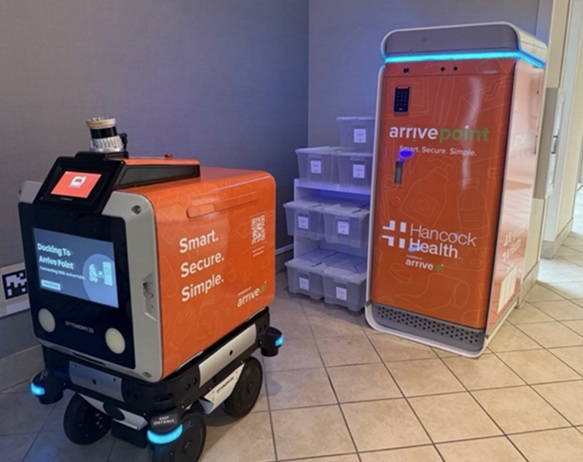
The white paper examines how automation performs in day-to-day hospital operations, where timing, human behavior, physical layout, and trust drive real-world results and long-term adoption. It also demonstrates how autonomous logistics can create durable efficiency gains in large, multi-stakeholder environments.
In this initial deployment, biospecimen transfers were automated using Arrive AI's Arrive Points™ as fixed, secure handoff locations connected to an autonomous ground robot running between the cancer center and the hospital laboratory.
Key Insights:
Sensor reliability affects workflow timing: The system must consistently recognize item presence at handoff under normal operating conditions.
Clear signals at the point of interaction matter: The handoff moment is about responsibility, not about system status, and requires clear confirmation.
Connectivity is the hidden limiting factor: Reliability is not determined by route length but by environmental stability.
Multidirectional movement is the real workflow: Supporting all directions of material movement is essential to maintaining the natural rhythm of clinical workflows.
Automation should fit workflows and surface adjustments: Effective automation fits current workflows while clearly signaling when small adjustments may be needed.
"During this initial deployment with Hancock Health, our Arrive Points™ enabled secure, asynchronous handoffs that fit naturally into existing hospital workflows, reducing walking time without adding extra steps for staff," said Dan O'Toole, CEO of Arrive AI. "The white paper captures what we saw on the ground: automation works in hospitals when it respects real‑world conditions, communicates clearly in the moments that matter, and is seamless so that staff can trust it from day one. These important insights are shaping how we evolve the platform so our workflow‑first approach can scale from a single route to whole hospitals, health systems, and eventually other industries that depend on time‑critical logistics."
The white paper can be viewed online at: https://cdn.prod.website-files.com/67c5de33fe42ad3c82b5dbd6/69a7292ef367b636f577d610_Arrive%20AI%20Whitepaper%20-%20autonomous%20systems%20in%20active%20care%20environments.pdf
About Arrive AI:
Arrive AI's (NASDAQ:ARAI) patented last mile (ALM) platform enables drone- or ground robot-based and human mail delivery to and from a physical smart mailbox, while providing tracking data, smart logistics alerts and advanced chain of custody controls to secure the last-mile delivery for all shippers, delivery services, and autonomous delivery networks. Arrive AI makes the exchange of goods between people, robots, and drones frictionless, efficient and convenient through artificial intelligence, autonomous technology and interoperability with smart devices including doorbells, lighting and security systems. Learn more about the company at www.arriveai.com. See our press kit here: https://www.dropbox.com/scl/fo/1hngbr3n0csio41as3zq2/AIFvqWlgye-qVgIOPG2BcUQ?rlkey=3q1ipgjt1he9ktcvd4vh0vl5t&st=6a2jrjxm&dl=0
Media contact:
Kylie Conway at media@arriveai.com
Investor Relations Contact:
Alliance Advisors IR, ARAI.IR@allianceadvisors.com
Cautionary Note Regarding Forward Looking Statements
This news release and statements of Arrive AI's management in connection with this news release or related events contain or may contain "forward-looking statements" within the meaning of Section 21E of the Securities Exchange Act of 1934, as amended, and the Private Securities Litigation Reform Act of 1995. In this context, forward-looking statements mean statements (including statements related to the closing, and the anticipated benefits to the Company, of the private placement described herein) related to future events, which may impact our expected future business and financial performance, and often contain words such as "expects", "anticipates", "intends", "plans", "believes", "potential", "will", "should", "could", "would", "optimistic" or "may" and other words of similar meaning. These forward-looking statements are based on information available to us as of the date of this news release and represent management's current views and assumptions. Forward-looking statements are not guarantees of future performance, events or results and involve significant known and unknown risks, uncertainties and other factors which may be beyond our control. Readers are cautioned not to place undue reliance on these forward-looking statements, which apply only as of the date of this news release. Potential investors should review Arrive AI's Registration Statement for more complete information, including the risk factors that may affect future results, which are available for review at www.sec.gov. Accordingly, forward-looking statements should not be relied upon as a predictor of actual results. We do not undertake to update our forward-looking statements to reflect events or circumstances that may arise after the date of this news release, except as required by law.
SOURCE: Arrive AI Inc.
View the original press release on ACCESS Newswire
FAQ
AI-generated questions and answers. How Rhea-AI works. Not financial advice.