
STOCK TITAN

Baidu's Apollo Go Secures Dubai's First Fully Driverless Testing Permit, Launches Local Operations Hub

Rhea-AI Impact
(Low)
Rhea-AI Sentiment
(Very Positive)
Tags

Baidu (NASDAQ: BIDU) announced that Apollo Go received Dubai's first permit for fully driverless vehicle trials without a safety driver, enabling a potential fully autonomous commercial ride‑hailing launch as early as Q1 2026. The company opened a 2,000‑square‑meter Apollo Go Park in downtown Dubai as its first overseas operations and management hub. Apollo Go and Dubai RTA plan to expand to a target fleet of more than 1,000 fully driverless vehicles; prior trials included a 50‑vehicle RT6 fleet and an earlier trial permit issued in July 2025.

Apollo Go reported global operational metrics including 240 million autonomous km (140 million fully driverless km), weekly rides >250,000, and > 17 million cumulative rides as of Oct 31, 2025.

Loading...
Loading translation...

Positive

  • Dubai issued first permit for fully driverless trials without safety driver
  • Apollo Go Park: a 2,000‑square‑meter overseas operations and management hub
  • Target expansion to more than 1,000 fully driverless vehicles in Dubai
  • Proven scale: 240 million autonomous km logged globally
  • Proven driverless mileage: 140 million fully driverless km recorded
  • Usage scale: weekly rides exceeding 250,000 and 17 million cumulative rides

Negative

  • None.

Key Figures

Planned Dubai fleet 1,000 vehicles Target for Apollo Go fully driverless fleet in Dubai in coming years
Apollo Go Park size 2,000 square meters Size of Apollo Go Park operations and management hub in downtown Dubai
Autonomous kilometers 240 million kilometers Total autonomous driving distance logged by Apollo Go
Fully driverless kilometers 140 million kilometers Distance completed in fully driverless mode by Apollo Go
Cities served 22 cities Global footprint of Apollo Go’s autonomous ride-hailing service
Weekly rides 250,000 rides Approximate weekly ride count for Apollo Go
Cumulative rides 17 million rides Cumulative Apollo Go rides as of October 31, 2025

Market Reality Check

$146.81 Last Close
Volume Volume 3,214,951 is in line with the 20-day average of 3,180,559 (relative volume 1.01x). normal
Technical Price 146.42 is trading above the 200-day MA at 103.73, indicating a pre-news uptrend.

Peers on Argus

BIDU was down 2.18% while peers in Internet Content & Information were mixed: TME -4.81%, RDDT +2.26%, NBIS +4.73%, PINS +0.56%, Z +1.26%, suggesting stock-specific factors rather than a broad sector move.

Historical Context

Date Event Sentiment Move Catalyst
Jan 01 Proposed spin-off Positive +15.0% Announcement of proposed Kunlunxin spin-off and separate Hong Kong listing.
Nov 18 Q3 2025 earnings Positive +2.7% Q3 2025 results with strong AI business growth and positive non-GAAP earnings.
Nov 13 AI product launch Positive -6.4% Launch of ERNIE 5.0 and multiple AI applications at Baidu World 2025.
Nov 11 Autonomous fleet permit Positive -0.3% Abu Dhabi fully driverless commercial permit and autonomous fleet expansion plan.
Oct 27 Conference announcement Positive +4.8% Announcement of Baidu World 2025 flagship AI technology conference details.
Pattern Detected

Recent AI and autonomous mobility announcements have often been positive but produced mixed price reactions, with several notable divergences where upbeat tech news coincided with flat or negative moves.

Recent Company History

Over the past few months, Baidu has highlighted multiple AI and autonomous driving milestones. On Oct 27, 2025, it promoted its Baidu World 2025 AI conference, followed by the Nov 13, 2025 unveiling of ERNIE 5.0 and new AI applications, where the stock declined despite the positive product news. Apollo Go’s expansion in Abu Dhabi on Nov 11, 2025 also saw little price follow-through. By contrast, the Jan 1, 2026 proposed Kunlunxin spin-off and Q3 2025 earnings both coincided with positive moves, indicating selective investor enthusiasm for corporate and financial catalysts versus pure technology updates.

Market Pulse Summary

This announcement highlights Baidu’s continued expansion of Apollo Go, adding Dubai’s first fully driverless testing permit and a 2,000-square-meter operations hub to its existing UAE footprint. With over 240 million autonomous kilometers and 17 million rides across 22 cities, the move reinforces its global ambitions in autonomous mobility. Investors may watch how quickly the planned 1,000-vehicle Dubai fleet scales, the evolution of local regulation, and how these deployments contribute to Baidu’s broader operational and financial metrics.

Key Terms

autonomous ride‑hailing technical
"Apollo Go, its autonomous ride‑hailing platform, has received Dubai's first..."
A service that summons self-driving vehicles on demand to pick up and drop off passengers, like a taxi app but without a human driver behind the wheel. For investors, it matters because replacing drivers can sharply lower ongoing labor costs and change the unit economics of transport, while requiring large upfront investment, exposing firms to regulatory and safety risks and creating potential for rapid scale or costly setbacks.
driverless vehicle trial permit regulatory
"has received Dubai's first driverless vehicle trial permit from the Roads..."
A driverless vehicle trial permit is an official authorization from a government or transport regulator allowing a company to test autonomous vehicles on public roads under set conditions. For investors, such a permit is like a testing license that reduces regulatory uncertainty and signals progress toward real-world deployment, affecting a company’s development timeline, potential costs, safety oversight and the likelihood of eventual commercial revenue.
fully autonomous vehicles technical
"operate fully autonomous vehicles on designated public roads without a human..."
Fully autonomous vehicles are cars, trucks, or other road vehicles equipped with sensors, software and computing power that allow them to operate without a human driver or steering input. Think of them as a robotic chauffeur that perceives the road, makes decisions and navigates on its own. Investors care because they can reshape markets for carmakers, fleets, services, insurance and infrastructure, creating new revenue streams while introducing regulatory, safety and adoption risks that affect valuations.
autonomous vehicles technical
"as a comprehensive center for autonomous vehicles, integrating intelligent road..."
Vehicles that use on-board sensors, cameras and software to navigate and drive without a human actively controlling them; think of them as robotic chauffeurs that can perceive roads, make decisions and follow traffic rules. For investors, they matter because they can reshape transportation costs, create new revenue streams (rides, logistics, software) and change regulatory and liability risks, so their adoption affects manufacturers, tech suppliers, insurers and transportation demand.
intelligent road infrastructure technical
"integrating intelligent road infrastructure, charging and maintenance facilities..."
Intelligent road infrastructure is transportation surfaces equipped with sensors, cameras, connectivity and software that collect and share real‑time information to manage traffic, enable safety features, support electric vehicle charging, and guide automated vehicles. Think of it as a smartphone for roads that helps reduce crashes, congestion and maintenance costs while creating new revenue and service opportunities. Investors watch it because deployment affects construction and technology spending, public contracts, recurring data or service income, and long‑term asset value.
autonomous mobility technical
"Apollo Go's rapid expansion into the UAE is backed by its industry-leading autonomous mobility..."
Autonomous mobility means vehicles and transport services that can navigate and operate with little or no human control using onboard sensors, software, and networked systems; it covers self-driving cars, delivery robots, automated shuttles, and the supporting digital infrastructure. Investors care because it changes who pays for and earns income from transportation—like replacing a human driver with software—and can shift costs, create new revenue streams, and introduce regulatory and safety risks that affect company value.
autonomous driving technical
"to advance autonomous driving testing and services in Dubai."
Autonomous driving is technology that allows a vehicle to navigate and control itself without a human constantly steering, braking or accelerating, acting like a robotic chauffeur that perceives the road, makes decisions and responds to traffic and obstacles. Investors care because it can change who makes money and how much—by cutting labor and operating costs, creating new software and data businesses, and shifting regulatory and liability risks that affect future revenue, adoption speed and company valuations.

AI-generated analysis. Not financial advice.

  • Apollo Go receives Dubai's very first driverless testing permit for fully autonomous vehicles without a safety driver, paving the way for a fully autonomous commercial ride-hailing service in the emirate as early as the first quarter of 2026.
  • New Apollo Go Park in Dubai becomes Apollo Go's first overseas operations and management hub, supporting a planned 1,000‑vehicle fleet target in the coming years.

DUBAI, UAE, Jan. 7, 2026 /PRNewswire/ -- Baidu Inc. (NASDAQ: BIDU and HKEX: 9888) today announced that Apollo Go, its autonomous ride‑hailing platform, has received Dubai's first driverless vehicle trial permit from the Roads and Transport Authority (RTA). The permit allows Apollo Go to operate fully autonomous vehicles on designated public roads without a human safety driver behind the wheel, marking another critical step toward Apollo Go's goal of launching a fully autonomous commercial ride‑hailing service in Dubai as early as the first quarter of 2026.

The driverless vehicle trial permit was formally issued by the RTA during the opening of Apollo Go Park in Dubai, Apollo Go's first facility of its kind outside China. Located in downtown Dubai, the 2,000‑square‑meter Apollo Go Park is designed as a comprehensive center for autonomous vehicles, integrating intelligent road infrastructure, charging and maintenance facilities, and related technologies. It is expected to evolve into a central command hub as Apollo Go and the RTA plan to expand the fleet to more than 1,000 fully driverless vehicles in Dubai.

The launch ceremony was attended by H.E. Mattar Al Tayer, Director General, Chairman of the Board of Executive Directors at the Roads and Transport Authority of Dubai, who observed Apollo Go's first fully driverless vehicle operating on designated public roads in the emirate.
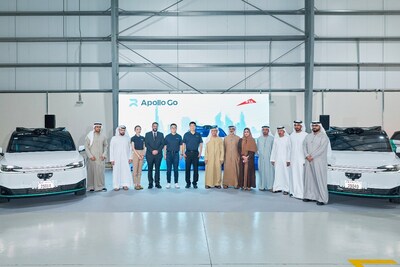
Baidu’s Apollo Go receives Dubai’s first fully driverless testing permit (Pictured center, from left to right: Liang Zhang, Managing Director of EMEA, Baidu Apollo; Yunpeng Wang, Corporate Vice President of Baidu and President of Baidu’s Intelligent Driving Group; H.E. Mattar Al Tayer, Director General, Chairman of the Board of Executive Directors at the Roads and Transport Authority of Dubai; and Ahmed Hashem Bahrozyan, CEO of the Public Transport Agency at the Roads and Transport Authority.)

"The opening of Apollo Go's first operations center outside China reflects the strong confidence of leading global companies in Dubai's advanced regulatory environment and the readiness of its smart infrastructure to accommodate and advance autonomous vehicle technologies in line with the highest standards of safety and efficiency," said H.E. Mattar Al Tayer, Director General, Chairman of the Board of Executive Directors of the Roads and Transport Authority of Dubai. "The RTA's issuance of Dubai's first permit for fully driverless operational trials without a safety driver represents a qualitative milestone, translating our commitment to developing a flexible and secure legislative framework that keeps pace with rapid advancements in mobility technologies, supports innovation, and fosters partnerships with leading specialized global companies in this field. The collaboration with Baidu Apollo Go forms part of the RTA's vision to expand future mobility solutions and enhance the deployment of autonomous vehicles across taxi and ride-hailing services. This will contribute to improving quality of life, enhancing road safety, reducing carbon emissions, and increasing the efficiency of the emirate's transport network."

"As Dubai's public transport network continues to grow, we see autonomous mobility as a powerful complement to our existing services," said Ahmed Hashem Bahrozyan, CEO of the Public Transport Agency at the Roads and Transport Authority. "Through this trial permit and the deployment of Apollo Go's autonomous vehicles on designated open roads, we will rigorously test safety, reliability, and customer experience, ensuring that any future large-scale rollout fully meets Dubai's standards and serves the needs of our residents and visitors."

"We are honored that the RTA has entrusted Apollo Go with Dubai's first driverless vehicle trial permit," said Yunpeng Wang, Corporate Vice President of Baidu and President of Baidu's Intelligent Driving Group. "Together with the opening of our first overseas Apollo Go Park today, this marks a truly significant milestone in Apollo Go's expansion in the UAE and our long-term commitment to the region. Building on our proven expertise worldwide, we look forward to working closely with the RTA and local partners to deliver safe, efficient, and sustainable autonomous ride‑hailing services, accelerating the emirate's transition toward intelligent transportation."

"Receiving Dubai's first driverless vehicle trial permit is a testament to the safety and maturity of our technology," said Liang Zhang, Managing Director of EMEA, Baidu Apollo. "By establishing our first overseas Apollo Go Park here, we are creating a strong foundation to localize our operations and work closely with the RTA to bring safe, efficient, and sustainable autonomous mobility to Dubai's residents."

This progress is built on the strategic cooperation agreement signed between Apollo Go and the RTA in March 2025 to advance autonomous driving testing and services in Dubai. In July 2025, the RTA granted Apollo Go the emirate's first autonomous driving trial permit and an initial batch of 50 autonomous driving test licenses. Since August, Apollo Go has been conducting trials of a 50‑vehicle RT6 fleet on designated public roads in Dubai.

Apollo Go's rapid expansion into the UAE is backed by its industry-leading autonomous driving technology and proven real-world operational expertise. As a leading autonomous ride‑hailing service provider globally, Apollo Go has logged more than 240 million autonomous kilometers, of which over 140 million kilometers were completed in fully driverless mode. With a global footprint across 22 cities, Apollo Go's weekly ride count has recently surpassed 250,000, and the service has completed more than 17 million cumulative rides as of October 31, 2025.

Media Contact
intlcomm@baidu.com

Cision View original content to download multimedia:https://www.prnewswire.com/news-releases/baidus-apollo-go-secures-dubais-first-fully-driverless-testing-permit-launches-local-operations-hub-302654927.html

SOURCE Baidu, Inc.

FAQ

What does the Dubai driverless permit mean for Baidu (BIDU) and Apollo Go?

The permit allows Apollo Go to operate fully autonomous vehicles without a safety driver and supports a potential commercial launch in Q1 2026.

When could Apollo Go start commercial fully autonomous ride‑hailing in Dubai (BIDU)?

The company said a fully autonomous commercial ride‑hailing service could begin as early as first quarter 2026.

How large is Apollo Go's new Dubai operations hub for BIDU?

Apollo Go Park in downtown Dubai is a 2,000‑square‑meter center for operations, charging, maintenance, and intelligent infrastructure.

What fleet size does Apollo Go plan for Dubai under BIDU's expansion?

Apollo Go and the RTA plan to expand the fleet to a target of more than 1,000 fully driverless vehicles in Dubai.

What real‑world scale has Apollo Go achieved globally that supports BIDU's Dubai plans?

Apollo Go has logged 240 million autonomous kilometers, including 140 million in fully driverless mode, with weekly rides over 250,000.

What prior testing did Apollo Go conduct in Dubai before the driverless permit?

Earlier approvals included a July 2025 autonomous driving trial permit and trials of a 50‑vehicle RT6 fleet on designated public roads.
Baidu Inc

NASDAQ:BIDU

BIDU Rankings

BIDU Latest News

BIDU Latest SEC Filings

BIDU Stock Data

50.33B
268.50M
3.5%
22.64%
1.97%
Internet Content & Information
Communication Services
Link
China
Beijing
