STOCK TITAN

GenAI Delivering Now, Tokenization Is Next: Financial Services Enters Period of Accelerating Transformation, Landmark Broadridge Study Finds

Rhea-AI Impact
(Neutral)
Rhea-AI Sentiment
(Neutral)
Tags

Broadridge (NYSE: BR) released its 2026 Digital Transformation & Next‑Gen Technology Study showing rapid industry shifts: 80% of firms now use generative or predictive AI (up from 31%), 54% report moderate-to-large investments in tokenization infrastructure, and 27% cite measurable GenAI benefits. The study highlights rising agentic AI use, growing conviction that DLT will reshape settlement, and execution and talent gaps as primary barriers.

Firms expect major asset classes to be tokenized within four to five years while noting cybersecurity and valuation risks that accompany tokenization adoption.

Loading...
Loading translation...

Positive

  • AI adoption jumped to 80% of firms (from 31%)
  • 27% of firms report measurable GenAI business benefits (+13 pts YoY)
  • 54% made moderate-to-large investments in tokenization infrastructure
  • 53% believe DLT will dramatically affect asset settlement

Negative

  • 64% cite cybersecurity risks linked to tokenization
  • 55% flag increased valuation risk from tokenized assets
  • 38% report lack of skilled talent as a GenAI adoption barrier
  • 43% expect to rebuild core systems to support AI models

Key Figures

Survey participants: over 900 leaders AI adoption 2026: 80% of firms AI adoption 2025: 31% of firms +5 more
8 metrics
Survey participants over 900 leaders Global financial services technology and operations survey base
AI adoption 2026 80% of firms Using generative or predictive AI in operations
AI adoption 2025 31% of firms Reported using generative or predictive AI last year
GenAI investment 72% of firms Report moderate to large GenAI investments
GenAI ROI concern 33% of firms Concerned about GenAI ROI, down from 42% a year ago
Tokenization investment 54% of firms Making moderate to large investments in tokenization and digital assets
Cybersecurity risk cited 64% of firms Cite cybersecurity risks associated with tokenization
Integrated platforms importance 84% of firms Emphasize importance of integrated platforms for AI and tokenization

Market Reality Check

Price: $177.78 Vol: Volume 984,053 is below t...
low vol
$177.78 Last Close
Volume Volume 984,053 is below the 20-day average of 1,669,764, indicating muted pre-news activity. low
Technical Shares trade below the 200-day MA of 231.69 with price at 177.78, reflecting a longer-term downtrend.

Peers on Argus

Pre-news, BR was up 1.17% while key IT services peers were mixed: WIT -1.38%, FI...

Pre-news, BR was up 1.17% while key IT services peers were mixed: WIT -1.38%, FIS -0.39%, GIB -0.52%, LDOS +1.27%, CTSH roughly flat at +0.03%. No clear sector-wide move is evident.

Historical Context

5 past events · Latest: Feb 23 (Neutral)
Pattern 5 events
Date Event Sentiment Move Catalyst
Feb 23 Investor conferences Neutral -0.7% Participation in multiple March 2026 investor events and fireside chats.
Feb 19 AI/legal report Neutral -0.7% Report on 2025 global securities class actions and AI-driven filing trends.
Feb 12 DLR growth update Positive +1.7% DLR repo platform hitting $365B ADV and $7.3T monthly volume, up 508% YoY.
Feb 11 Client tech adoption Positive +1.7% First Japan asset manager adopting Broadridge’s MBS Trade Assignment Portal.
Feb 06 CQG acquisition Positive -6.0% Agreement to acquire CQG to build an end-to-end global futures trading suite.
Pattern Detected

Recent news flow has featured strong digital asset and infrastructure themes, with positive price alignment on tokenization/tech adoption updates but a notable selloff following the CQG acquisition announcement.

Recent Company History

Over the past month, Broadridge reported robust digital asset traction, including a DLR repo platform posting 508% year-over-year ADV growth and $7.3 trillion in January volumes, which aligned with a positive price move. It also announced a Japan MBS trade assignment client win and an agreement to acquire CQG, where the stock fell 6.01%. Additional AI- and conference-related reports saw modest negative reactions, highlighting mixed investor responses to strategic updates.

Regulatory & Risk Context

Active S-3 Shelf
Shelf Active
Active S-3 Shelf Registration 2025-08-05

The company has an effective S-3ASR shelf registration filed on 2025-08-05 and expiring on 2028-08-05. The filing is marked effective with 0 recorded usages to date in the provided context, and no specific capacity or takedown amounts are disclosed here.

Market Pulse Summary

This announcement underscores that AI and tokenization have moved from experimentation to scaled exe...
Analysis

This announcement underscores that AI and tokenization have moved from experimentation to scaled execution across financial services, with 80% of firms using AI and over 50% investing in tokenization. For Broadridge, it complements recent updates on digital asset platforms and trading infrastructure. Investors may track how quickly these industry trends convert into recurring revenue growth, margin performance, and platform adoption metrics disclosed in future filings and product-specific updates.

Key Terms

genai, agentic ai, tokenization, distributed ledger, +4 more
8 terms
genai technical
"With GenAI deployment delivering measurable business results, financial services firms..."
Generative AI (genai) is a type of artificial intelligence designed to create new content, such as text, images, or music, that resembles human-produced work. It matters to investors because it has the potential to transform industries by automating tasks, enhancing creativity, and enabling new products and services, which can influence company performance and market opportunities.
agentic ai technical
"using agentic AI to drive immediate productivity gains while investing..."
Agentic AI refers to computer systems that can make their own decisions and take actions without needing someone to tell them what to do each time. It's like giving a robot a degree of independence to solve problems or achieve goals on its own, which matters because it could change how we work and interact with technology in everyday life.
tokenization technical
"taking aim at the tokenization of market infrastructure."
Tokenization is the process of converting real-world assets or rights into digital tokens stored on a computer network. This allows assets, such as property or investments, to be divided into smaller parts, making them easier to buy, sell, or transfer electronically. For investors, tokenization can increase access to a wider range of investments and make transactions faster and more efficient.
distributed ledger technical
"investing in distributed ledger and blockchain infrastructure that could..."
A distributed ledger is a digital record of transactions that is shared and synchronized across multiple computers or locations. Unlike a traditional record kept in one place, it allows many parties to see and verify the same information simultaneously, making it more transparent and harder to alter. This technology matters to investors because it can increase trust, reduce the need for middlemen, and improve the efficiency of recording and verifying transactions.
blockchain technical
"investing in distributed ledger and blockchain infrastructure that could..."
A blockchain is a digital record-keeping system that securely stores information across many computers, making it difficult to alter or tamper with. Think of it like a shared, unchangeable ledger that everyone can see and verify, ensuring transparency and trust. For investors, this technology offers a way to securely track transactions and assets without relying on a central authority, potentially reducing costs and increasing security.
digital asset financial
"investments in tokenization and digital asset infrastructure, signaling that..."
A digital asset is a representation of value or rights that exists only in electronic form—like digital versions of cash, stocks, or collectibles kept in a virtual wallet. They are transferred and recorded using computer systems that make copying or tampering difficult, and can include currencies, tokenized shares, or unique digital items. Investors care because digital assets can offer new ways to diversify, trade and raise capital, but they also bring different risks around price swings, custody and regulation.
cybersecurity technical
"they also acknowledge risks related to regulatory uncertainty, interoperability challenges, cybersecurity..."
Cybersecurity involves protecting computers, networks, and digital information from theft, damage, or unauthorized access. It is essential for safeguarding sensitive data and maintaining trust in digital systems, which matters to investors because strong cybersecurity reduces the risk of costly breaches and disruptions that can impact a company’s performance and reputation. Think of it as locking and safeguarding valuable information much like securing a safe to prevent theft.
market infrastructure technical
"tokenization is a long-term structural evolution to financial market infrastructure that..."
Market infrastructure consists of the systems, rules, and institutions that enable financial transactions to happen smoothly and securely. It is like the roads and bridges of the financial world, ensuring money and assets move efficiently between buyers and sellers. This foundation helps investors trust that their trades are completed correctly and promptly, reducing risks and supporting a stable financial system.

AI-generated analysis. Not financial advice.

NEW YORK, Feb. 25, 2026 /PRNewswire/ -- With GenAI deployment delivering measurable business results, financial services firms are doubling down on technology transformation and taking aim at the tokenization of market infrastructure.

According to the sixth annual 2026 Digital Transformation & Next-Gen Technology Study from global Fintech leader Broadridge Financial Solutions, Inc. (NYSE: BR), leading financial services firms are moving beyond GenAI experimentation toward scaled execution, using agentic AI to drive immediate productivity gains while investing in distributed ledger and blockchain infrastructure that could fundamentally reshape financial markets.

The global study, based on a survey of more than 900 financial services technology and operations leaders across wealth management, capital markets, and asset management, finds the industry at a pivotal moment: AI is becoming foundational to day-to-day operations, while tokenization represents the next wave of market evolution.

"AI proved the industry can modernize at speed," said Germán Soto Sanchez, Chief Product and Strategy Officer. "Tokenization is the next leap forward that will re-architect markets. Its clear financial services firms see tokenization is a long-term structural evolution to financial market infrastructure that delivers efficiency, transparency, and liquidity."

AI Moves from Pilots to Production

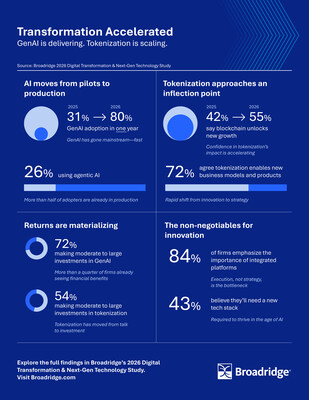
AI adoption has accelerated dramatically over the past year. Eighty percent of firms report using generative or predictive AI in operations, up from 31% last year, reflecting a rapid move from pilot programs to enterprise deployment. AI is also viewed as delivering the greatest business impact among next-generation technologies, surpassing cloud. As confidence in returns grows, 72% of firms report making moderate to large GenAI investments, while concern about GenAI ROI has fallen to 33%, down from 42% a year ago.

That shift is translating into results: 27% of firms report measurable business benefits from GenAI, a 13-point increase year over year, underscoring AI's growing impact on productivity and operational efficiency.

As generative AI matures, firms are beginning to deploy agentic AI—more autonomous systems capable of executing tasks and orchestrating workflows with limited human intervention. While still early, 26% of firms report current use of agentic AI, with more than half of those deployments already beyond pilot phases. Adoption is most advanced among large institutions, where nearly one-third of firms managing more than $250 billion in assets report active use.

Tokenization Approaches an Inflection Point

As AI becomes embedded in operating models, firms are turning their attention to longer-term structural change, reimagining how assets are issued, traded, and settled through tokenization.

A majority of firms increasingly view tokenization as a structural evolution of market infrastructure rather than a near-term replacement for existing systems. While near-term adoption remains measured, confidence in blockchain and distributed ledger technology continues to rise with 53% of firms believing DLT will have a dramatic effect on the way assets are settled—underscoring growing conviction that next-generation infrastructure will reshape post-trade operations and core market infrastructure.

That conviction is increasingly translating into capital commitments. More than half (54%) of firms report making moderate to large investments in tokenization and digital asset infrastructure, signaling that the industry is moving beyond exploration toward scaled buildout.

Market participants expect a significant portion of major asset classes, including equities, mutual funds, and alternatives, to be tokenized within the next four to five years—with its perceived strategic importance projected to rise sharply over the next five years. Seventy percent of firms say external partnerships will be critical to capturing value as tokenized market infrastructure develops, signaling the need for ecosystem collaboration as standards and interoperability frameworks mature.

While firms cite benefits including enhanced liquidity, improved operational efficiency and faster settlement, they also acknowledge risks related to regulatory uncertainty, interoperability challenges, cybersecurity, and market structure fragmentation. The study found that 64% of firms cite cybersecurity risks associated with tokenization and 55% point to increased valuation risk. Notably, many firms believe that forthcoming digital asset regulations will ultimately have a positive impact on adoption by providing greater clarity and market stability.

Execution, Not Strategy, Is the Bottleneck

Across both AI and tokenization initiatives, the primary barriers to progress lie in firms' ability to execute.

Eighty-four percent of firms emphasize the importance of integrated platforms, and 43% expect to rebuild core systems to support AI-driven operating models.

At the same time, talent gaps are becoming more acute: 37% of firms cite lack of skilled talent as a barrier to agentic AI adoption, reflecting rising demand for advanced technical and data capabilities. Regarding GenAI, 38% of firms said lack of skilled talent is their biggest barrier to adoption of GenAI, up from 28% in 2025. When asked about AI overall, 65% of firms say they have no formal mandate or incentives in place to use AI, and 61% say AI training is encouraged, but there are no formal targets in place

An Industry Embarking on Structural Change

Taken together, the findings point to an industry transitioning from digital experimentation to operational transformation. AI is delivering measurable impact today. Tokenization represents the next structural shift in how financial markets function.

The firms that succeed will be those that pair ambition with disciplined execution—modernizing core infrastructure while building the capabilities required to operate in increasingly digitized, interoperable markets.

Methodology

Broadridge commissioned Phronesis Partners to conduct this survey. This survey, as part of Broadridge's annual series, was conducted in a fashion consistent with previous years. The survey was taken by over 900 financial services technology and operations leaders from around the world and across wealth management, capital markets, and asset management firms.

About Broadridge

Broadridge Financial Solutions (NYSE: BR) is a global technology leader with the trusted expertise and transformative technology to help clients and the financial services industry operate, innovate, and grow. We power investing, governance, and communications for our clients – driving operational resiliency, elevating business performance, and transforming investor experiences. 

Our technology and operations platforms process and generate over 7 billion communications per year and underpin the daily trading of more than $15 trillion of securities globally. A certified Great Place to Work®, Broadridge is part of the S&P 500® Index, employing over 14,000 associates in 21 countries.

For more information about us, please visit www.broadridge.com.

Broadridge Contacts:

Investors: 
broadridgeir@broadridge.com

Media:
Gregg Rosenberg
Global Head of Corporate Communications
Gregg.Rosenberg@broadridge.com

 

Cision View original content to download multimedia:https://www.prnewswire.com/news-releases/genai-delivering-now-tokenization-is-next-financial-services-enters-period-of-accelerating-transformation-landmark-broadridge-study-finds-302696514.html

SOURCE Broadridge Financial Solutions, Inc.

FAQ

How widespread is GenAI adoption in financial services according to Broadridge (BR)?

GenAI is now widely adopted: 80% of firms report using generative or predictive AI. According to Broadridge, this reflects a shift from pilots to enterprise deployment, with 72% making moderate-to-large GenAI investments and rising measurable benefits.

What does Broadridge (BR) say about tokenization timelines for major asset classes?

Firms expect significant tokenization within four to five years for major asset classes. According to Broadridge, respondents foresee tokenization rising sharply in strategic importance and are investing in digital asset infrastructure now.

What execution barriers to AI and tokenization did Broadridge (BR) identify?

Execution, not strategy, is the primary bottleneck: 84% emphasize integrated platforms and 43% expect core system rebuilds. According to Broadridge, talent shortages and system modernization are key constraints on scaling initiatives.

How prevalent is agentic AI use in financial firms per Broadridge (BR)?

Agentic AI is emerging: 26% of firms report current use, many beyond pilot phases. According to Broadridge, adoption is strongest at large institutions managing over $250 billion, where nearly one-third report active agentic AI deployments.

What risks do firms associate with tokenization in the Broadridge (BR) study?

Firms highlight cybersecurity and valuation concerns: 64% cite cybersecurity risk and 55% cite valuation risk. According to Broadridge, regulatory uncertainty, interoperability, and market fragmentation are additional adoption challenges.
Broadridge Finl Solutions Inc

NYSE:BR

BR Rankings

BR Latest News

BR Latest SEC Filings

BR Stock Data

20.52B
116.18M
Information Technology Services
Services-business Services, Nec
Link
United States
LAKE SUCCESS